

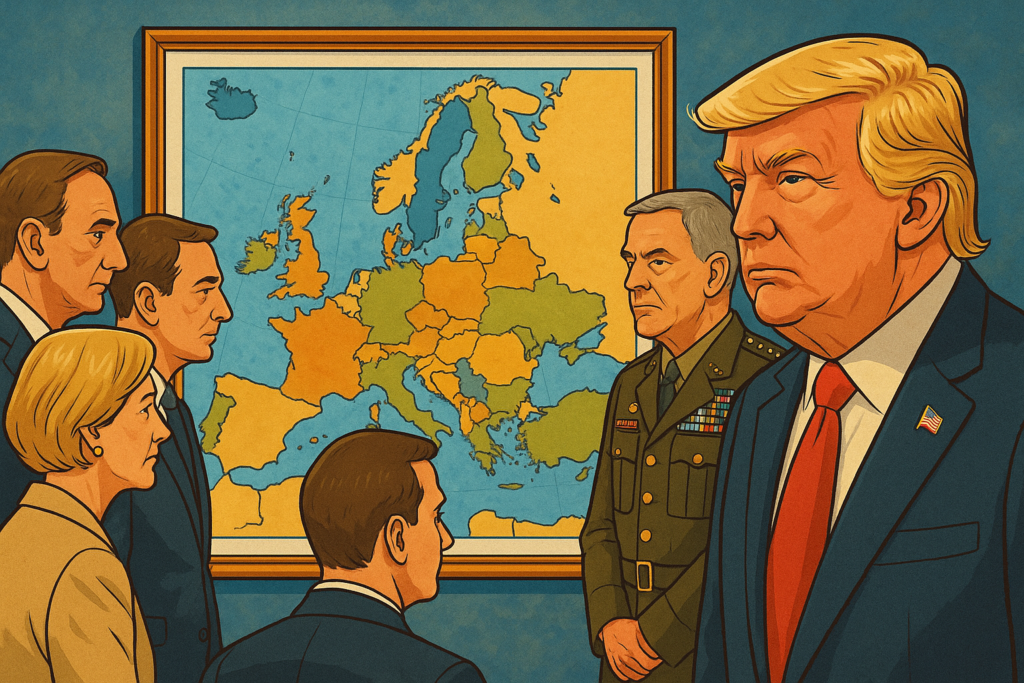
The new US National Security Strategy marks a substantive and uncomfortable shift in how Washington views the transatlantic relationship with Brussels.
The new geopolitical guidelines make clear that the transatlantic relationship is no longer conceived as a partnership between equals. Instead, the European Union (EU) is portrayed as a project that needs to be corrected, disciplined and reshaped to serve US interests.
Under Trump’s second term, a profound inflection in US foreign policy has thus taken shape: towards Europe, the United States increasingly assumes the role of an embarrassing partner, ever less willing to recognise strategic legitimacy and autonomy on the other side of the Atlantic.
These shifts in US policy are not merely rhetorical. They reflect the global projection of what may be described as the "Trump corollary to the Monroe Doctrine", according to which no region deemed strategic should be allowed to develop genuine geopolitical autonomy outside the decision-making orbit of the White House.
Although originally conceived for the Western Hemisphere, the principle underpinning this corollary—based on strategic primacy, exclusivity of influence and the rejection of autonomous power centres—is implicitly extended to the international system as a whole.
Applied to Europe, this "corollary" redefines the terms of a long-standing alliance: the EU may be strong—but not independent; sovereign—but not autonomous; relevant—but only if aligned with the White House; it may be relevant, provided it aligns with the White House agenda.
By transforming allies into spheres of influence, the United States converts the transatlantic partnership into a relationship marked by structural asymmetry (as seen in unbalanced tariff arrangements), political surveillance (including covert interference in some EU member states), and strategic pressure—illustrated by claims that "Europe needs to correct its current trajectory" in order to restore its greatness.
It is within this context that Washington becomes, for Brussels, an embarrassing partner in the full sense of the term. Broadly speaking, the US National Security Strategy does not recognise European integration as a legitimate and successful political project, but rather as an arrangement responsible for the continent’s alleged "civilisational erosion", whose supranational trajectory is deemed incompatible with Western stability.
The White House explicitly urges Europe to "become European again", reclaiming a supposedly lost identity and abandoning what the Trump administration defines as regulatory excesses (particularly in relation to big tech), multilateral illusions and civilisational weaknesses. From a diplomatic standpoint, this constitutes a profoundly asymmetrical demand, shifting cooperation away from partnership and towards political and economic tutelage.
In the face of this adverse scenario, the EU must stand its ground—not to break with the United States, but to refuse the role of a subordinate ally.
When an alliance becomes uncomfortable
The concept of an embarrassing partner describes situations in which a formal ally generates political, symbolic, economic and strategic costs for its own partners. This has been the role played by the United States since Trump took office in January 2025.
The publication of the National Security Strategy formally confirms that the Trump administration has abandoned any concern for preserving collective consensus, institutional sensitivities or the discursive narratives that historically sustained the transatlantic relationship.
The criticism levelled at the EU is blunt, systematic and diplomatically inelegant. Brussels is portrayed as a bureaucratic machine that erodes national sovereignty, restricts political freedoms and suffocates the continent’s economic dynamism.
Migration policies, environmental, digital and industrial regulations, restrictions on freedom of expression and demographic decline are presented as the "symptoms" of a civilisation that has allegedly lost self-confidence and historical vitality.
The problem is that, in diplomatic circles, this US perception stems not merely from political disagreement, but from a moral and civilisational delegitimisation of the contemporary European model. Claims that the continent will become "unrecognisable in 20 years or less" lack solid analytical grounding and empirical evidence.
In this context, the United States ceases to act as a cooperative ally and adopts a posture that publicly exposes European vulnerabilities (seeking to weaken the EU and its member states), instrumentalises internal divisions (by encouraging far-right, nationalist and Eurosceptic parties), and unilaterally redefines the terms of cooperation (through the imposition of trade tariffs and investment obligations).
The war in Ukraine is paradigmatic in this regard: the Trump administration accuses the EU and European governments of nurturing unrealistic expectations, blocking diplomatic solutions and constraining internal democratic processes in order to sustain unpopular policies.
Crucially, this pressure goes far beyond rhetoric. In practice, it translates into concrete material demands, such as accelerated increases in military spending, the opening of European markets to US goods and services, economic alignment aimed at containing China, and direct restrictions on the EU’s regulatory reach.
A structural tension thus emerges in the transatlantic relationship: the EU is called upon to act as a sovereign actor, yet since Trump’s return it has been treated as if it lacked full political, economic and social legitimacy.
Holding one’s head high: A strategic imperative
The new US National Security Strategy claims to desire a stronger, more sovereign and more self-reliant Europe. The United States does not discard Europe—but such autonomy must be carefully conditioned by the "Trump corollary to the Monroe Doctrine".
For example, EU and NATO member states are expected to spend more on defence, but within an industrial, technological and doctrinal ecosystem aligned with the United States—that is, by purchasing weapons and equipment from the US military-industrial complex.
It is within NATO that the constraining nature of the transatlantic partnership becomes most evident. Under the influence of Trumpism, NATO ceases to be framed as a political community or a cooperative military alliance, and instead functions as an instrument of pressure and discipline over allied states.
Moreover, European integration through the EU is not strengthened but relativised through the encouragement of selective bilateral relations, particularly with Central, Eastern and Southern European countries. Leaked intelligence documents even suggest that the US seeks to persuade four countries—Austria, Italy, Hungary and Poland—to leave the EU. At this stage, Washington appears to prefer a fragmented Europe, more permeable to external influence, over a cohesive, integrated and politically assertive Union.
In the realm of policies and regulation, the discomfort is even more acute. Open criticism of European environmental, industrial and climate policies places the EU in a permanent defensive position. Aligning with the US would mean contradicting hard-won internal European consensus; diverging, in turn, entails risks of strategic, military and economic isolation.
What is at stake is the classic alliance dilemma: distancing itself from the US risks weakening a key strategic bond; preserving the alliance unconditionally means absorbing the political and symbolic costs generated by the ally’s conduct.
Holding one’s head high, therefore, is neither a symbolic gesture nor a rhetorical device, but a strategic imperative if the EU is not to become the US’s backyard.
The Union urgently needs its own strategy to navigate alliance dilemmas—choosing between remaining comfortably subordinate, with its legitimacy permanently questioned, or advancing, even gradually and pragmatically, towards genuine strategic autonomy capable of sustaining legitimate disagreements without dismantling the transatlantic alliance.
Between constraint and political maturity
The new US National Security Strategy signals that the transatlantic relationship has entered a phase of structural discomfort. The United States has become, for Europe, an embarrassing partner: indispensable yet difficult; an ally, but normatively intrusive; a protector, yet politically unstable.
Leadership voices within the EU have already indicated, clearly and firmly, the strategic direction the Union intends to pursue. Kaja Kallas, the EU’s High Representative for Foreign Affairs, rejected Trump’s criticism of the EU, stressing that the United States remains “Europe’s greatest ally” and that, despite disagreements, both sides must "stand together" in the face of global challenges—emphasising cooperation rather than open confrontation.
Similarly, Ursula von der Leyen, President of the European Commission, warned that no actor—including the United States—should interfere in European democratic processes, affirming that it is the prerogative of European peoples to choose their leaders and that sovereignty must be respected without external interference.
Standing upright in the face of Trump does not imply hostility towards the United States, but political affirmation. Strategic autonomy is not anti-Americanism; it is a minimum condition of political maturity. Without it, the EU risks remaining relevant only as a geopolitical instrument, and irrelevant as a historical project in its own right.
Europe is not a backyard and it should never accept being treated as one. And the sooner this position is affirmed with clarity, coherence and political continuity, the greater the chances of triggering and accelerating concrete material change.
