
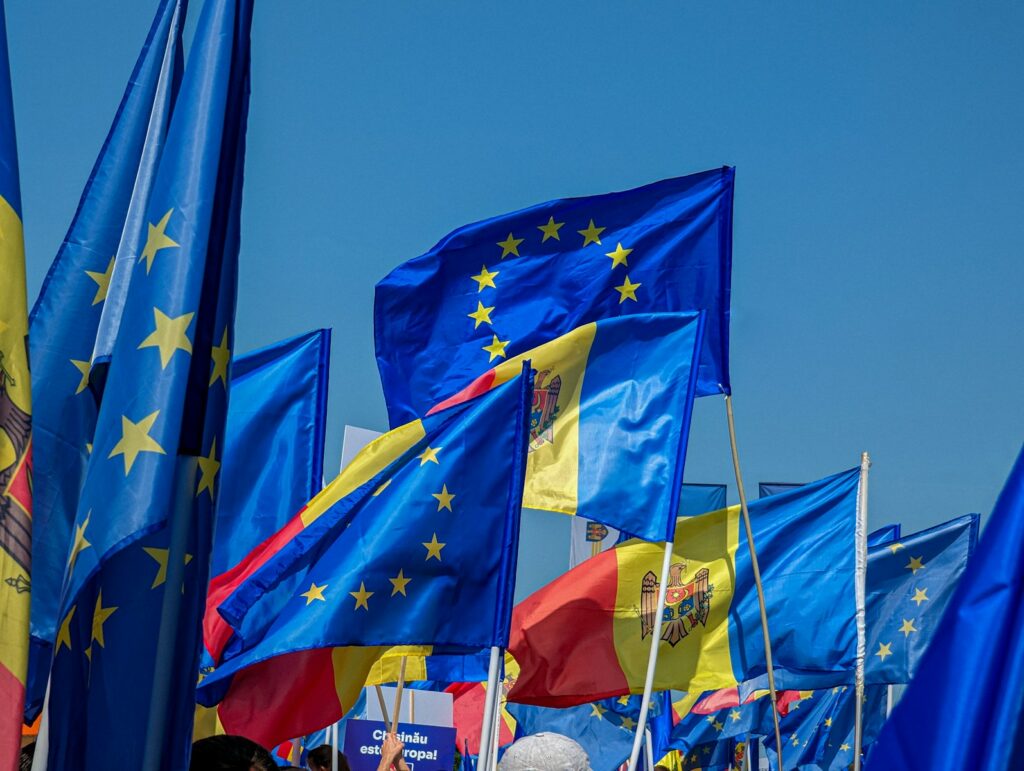
Moldova has been recognised by the EU Council for its progress on reforms needed for EU accession, even as the country continues to face security and economic challenges linked to Russia’s invasion of neighbouring Ukraine.
The Council noted on Tuesday Moldova’s completion of the screening process — an assessment of national laws compared to EU standards — and that all six negotiating clusters are ready to be opened.
The clusters cover areas such as the rule of law, justice, and economic criteria, the Council said, cited by the European External Action Service (EEAS).
Moldova’s authorities have recently gained a renewed political mandate following the 20 October 2024 referendum on EU membership and the latest parliamentary elections, with the elections described as well-managed despite instances of foreign interference and cyber-attacks, particularly from Russia, the Council stated.
Strengthening the judiciary and combating corruption
The Council cited progress on justice reforms, including efforts to vet and appoint judges and prosecutors, as well as to enhance the independence and integrity of the judiciary.
The body urged further strengthening of the National Integrity Authority — Moldova’s main agency for monitoring public officials’ assets — and further action against corruption and money laundering.
The Council acknowledged Moldova’s approach that involves civil society, the private sector, and diaspora communities in reform efforts.
Moldova’s request to join the EU’s Fundamental Rights Agency was also welcomed.
Energy security was cited as another area where Moldova has made advances, with steps to reinforce infrastructure links and reduce supply vulnerabilities.
The Council referenced Moldova’s actions to counter disinformation and foreign interference by developing a national communication strategy and engaging local groups, including farmers, youth organisations, and faith leaders.
On economic reforms, the Council welcomed the establishment of a €1.9 billion Reform and Growth Facility — part of Moldova’s wider plan to modernise the economy — alongside continued alignment with EU internal market rules through agreements like the Deep and Comprehensive Free Trade Area.
The Council reaffirmed EU support for Moldova’s sovereignty and territorial integrity, and called on Russia to withdraw its military presence from Moldovan territory.
Moldova’s strong cooperation with the EU on foreign and security policy, including alignment with EU positions on sanctions and participation in EU-led security missions, was also highlighted.
