
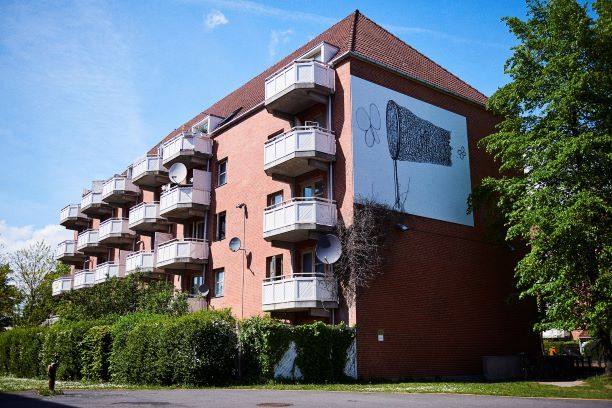
In a preliminary ruling last week, the European Court of Justice (ECJ) concluded that Danish legislation which targets neighborhoods with a high "non-Western" population through evictions may be direct or indirect discrimination based on ethnic origin and thus violating EU’s Race Equality Directive.
The ECJ found that the law, which aims to reduce social housing in “transformation areas”, could lead to greater lease termination and eviction for residents of certain ethnic backgrounds, creating a potential direct or indirect ethnic bias. The law’s focus on "non-Western" populations could result in treating people less favorably due to their ethnic origin, even if not was explicitly stated.
The stated aim of the Danish legislation, under which a development plan was made, is the eradication of immigration "ghettos" by 2030. This was based on a concept of “parallel societies” according to socio-economic factors defined by the Danish government. The purpose of the law was also to promote integration of immigrants.
As previously reported by The Brussels Times, residents in Mjölnerparken, a neighborhood in Copenhagen, filed a lawsuit in May 2020 against the Danish government seeking a declaration that evictions under the country’s “Ghetto Package” contradicted EU law and the European Convention on Human Rights.
What upset the residents in Mjölnerparken was that the government had classified their neighborhood as a “ghetto” because it has 50 % or more residents of “non-Western” background, thereby discriminating immigrants with that background.
Treatment based on ethnic origin
The Advocate-General at ECJ stated in February 2025 that direct discrimination occurs when adverse treatment is based directly on ethnic origin. She found that the division between ‘Western’ and ‘non-Western’ immigrants and their descendants is based on this criterion.
According to The Open Society Justice Initiative, which had helped the residents in Mjölnerparken to appeal against the Danish Ministry of Social Affairs and Housing, the ECJ ruling last week (18 December 2025) was a victory for the residents challenging discriminatory housing laws.
Asked for a comment on the ruling, the Danish authorities referred to a statement of the Minister of Social Affairs and Housing, Sophie Hæstorp Andersen, on the ministry’s website: “The EU court has ruled in the case regarding parallel society legislation. The case is now back to the Eastern High Court, and we’ll of course read today's judgment from the EU court closely."
"This case was never about housing alone; it was always about pernicious discrimination rooted in racism and xenophobia,” commented James Goldston, executive director of the Open Society Justice Initiative. “The ruling vindicates the residents who have stood firm in demanding their rights, even as they watched their neighborhoods stigmatized and their families forced from homes they've lived in for decades.”
“We are proud to have supported their fight for justice,” he added. “The Court’s decision sends a vital message that governments cannot stigmatize, segregate, or dispossess people on the basis of who they are or where their families come from.”
The European Court of Justice interpreted the concept of ethnic origin as being defined on the basis of a combination of criteria, such as a common nationality, religion, language and culture, and common traditions and living conditions. According to case law, discrimination on grounds of ethnic origin constitutes a form of racial discrimination.
The Court noted that the concepts of ‘immigrant’ and ‘descendant’, under the legislation in question, are based on a complex combination of criteria relating to the country of birth of the person concerned or the country of birth and nationality of his parents, which, taken in isolation, are not sufficient to determine membership of an ethnic group.
It is for the referring Danish court to determine, as a first step, whether there is any difference in treatment on grounds of ethnic origin. The referring court must examine whether the law on public housing results in certain persons being treated less favourably than other persons in a comparable situation.
According to Eddie Omar Rosenberg Khawaja, the lawyer who represented the residents, the ECJ ruling does not differ in substance from the previous ruling by the Advocate-General of ECJ. “Both made their analysis on the basis of the same elements,” he told The Brussels Times. “The ECJ highlighted that the Danish courts could include all those elements, when determining whether the criterion (‘non-Western’) is actually linked to ethnic origin in the specific case.”
Direct or indirect discrimination
The new ruling confirmed that direct or indirect discrimination can be the consequence of the application of the ‘Ghetto Law’. How would you describe the difference between them?
“The court highlights all relevant elements related to how to determine either direct or indirect discrimination. It confirms that the specific circumstances of the case and the use of the criterion of "immigrants and descendants from non-Western countries" could lead to direct or indirect discrimination.
The difference between indirect and direct discrimination depends on whether the criterion in any way is linked to the ethnic origin of the inhabitants of Mjølnerparken and other areas. If Danish courts would conclude that the housing ministry has not been able to show that there is no link, then it would be direct illegal discrimination.
If there is no link, it could be indirect discrimination if different ethnic groups are negatively affected by the use of the criterion. If the effect is considered disproportionate, indirect illegal discrimination has occurred. This would also be the case if the reason to accept a negative effect is actually linked to general considerations that certain elements of ethnic origin are problematic and ‘non-Danish’.
How binding is a preliminary ruling like this on a national court in an EU Member State?
“The parties will have consider how to proceed. If the ministry considers that it would not be able to meet the burden of proof required by the ECJ, it would need to consider acknowledging that the development plan based on the current legislation is invalid, as requested by the plaintiffs. Otherwise, the Danish Eastern High Court would have to assess the specific roadmap for the assessment which is laid out by the ECJ in great detail.”
“I’m confident that such assessment would lead to the finding that the burden of proof on the ministry has not been shifted and that the development plan therefore is invalid based on the fact that it causes direct ethnic discrimination.”
What solution or compensation can the affected residents expect to receive and when?
“This is not part of the litigation and not for the court to assess or adjudicate,” he replied. “We have not made any detailed assessments of this at this stage. This would be work to follow, if the plaintiffs request of invalidity of the legislation is accepted and would be made initially through consultations with the relevant authorities.”
There are similar immigration "ghettos" in other EU Member States. Do you know if other countries are considering similar legislation as in Denmark?
“Other EU Member States might have felt inspired to enact similar legislation but have - to my knowledge - been waiting to consider what kind of criterion to use. The use of “non-Western” remains a very Danish invention. However, the ruling underlines that any criterion has to be neutral and cannot not in any way be linked to ethnic origin.”
“In my view, the ruling has created an extremely narrow path that can be taken when integration is to be done through legislation,” Eddie Omar Rosenberg Khawaja concluded.
The ECJ ruling is a lesson for Denmark when its half-year EU Presidency approaches its end this December. The Danish government led by Prime Minister Mette Frederiksen adopted a hardline position on migration at the very start of EU Presidency. The issue at stake is how far a government can go and what means it can use in enforcing integration of immigrants.
