
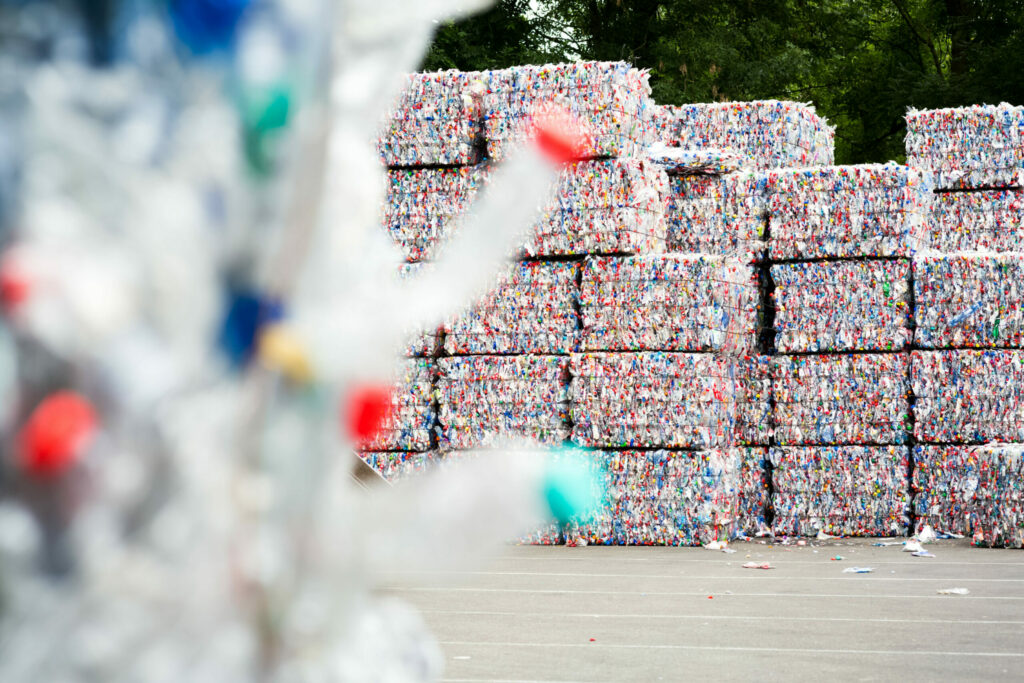
The European Union has announced measures to support its struggling recycled plastics industry, which is on the bring of collapse with tough competition from China.
The European Commission plans to promote investment in chemical recycling, a technology that uses high temperatures to break down plastics for reuse.
While chemical recycling consumes significant energy and generates more pollution compared to mechanical recycling, the Commission believes it could “play a role” for food packaging like yoghurts.
The EU is preparing to integrate chemical recycling into its rules that mandate a minimum proportion of recycled plastic in bottles.
To further assist the plastics sector, the Commission aims to simplify the transition from waste to recyclable raw materials by introducing common standards across member states.
Tighter controls on imports are also planned to protect European businesses from unfair competition.
These measures are described as the beginning of a broader legislative framework focused on the circular economy.
However, some industry representatives have criticised the proposed measures as insufficient.
French environmental services company Veolia has urged the Commission to implement more robust actions to meet the sector’s significant challenges.
The pleas for assistance come after plastic industries, grappling with rising energy costs and international competition, warned earlier this month that they were “on the brink of collapse.”
In the long term, Europe’s plastic production is steadily declining, while imports from Asia continue to grow.
Globally, virgin plastic production is projected to rise by 4% in 2024, reaching 430.9 million tonnes. More than half of this plastic originates from Asia, with China contributing 34.5%.
Related News
China also leads in producing circular plastics, which include mechanically recycled plastic, biomaterials, chemically recycled products, and materials derived from carbon capture.
China accounts for 30.3% of this market, followed by the rest of Asia at 24.6%, with Europe contributing 19%, according to industry association Plastics Europe.
Meanwhile, the EU faces increasing volumes of plastic waste, which exacerbate pollution across the continent.
Improving packaging sustainability, alongside reducing packaging altogether, is seen as critical.
In 2021, European citizens generated an average of 190 kg of packaging waste each.
Without additional measures, this figure is expected to rise to 209 kg per person by 2030, according to EU estimates.
