
The way in which Europe responded to Germany’s defeat in 1945 was both clever and courageous. It led to what could rightly be called a “miracle of European peace”. The way in which Europe responded to the Soviet Union’s defeat in 1989 was less bold and less smart. We are now paying for the consequences.
Philosopher Philippe Van Parijs reflects on current events and debates in Brussels, Belgium and Europe
In his May 1950 declaration, Robert Schuman expressed his conviction that a “merging of the markets” — first limited to coal and steel, later generalized to all goods and services — would help “safeguard world peace”.
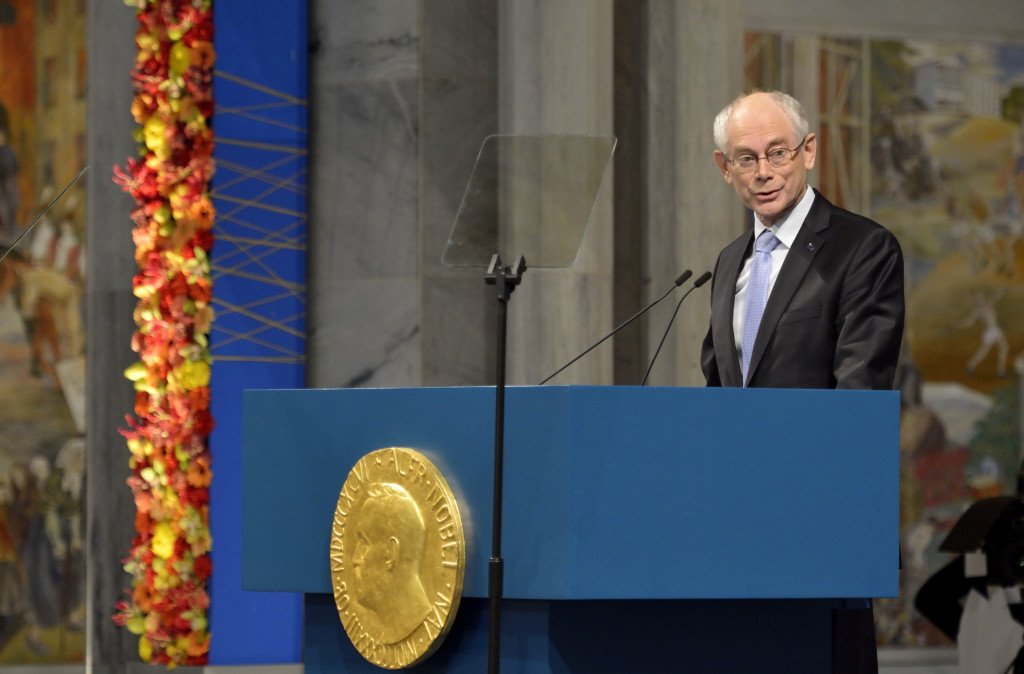
Indeed, the following decennia were marked by an exceptional period of international peace on the European continent. They provided a striking illustration of Montesquieu’s doux commerce thesis — international trade makes for international peace — and earned the European Union the 2012 Nobel peace prize.
Since 2022, however, Europe is again caught up in an international war. Clearly, no new miracle of European peace followed the Soviet Union’s defeat in 1989. Why not?
Mutual trust
To speak about a merging of the markets would be excessive, but trade between Russia and the European Union intensified after 1989.
Wandel durch Handel was a guideline for Germany’s approach to Russia, and not only Germany’s. Instead of taming aggressive emotions and strategies, however, commercial interdependence has been weaponized by both sides.
What is it that was present after 1945 that was absent after 1989? The way in which the Nobel committee motivated the EU’s peace prize gives us a clue: European integration, it said, “showed that by building up mutual trust, historical enemies can become close partners”.
How was this achieved? Not by the intensification of intra-European international trade as such, but by the creation and expansion of common institutions: those needed to regulate the common (and later single) market, but also many that went very far beyond that.
The outcome was a multiplication of initiatives and incentives that led European citizens to interact, cooperate and collaborate to an ever-greater extent across the EU’s internal borders.
The formal institutions played a key role in this process, above all the European Parliament, which gathers a wide variety of parliamentarians representing an even wider variety of citizens.
Beyond the formal institutions, cross-border interaction and collaboration happens even more in the pan-European civil society, partly as a direct effect of European Union policies such as the Erasmus+ programme, but also as a response to the need to create cross-border coalitions in order to lobby effectively, whether as farmers or environmentalists, as trade unionists or armament producers.
NATO expansion
The development of trust-generating formal and informal institutions in the wake of European market integration was the structural response to Germany's defeat.
The structural response to the Soviet Union's very different defeat was less smart. It started with clever Western experts recommending swift privatisation, with two immediate effects: a dramatically impoverished shrinking population and a battalion of fabulously wealthy oligarchs. In parallel, commercial interdependence increased, but no noteworthy effort was made to create trust-building institutions. Quite the opposite.
In the aftermath of the dissolution of the Warsaw Pact in 1991, some argued for making Russia a member of NATO, others for disbanding the organisation. They did not succeed. No doubt in part because NATO, like any other organization, wanted to keep going in its own interest and in that of its many employees. But also because several Eastern European countries, still traumatised by their protracted submission to Moscow, wanted every guarantee against the risk of it being revived.
For other European countries the risk was negligible. But given that the US was covering the bulk of the cost, NATO offered them a very cheap insurance policy against that negligible risk.
The bold idea of scrapping NATO and developing institutions that included the ailing Russian federation as a respected partner should have excited visionaries of the same calibre as those who kicked off the European integration process, but it was quietly discarded.
Consequently, NATO not only survived but it soon expanded to include almost all European components of the former Soviet bloc except Russia: three countries in 1999, then six more in 2004.
There followed what, after Putin’s 2007 Munich speech, should have been understood by all as supreme provocation. In 2008, President Bush offered NATO membership to Russia's biggest European partner, the country that among all former components of the Soviet Union except Belarus was closest to Russia historically, linguistically, religiously and ethnically: Ukraine.
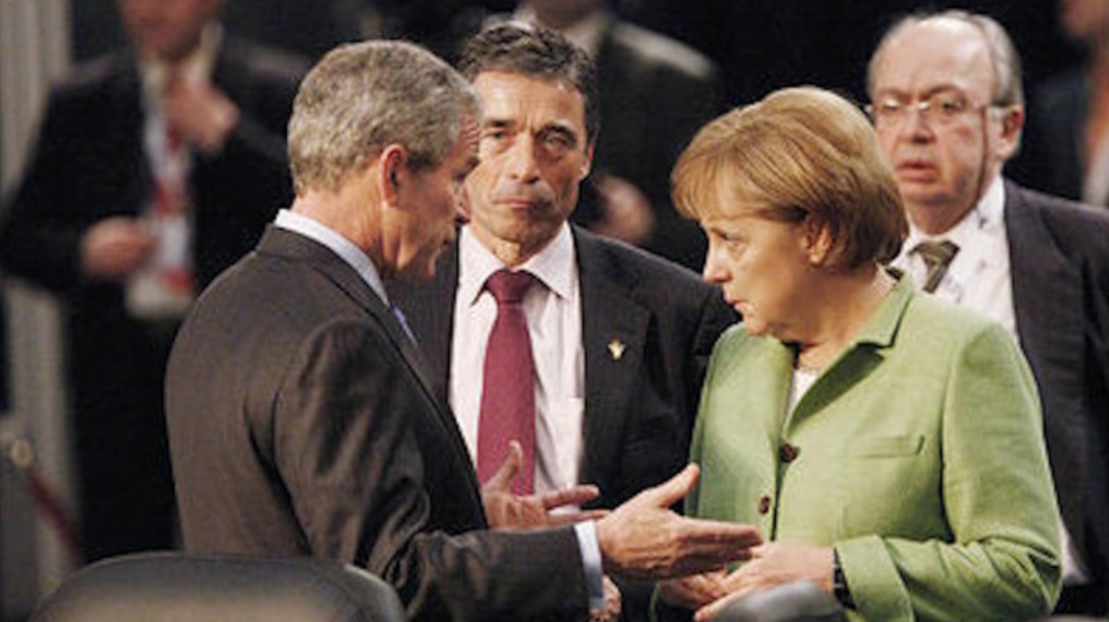
US President George W Bush greeting Chancellor Angela Merkel at the 2008 NATO summit in Bucharest
Fear
The state in which Western-steered privatisation had left Russia by the end of the 20th century had created fertile ground for a strong man who could revive the country’s demography and economy and enable Russians to regain national pride.
The resulting situation was not that different from the one that prevailed in Germany after both the first and second world wars. But after the second world war, wisdom and statesmanship managed to avoid the stupidity of the response to Germany’s defeat in 1918.
Alas, this wisdom and statesmanship did not prevail after the more peaceful defeat of the USSR. An expansion of a military alliance all along Russia’s Western border, with hostility to Russia as its only possible motivation, was understandably perceived as a threat by Russia’s leaders and provided them with all that was needed to persuade the Russian population that some pre-emptive action was justified.
And if ancient Greek historians and contemporary ethologists are to be believed, there is no more fundamental cause of war than fear.
Hence: yes, le commerce peut adoucir les moeurs, and it could have done so between the European Union and Russia after 1989 just as it did between France and Germany after 1945. But it cannot do so on its own. Commerce needs help from a robust superstructure of trust-building institutions, both formal and informal.
Its pacifying effects can easily be annihilated, indeed disastrously reversed, by distrust-boosting policies. The only thing commercial interdependence then offers is the capacity to damage each other — and oneself in the process — through economic sanctions.
No miracle
There was, therefore, no second miracle of European peace. Instead, we now find ourselves forced to spend vast amounts of money, largely on American weapons, at the expense of our social protection, of our health care and our schools, of climate change mitigation and development aid, in order to enable Europeans to keep killing and maiming one another and destroying one another's infrastructure.
The peace dividend is being dilapidated. Forever? Hopefully not.
If and when it finally comes, the deal that will put an end to the war in Ukraine will not be considered a just peace by either side. But it will stop slaughtering and destruction.
One will then be right in regretting that the same deal had not been made much earlier, thereby sparing countless families on both sides the loss of a son, a father, a partner and reducing the colossal costs of reconstruction. One will then have no option but to patiently heal the deep wounds, repair the broken links and laboriously restore a modicum of mutual trust.
However pointless, it will then be forgivable to deplore that no one, at the right time, had the Monnet-Schuman-Adenauer wisdom and power to bring about a second miracle of European Peace.
