

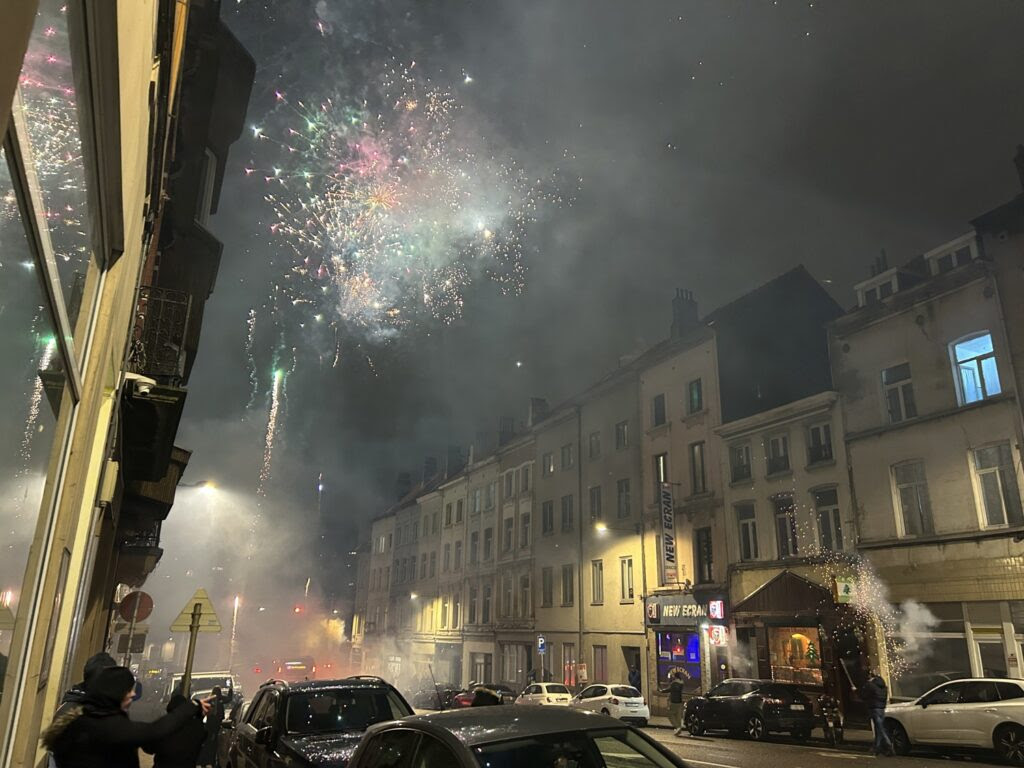
Another walk on New Year’s Day. The kind that should smell like frost and pine. Instead, the air still smells acrid.
The forest near my home outside of Stockholm is speckled with the leftovers of celebration: cardboard tubes, plastic wadding, charred sticks, glittering fragments in the snow.
It looks harmless until you picture what it means for animals that live here –startled into blind flight at midnight, forced to cross roads and fences in panic, then left to navigate a landscape littered with debris.
Europe doesn’t have a “fireworks problem”. It has a consumer‑fireworks problem.
The loudest, most polluting, least controlled fireworks are not the ones handled by trained pyrotechnicians under a permit. They are the rockets and firecrackers sold to private individuals and launched from balconies, courtyards, streets and parks—often late at night, often with alcohol in the mix, and almost always with consequences we have normalised as “part of New Year” celebrations.
I write this with two hats on: as CEO of a Swedish construction company and real-estate developer, and as Chair of Artkrisen, a foundation that funds biodiversity and animal-welfare projects.
The two roles meet on New Year’s Eve. In my work, “sustainable cities” is not a slogan. It is about reducing risk, protecting health, and designing shared spaces that remain livable.
Through my charitable work at Artkrisen, I see—year after year—how pets and wildlife, including red-listed species, are stressed, injured, displaced and sometimes suffer fatal outcomes during consumer-fireworks celebrations. Yet once a year we accept a consumer product that reliably turns shared space into panic, smoke, litter and emergency calls.
Injuries to humans and animals
The animal impacts are not just anecdotal. Weather‑radar research has recorded mass flight responses in birds immediately after midnight on New Year’s Eve. GPS‑tracking studies on migratory geese show sharp disturbance, longer and higher flights, and behavioural after‑effects that persist beyond the night itself.
For mammals, the soundscape becomes a predator—triggering blind flight across roads, fences, ice and obstacles. Pet owners know the symptoms: shaking, hiding, refusal to eat or go outside, bolting, and animals that disappear. A recent review report from the Swedish University of Agricultural Sciences (SLU) summarizes the evidence across species and the policy landscape in Sweden and the EU.
This is, in other words, a biodiversity issue. When Europe’s cities and landscapes already struggle to keep species from slipping onto red lists, it is hard to defend a tradition that predictably pushes wildlife into avoidable fear and injury—simply for the convenience of private sales.
There are also the harms we breathe. Studies repeatedly show short, intense spikes in fine particulate pollution during fireworks episodes, including metal‑laden particles that are more respirable. We accept that this settles on playgrounds, roofs and waterways—and drifts through the very urban nature we claim to protect.
Then come the human injuries: eye trauma, burns, damaged hands, fires. Even where rules exist, private use is difficult to police at street level. Every city recognises the pattern: more strain on emergency services, more conflict, and a morning‑after landscape of plastic and cardboard.
Brussels is already on the front line. The Brussels‑Capital Region has banned fireworks across the Region (including on private property), and has recently tightened its approach further by banning possession, transport, use, display and sale for a defined period. That is not moral panic; it is risk management.
But it is not enough to ensure effective enforcement. Brussels’ own Animal Welfare Council has argued that a general ban on the use, possession and purchase of fireworks by private individuals should be considered.
EU Directive falls short
This is where the EU currently falls short. Directive 2013/29/EU (‘harmonisation of the laws of the Member States relating to the making available on the market of pyrotechnic articles’) is important. It focuses on product categories, safety and age limits but is not designed to address the cumulative impact of millions of private detonations.
In practice, the single market keeps consumer fireworks circulating across borders, while cities and regions are left to fight a losing enforcement battle on the ground. Keep professional, permitted displays for public events. But stop treating rockets and firecrackers as a household purchase—like candles and confetti.
Several countries are moving in this direction; the Netherlands has legislated in 2025 a nationwide ban on the sale of consumer fireworks starting on New Year’s Eve 2026. The EU should stop waiting for a patchwork to mature and make the rule clear: pyrotechnics are for professionals, not for private hands.
Sweden offers a small lesson. In the building sector, major retailers have already stopped selling consumer fireworks. I am proud of that. But the market simply moves: other shops fill the gap, cross‑border purchases continue, and the same chaos returns. As long as private sales remain legal somewhere in the single market, the pressure leaks across borders.
This is not about banning celebration. It is about modernising it. Drone shows, light installations and community events can create wonder without fear. Europe can keep the sparkle—without the panic.
A Union that can regulate chemicals, plastics and emissions can also decide that explosive consumer fireworks do not belong in private hands. For animals. For people. For the air we share. And for the kind of Europe we say we are building.
