

On Thursday, 9 October, as part of a terrorism-related investigation of a terror plot targeting Belgian Prime Minister Bart De Wever, police were able to arrest three suspects, one of whom was later released due to lack of evidence.
One curious detail about the incident involved a 3D printer found at the apartment of one of those arrested. According to investigators from the Federal Prosecutor’s Office, the device may have been used to produce bomb components, which could later be attached to a drone.
This case highlighted a new danger faced by the Belgian public: 3D printed weapons. With fast technological development in the sphere and groups of enthusiasts jumping on the trend worldwide, consumer-grade printers have become capable of producing complex designs for guns and explosive devices alike.
Turning printers into weapon workshops
Printing out a weapon is often sensationalised. The impression given is that anyone can produce a ready-made design out of plastic. The truth is a little more complicated though, as rather a lot of technological and construction savvy are required.
For firearms specifically, various parts first have to be individually printed out layer by layer. Gunsmiths also have to know how to assemble such a gun. This often requires a number of metallic parts, as current 3D printing materials cannot reliably resist the pressure and high temperatures caused by firing projectiles. Hobbyist 3D printers mostly print with plastic-like polymers – common spooled filaments and resins that behave like hard or flexible plastics.
The phenomenon first emerged in the United States, where the right to bear arms is protected constitutionally. Improvised gunsmiths started with fully-printed single shot pistols like the 2013 model “Liberator” released by notorious forefather of the movement Cody Wilson. However, back then, it was a tedious, slow and costly process, which often produced unstable results.
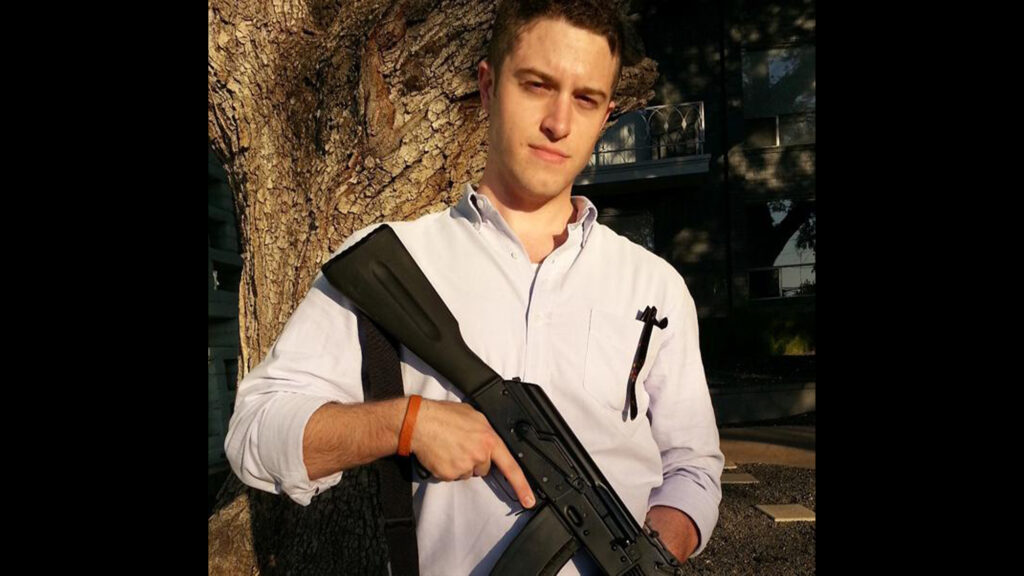
Cody Wilson is the founder and director of controversial Defense Distributed, a non-profit organisation that develops and publishes open source gun designs, so-called "Wiki Weapons". His organisation faces constant legal battles within US. Credit: Wikimedia Commons
3D printed weapons remain a niche. However, their popularity is steadily growing as in recent years, making fully or semi automatic weapons has become easier.
Some other components, like receivers, have to be modified with complex metal milling machines before being installed. Sold ready-made by US specialist online gunsmith shops, these “mills” are automated machines that are pre-programmed to precisely cut, shape, drill or engrave forms by removing material from a solid block.
When it comes to the production of explosive devices, like those allegedly involved in the terror plot against De Wever, the capabilities of 3D printers are quite limited. Mostly, plastic-like materials are used for capsules containing explosive materials and sometimes for drone bodies. Another option is customisation – production of little modification components like stabilising fins for airbombs or impact fuses.
3D printed weapons change the world
Countries within the EU, including Belgium, have always been proud to enforce harsh gun control in contrast to the US. However, Europe is fast catching up when it comes to these kind of weapons. Printer-based gunsmithing has not yet changed the bigger picture, but there are reasons to be concerned.
One particular semi-automatic model, credited as the most popular 3D gun design, FGC 9 has specifically been developed with a heavily regulated European context in mind. Designed by German-Kurdish ex-military Jacob Duygu, FGC 9 uses a mix of polymer-printed parts and generic industrial supplies. The only complex part of the design is used to produce the metal barrel, which requires so-called chemical machining. Last barrier of entry is ammunition used. It is however, widely available on the illegal market.
In Myanmar, a Southeast nation at civil war between the military junta and various pro-democracy rebel groups, the latter were able to show what 3D printed technology is capable of. The group known as People’s defence forces were known to use FGC 9 due to low availability of traditional firearms. In addition, thousands of engineering students from top universities involved in the rebel groups manufactured cheap fixed-wing (mini-plane) drones with a full printed 3D body and modified airbombs.

Screengrab from video of rebel commander in Myanmar firing FGC-9. Credit: Wikimedia Commons
Another prime example of this phenomena is Ukraine, where this technology is used daily by volunteers, hobbyists and engineers to create deadly weapons. The country at war with Russia has print hubs operating as miniature factories for drones, munitions and firearm modifications. Due to limitations, these places blend traditional production with 3D printing, but the latter plays a crucial part in the process.
Parts for kamikaze and reconnaissance drones, alongside lightweight aerodynamic munition casings for payload have been a gamechanger in modern warfare. This process is cheap, relatively quick and scalable. Getting this technology from the trenches onto the streets is not as hard as you might think.
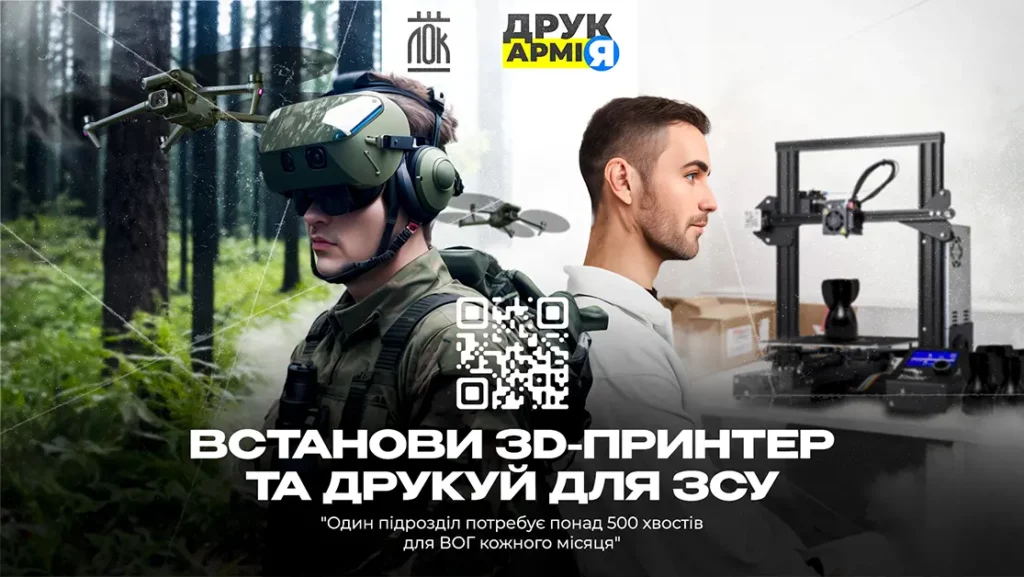
Ukrainian 3D print army agitational image. The writing reads, "Install a 3D printer and print for Ukrainian armed forces. One unit needs 500 "tails" for grenades each month". Credit: Ukrainian 3D print army
In the US, there are concrete examples of both criminals and extremists using 3D printed weapons. One of the most high profile recent cases was the shooting of Brian Thompson, the CEO of a major US health insurance company. According to the police, his alleged killer was politically motivated and used a 3D printed firearm and suppressor.
The only known 3D printed weapons case in Belgium, other than the terror plot against De Wever, is the raid of an illegal 3D-weapon workshop in Leuven. Touted as “one of the biggest police successes in the fight against 3D arms trafficking in Europe”, the operation was able to stop production of semi- and fully automatic weapons, allegedly sold to gangs in Marseille. There is an established link between Marseille and Brussels criminal underworld, largely involved in the 2025 shooting spike.
With other cases not in the public domain, as confirmed to The Brussels Times by the Flemish Peace Institute, the true scale of the problem remains unknowable. So the question arises: can 3D printed firearms become a problem here in Europe and more specifically in Belgium?
Can ghost guns reach the streets of Brussels?
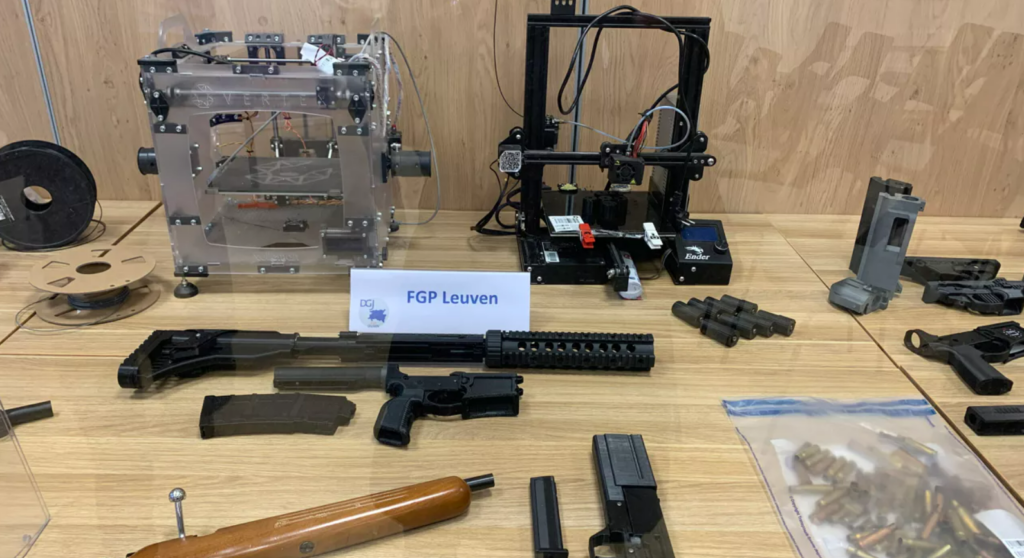
3D printed weapons confiscated from an illegal workshop in Leuven, Belgium. Credit: Leuven Federal Judicial Police
To better understand the current situation in Belgium surrounding 3D printed weapons, The Brussels Times spoke to the director of the Flemish Peace Institute and expert on illicit arms trafficking, Nils Duquet. The Flemish Peace Institute is an independent body under auspices of the Flemish Parliament that conducts research into peace, arms control, conflict and violence management.
Nils Duquet confirms the worries surrounding the rise of 3D printed weapons, noting that the organisation sees them as a threat to the Belgian public, although a future one. The danger is not imminent, as Duquet says that the prevalence of printed firearms remains a “very, very small fraction” of seized arms – for now.
"We see it as part of a bigger problem of availability," he explains. Currently, professional criminals still prefer industrially manufactured weapons for their reliability, while 3D printed weapons have a dubious reputation.
"If they have a choice between a real manufactured firearm or a printed one, they will go for the real one." In addition to the factor of reputation, the production scale of 3D printed weaponry remains small with high availability from the other sources.
However, the dynamic on the street is shifting. The institute has observed that access to firearms is increasing among younger, lower-level criminals. Unlike high-level associates that often prefer to avoid the heat of police attention, these younger members are impulsive and work in a more violent low-level drug dealing market.
Duquet warns that this situation could "lead to an escalation of violence", which can in turn drive up demand for even more firearms. The director of the Flemish Peace Institute is convinced that this is where 3D printed guns can jump into the market gap.
Aside from criminal circles, right-wing extremist groups, surging in Europe, have a special appetite for 3D printed weapons. “In recent years several important seizures of 3D printed weapons and components have been made in right wing extremist networks across Europe. In jihadist and left-wing extremist networks in Europe 3D printed firearms seem less popular,” notes Duquet.

In 2023 three Finish neo-nazis (two of them on the picture) were preparing for a "race war", stocking up on 3D printed weapons. Credit: Finnish police
A major hurdle in combating this potential trend lies in a specific European legal blind spot. While manufacturing a firearm without a license is strictly illegal, possessing the tools to do so is not. Police officers might raid a suspect's home and find a 3D printer alongside weapon blueprints, yet find themselves unable to prosecute them."You cannot charge the person with anything because you cannot prove that this person was actually building them," Duquet says.
To close this loophole, Duquet advocates for a policy where the digital blueprints themselves are subject to licensing, much like the physical weapons they create. "There is no reason to possess the files if you don't want to build one," he argues. Although, this approach will not impact the spreading of blueprints which are still available online, as Duquet admits.
Beyond national laws, Duquet points to the need for a cohesive European framework, including software locks on printers and stricter traceability.
While they may not yet be the weapon of choice for the Brussels underworld, the potential for these "ghost guns" to bypass traditional controls makes them a threat the state can no longer afford to ignore.
