
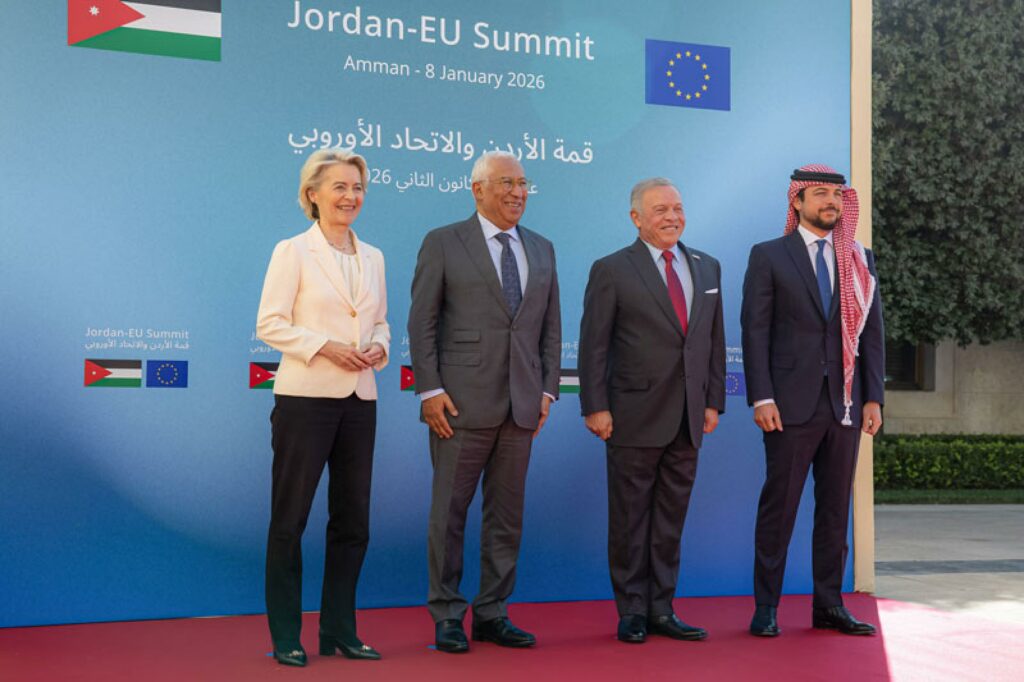
The leaders of the European Union and the Hashemite Kingdom of Jordan have agreed to strengthen their partnership and support regional peace efforts, following the first EU–Jordan Summit in Amman on 8 January 2026.
The summit marked one year since EU–Jordan relations were elevated to a Strategic and Comprehensive Partnership, which aims to boost cooperation on economic resilience, democratic values, human rights and security.
Both sides confirmed they remain committed to the principles of the United Nations and called for more effective multilateral collaboration, according to the joint statement released on Thursday by European External Action Service (EEAS).
Major regional conflicts including the Israeli–Palestinian crisis, the situations in Lebanon and Syria, and the war in Ukraine were discussed, with the EU and Jordan jointly urging peaceful resolutions and respect for international law.
The joint statement called for the full implementation of United Nations Security Council Resolution 2803, as well as former US President Trump’s plan for Gaza, and reaffirmed support for a two-state solution between Israel and Palestine, with both nations living side by side in security, the summit statement noted.
Humanitarian and economic cooperation
Both parties expressed concerns over the humanitarian emergency in Gaza and stressed the need for urgent, safe delivery of aid throughout the region.
They called on all sides to ensure access for aid agencies and reiterated their support for Palestinian refugees, highlighting the role of the United Nations Relief and Works Agency (UNRWA) and Jordan’s contributions as host of millions of refugees.
The EU reaffirmed a support package for Jordan valued at €3 billion, announced in January 2025, including macro-financial assistance, grants, and investments.
The EU and Jordan also agreed to review bilateral trade agreements, promote sustainable trade, and mobilise private sector investments, according to the joint statement.
Measures to aid Jordanian businesses were also discussed, with plans to review rules to help local companies export more products — particularly in the context of the country’s refugee crisis.
Rule of law, security and climate commitments
The summit stressed progress on Jordan’s political modernisation, urging improvements on rule of law, governance, and fundamental freedoms. Both sides agreed to continue work on electoral reforms following the EU’s positive assessment of Jordan’s 2024 elections.
Security collaboration will be enhanced, including border management and efforts against organised crime and terrorism, in coordination with EU agencies such as Europol and Frontex.
The leaders announced the launch of an EU–Jordan Security and Defence Dialogue in 2026, along with further EU support to Jordanian armed forces.
Climate and energy issues featured strongly, with Jordan joining the Global Energy Transition Forum (GETF).
The EU and Jordan pledged increased cooperation in renewable energies, energy efficiency, and water management, particularly emphasising long-term solutions to Jordan’s water scarcity.
Youth, education and future summits
Commitments were made to boost education and job opportunities, especially for women and young people in Jordan, with plans for expanded vocational training and social protection programmes aligned with labour market standards.
Both sides underlined the importance of the new India–Middle East–Europe Corridor for trade and digital connectivity, and agreed to further develop infrastructure and technology links such as submarine internet cables.
The EU and Jordan confirmed that the next EU–Jordan Summit will take place in Brussels in 2028, signalling ongoing cooperation, the joint statement concluded.
