
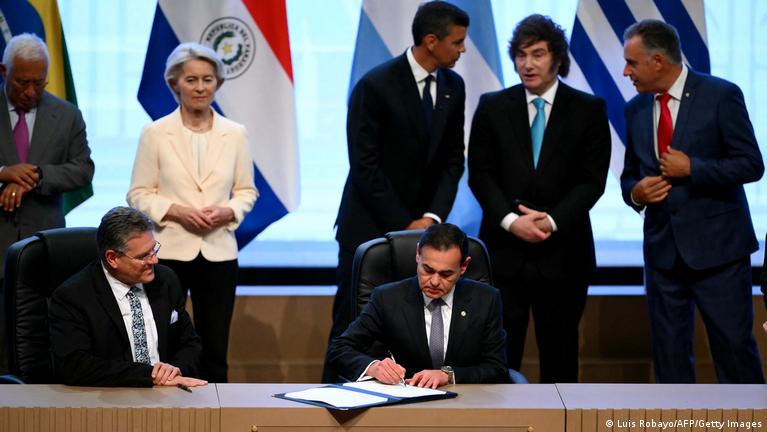
Saturday, 17 January was a momentous day for transatlantic relations. While European Commission President Ursula von der Leyen was in Paraguay to sign the EU’s new trade partnership with the South American countries of Mercosur, Donald Trump announced punitive tariffs on eight European countries that have objected to him trying to seize Greenland from Denmark, a NATO ally.
While the transatlantic relationship between Europe and the US is disintegrating, ties with South America are deepening.
Born in 1999
The EU’s biggest-ever bilateral trade deal has been an awfully long time in the making: more than 25 years.
The internet was still dial-up, the EU had only 15 members and euro banknotes were not yet in circulation when the European Commission first started negotiating a trade agreement with Mercosur, back in 1999. I remember it well: I was a still-young trade correspondent for The Economist at the time.
And if I’m honest, back then it didn’t seem to matter that much. The four Mercosur countries – Brazil, Argentina, Paraguay and Uruguay – weren’t major trading partners for the EU. The US was also pushing for a more ambitious Free Trade Area of the Americas that spanned the entire western hemisphere (except Cuba).
Above all, the then-recently established World Trade Organisation (WTO) was in its heyday, and globalisation all the rage. In the context of a rapidly globalising world economy that promised to open up further on the basis of impartial multilateral rules, a potential preferential pact between the EU and a handful of South American countries seemed like a sideshow.
Trade upheaval
How times have changed. Disappointingly, negotiations at the WTO over the years have achieved very little liberalisation. Worse, President Trump is now trashing the multilateral trading order. He is arbitrarily imposing import tariffs left, right and centre, and has bullied almost everyone – including the EU – into agreeing flimsy, one-sided “deals” that make a mockery of the rules-based WTO system.
Far from seeking to trade freely with the western hemisphere, the US now seeks to dominate the Americas, steal its oil and mineral resources, and intervene at will in its politics. Indeed, Trump slapped a 50% tariff on Brazil for having the temerity to prosecute (and later convict) its far-right former president Jair Bolsonaro for mounting an attempted coup.
As for the US’s traditional allies in Europe, they are increasingly treated as vassals and prey too. Trump threatens to invade Greenland, abandon Ukraine to the murderous clutches of Russia’s Vladimir Putin, foment far-right insurgencies against democratically elected EU leaders and destroy the EU itself.
While the US remains the EU’s largest export market, Trump weaponises this dependency as leverage, and European companies can no longer count on continuing access to American consumers. His latest threat to impose 10% tariffs on Denmark’s European allies in February, rising to 25% in June, underscores that. Rightly, EU leaders are now debating how to retaliate, while the European Parliament has suspended ratification of the EU’s trade deal with Trump.
Meanwhile, China, which was a minor player in world trade in 1999, has become the world’s biggest exporter. While Trump’s tariffs have dented China’s sales to the US, it notched up a record €1 trillion trade surplus in 2025 as its exports elsewhere soared. China’s industrial prowess and cut-price competition stoke deindustrialisation fears in both Europe and Latin America. And its chokehold over global supplies of rare-earth minerals – which are critical for the production of everything from cars to fighter jets – gives it worrying leverage too.
The new transatlantic relationship
Against this new global backdrop of American aggression, Chinese chokeholds and proliferating protectionism, both the EU and Mercosur have powerful reasons to build new partnerships that bypass the US and provide alternatives to China.
Economically, the Mercosur deal offers the EU preferential access to a €2.7 trillion market of 270 million people with which it trades around €150 billion a year. By 2040, this will eliminate customs duties on most trade in goods, which are as high as 35% in the case of cars. It will also streamline trade in services, such as finance and tech. As a result, the Commission reckons it will increase EU exports by €49 billion, supporting jobs and investment.
The deal will not only help Europe diversify its exports away from the US, it will also improve its access to Mercosur’s minerals, such as lithium and copper which are essential for the climate transition.
Politically, the trade deal is part of a broader partnership that will pursue closer cooperation on burning issues such as climate change, another area where Trump is seeking to destroy the global order. It is based on a shared commitment to liberal democracy, multilateralism and international law, all of which Trump spurns. Cultural connections – albeit clouded by the contested history of colonialism – are crucial too, not least people flows in both directions. There are many Brazilians of Italian heritage and many Argentinians living in Spain.
Geopolitically, the EU-Mercosur partnership cements an alternative transatlantic relationship that connects north and south, and challenges Trump’s assertion of hegemony over the Americas. For Brazil, it also provides an alternative to the China-dominated BRICS club of big emerging powers and drags it away from Russia’s orbit.
Picking up the pieces
More broadly, the Mercosur deal is the centrepiece of the EU’s post-Trump trade strategy, which seeks to salvage as much as possible of the rules-based order while diversifying economic relationships.
The EU already has trade agreements with most of Latin America and the Caribbean; its agreement with Mexico has just been updated. Globally, it is negotiating with the likes of Australia, India and Malaysia. And it is also looking to cooperate more closely with the Comprehensive and Progressive Agreement for Trans-Pacific Partnership (CPTPP), a €14 trillion market of 12 mostly Pacific countries.
Despite the geopolitical stakes, EU agricultural protectionism almost killed the Mercosur deal. Even though it regrettably does little to open EU markets to tasty Brazilian beef and Argentinian Malbec, European farmers still blockaded streets with tractors to try to kill it. They were eventually bought off with additional subsidies and safeguards against import surges.
Even then, the deal was agreed by only a qualified majority of member states, after France, Poland, Ireland, Austria and Hungary were outvoted and Belgium abstained. The European Parliament still needs to approve the deal too. Especially after Trump’s latest outrage, it would be unforgivable if legislators failed to do so.
