
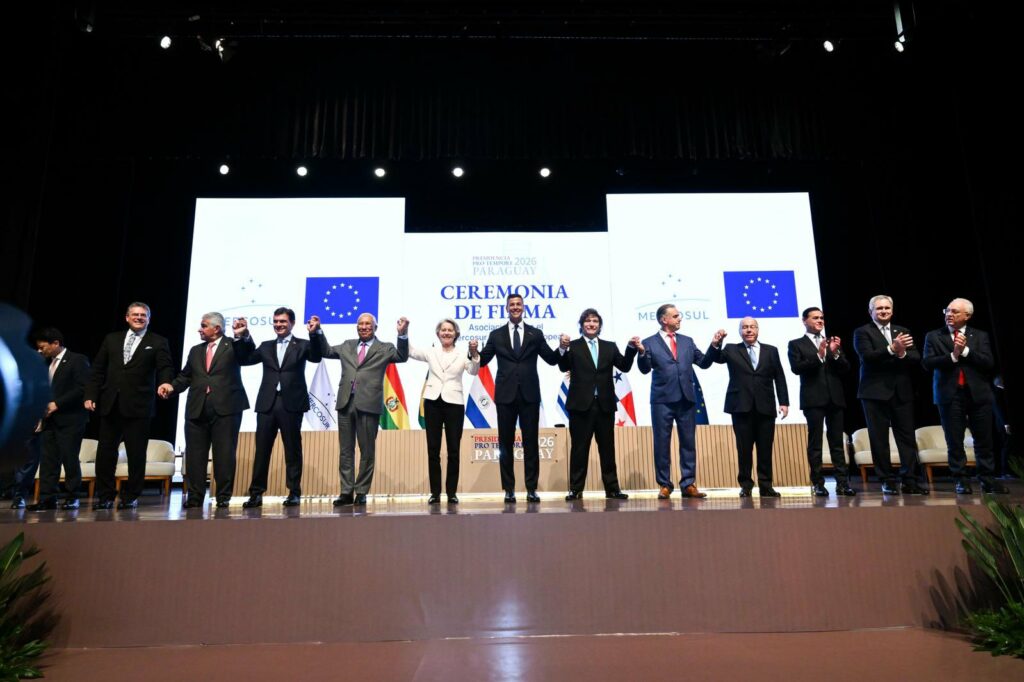
The European Union and the Mercosur bloc have signed a Partnership Agreement and an Interim Trade Agreement, in a deal the European Commission said would create a trade zone covering about 700 million consumers.
The agreements were signed in on Saturday by EU Trade Commissioner Maroš Šefčovič and his Mercosur counterparts, with European Commission President Ursula von der Leyen and European Council President Antonio Costa among the leaders who witnessed the ceremony, .
The Commission said it expects the deal to increase EU exports to Mercosur by an estimated 39% a year, worth about €49 billion, and to support “hundreds of thousands” of EU jobs.
EU businesses are expected to save around €4 billion a year in duties as tariffs are removed on exports including agri-food products and industrial goods such as cars, machinery and pharmaceuticals.
Von der Leyen said the agreement would open “a new chapter of opportunity” for citizens in both regions and that the EU and Mercosur were “choosing cooperation over competition”, according to her published remarks.
What changes for food and farming
EU agri-food exports to Mercosur are expected to rise by up to 50%, with tariff reductions covering products such as wine, spirits, dairy and olive oil, the Commission said.
The agreement also includes protection for 344 EU Geographical Indications — names for region-linked foods and drinks that are legally protected from imitation.
For sensitive farm sectors, the Commission said the deal includes tariff rate quotas, a legally binding safeguard mechanism that can be used in the event of a surge in imports, and tighter controls to prevent non-compliant products entering the EU, including more audits in third countries and strengthened checks at EU borders.
The Commission also said it plans a €6.3 billion “Unity Safety net” fund from 2028 to support farmers in case of market disturbances.
On sustainability, the Commission said the agreement includes enforceable climate commitments, with the Paris Agreement treated as an “essential element”, and a pledge to work towards climate neutrality by 2050.
The next step is ratification: the full partnership agreement must be approved by all EU member states under their national procedures, while the interim trade agreement will go through an EU-only process requiring the European Parliament’s consent and final approval by the Council.
