
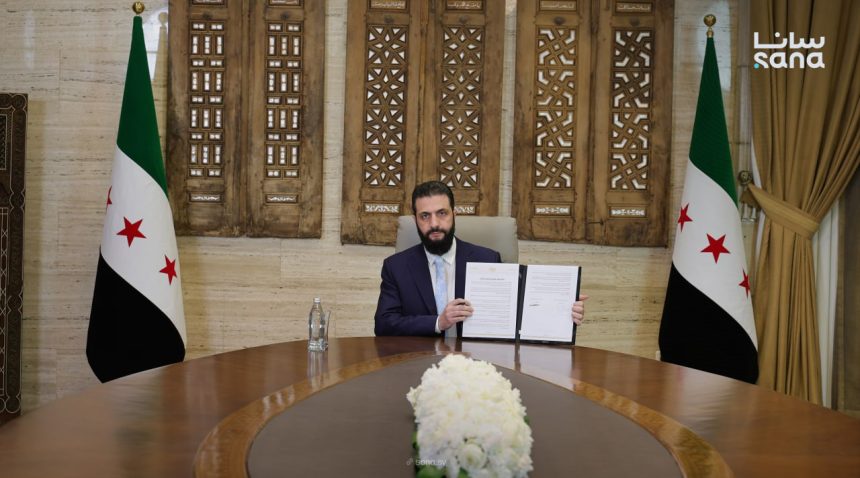
EU’s High Representative for foreign affairs and security policy, Kaja Kallas, issued a statement on Monday evening where she welcomed the ceasefire between the Syrian interim authorities and the Kurdish-led Syrian Democratic Forces (SDS) in north-east Syria following a government military offensive which has led to SDF’s withdrawal and even collapse.
In the statement, she described the ceasefire as a “vital step” to prevent the country from sliding back into turmoil and demanded that all military activities must cease immediately. All civilians must be protected. But the fighting has continued despite the agreement on Sunday between Syrian President Ahamad al-Sharaa and SDF commander Mazloum Abdi.
The 14-point agreement, which replaced a previous 8-point agreement which was not implemented as foreseen by the end of 2025, would see the handover of two governates to the Syrian government. The civilian institutions in a third governorate, with is dominated by the Kurdish population, would be integrated into the institutions of the Syrian state and ruled by a governor appointed by presidential degree "as a guarantee of political participation and local representation".
The Syrian government would also take control of all border crossings, oil fields, and gas fields in the region, with protection secured by regular forces to ensure the return of resources to the Syrian state, while considering the special case of Kurdish areas. The take-over seems already have taken place on the ground.
Contrary to what was agreed in recent talks, SDF-troops would not be integrated into the national army as separate units under their own commanders but on an individual basis, following necessary security vetting. Such vetting has not been done with regard to the jihadist fighters who fought in al-Sharaa’s guerilla army and have been complicit in attacks against the Alawite, Druze and Kurdish minorities.
Kallas did not mention the fate of the Kurdish autonomous administration. According to the statement, the EU goal remains a genuinely inclusive political transition including the “full protection of Kurdish rights”. EU’s position is that the transition should be peaceful through dialogue and negotiations and not by military force.
For that lofty goal, and for the recovery of Syria’s economy and the safe return of Syrian refugees, including displaced persons inside the country, the EU lifted all economic sanctions, first by suspension of them in February and then fully in May 2025.
Asked if the sanctions were lifted without any conditions, Anouar el-Anouni, the Commission’s spokesperson for foreign affairs, told The Brussels Times that the lifting of the sanctions should be seen in the context of the transition in Syria after the fall of the Assad regime.
“Our sanctions policy is always in touch with the development on the ground. We’ll judge the Syrian authorities by their deeds and not their words. Sanctions is always conditional on what we see on the ground.”
Another issue concerns the consequences of the sudden defeat of SDF for the fight against the Islamic State (IS) and its captured foreign fighters, including their families, that until now have been detained in camps guarded by Kurdish troops. Kallas referred to Syria’s “commitment to counterterrorism” to counter any IS resurgence after it recently joined the Global Coalition which fought IS.
The central government's offensive into the Kurdish-held areas on the other side of the Euphrates river started almost immediately after the ceasefire in Aleppo, following the attack last week against Kurdish neighborhoods by militias belonging to the Syrian national army. One of the first negative side-effects of the new offensive is the release or escape of those detained in the camps.
As previously reported, 12,000 Daesh/IS prisoners together with their families are held in jails and camps in north-east Syria, in total 45,000 including 30,000 children raised under its extremist ideology. Among the fighters, 5,000 are from Syria, 5,000 from Iraq and the rest from ca 55 other countries, including EU Member States, that mostly refuse to bring them to trial and repatriate their families.
The outbreak of violence leads again to mass displacement of civilians and risks creating a security vacuum which IS could exploit to carry out terrorist attacks.
During the civil war when Assad was in power, the Kurdish administration (AANES) established a functioning local self-government in north-east Syria (one third of Syria’s territory). Its militia, the Syrian Democratic Forces, including both Kurds and Arabs, fought successfully the Islamic State, in partnership with US forces. In the war, thousands of Kurdish soldiers were killed.
AANES was disappointed with the indifference of the US and the EU to Kurdish autonomy in Syria and their support to the Syrian transitional government which is still far from implementing true democracy in the country. Kurds in Syria feel betrayed again, as happened in 2018 when the first Trump administration decided to withdraw its special forces in the north of the country.
The main losers after the American withdrawal were the Syrian Kurds. Without American presence on the ground in Syria, there was nothing to stop Turkey from intervening in northern Syria and crush Kurdish self-rule there under the pretext that the terror-listed PKK had infiltrated SDS.
When Ilham Ahmed, Co-Chair of the Foreign Relations Department of AANES, held a press conference last week, she seemed still optimistic about a peaceful and inclusive transition based on dialogue despite the clashes in Aleppo. Early Tuesday morning she issued a desperate statement regarding the attacks by the interim government and “Turkish state-backed militia groups”.
“The aim of these attacks is to eliminate the coexistence based on the brotherhood of peoples,” she wrote, calling on the Kurdish people to resist what she called ‘genocidal attacks’. “We are confident that they will show the same resistance as before. Our people must make their position clear everywhere, internationally, in the field of diplomacy, and in terms of self-defense and resistance.”
AANES has declared a general mobilization of Kurdish forces and called on Kurds abroad to come to its defence.
How can the withdrawal of SDF in the first days of the government offensive be explained? “It’s difficult to say,” replied Dr Moran Levanoni, a researcher at the Israeli Institute for National Security Studies (INSS). “It’s possible that we overestimated the Kurdish forces. The desertion by tribal Arab forces was a crucial factor in addition to the threats posed by the Syrian army and Turkey.”
How do you interpret the new agreement? “Following the Kurdish military collapse, al-Sharaa allowed himself to dictate stricter conditions than in the previous agreement.”
Why was not AANES involved in the talks? “I do think that AANES was also involved in the talks but at this stage the military commander was still more dominant.”
Does this mean the end of Kurdish local self-government? “As al-Sharaa, in my opinion, aims at achieving stability in Syria, I would assess that he’ll enable a sort of cultural autonomy in order to reduce the resentment against the central government.”
