
US President Donald Trump’s speech on Wednesday at the World Economic Forum at Davos took the form of a rambling and complacent tirade which insulted EU and its Member States but might leave a door open for a mutually acceptable solution on Greenland - the main issue at today’s extraordinary European Council meeting in Brussels.
In his speech, Trump praised himself for what he claims to be a successful economic policy in the US, throwing unverified figures around, denigrated his predecessor Joe Biden, accused Denmark of ingratitude, extolled the US above all, and took credit for initiatives that have not yet resulted in permanent peace settlements neither in Ukraine nor in the Middle East.
“Trump is the most un-American president in our history,” wrote well-known journalist Thomas L. Friedman in an op-ed in The New York Times before the speech. In contrast to his first administration, when he was contained by serious advisors, this time he is surrounded with yes-people or sycophants, with an impotent or self-neutered Congress. It is all about “Me first” and “America alone”.
As regards Greenland, Trump continues to insist that the US must have the island, an autonomous part of Denmark with an association agreement with the EU, at all costs.
“No nation or group of nations is in any position to be able to secure Greenland other than the US,” he claimed in his speech, adding that the reason was not its minerals but because of strategic national security and international security. “That’s the reason I’m seeking immediate negotiations to once again discuss the acquisition of Greenland by the US.”
To EU’s relief, Trump apparently withdraw his threat to impose tariffs on those EU Member that had sent troops to Greenland to mark a military presence or military exercises. But any negotiations have not yet started in earnest. European Commission President Ursula von der Leyen, who also gave a speech at Davos, did not stay for a possible meeting with Trump.
She returned for a speech at the European Parliament and to prepare the upcoming European Council meeting. According to her spokespersons on Wednesday, that was the best use of her time and in line with her set of priorities. Instead, other leaders talked with Trump, presumably explaining to him that Greenland is a matter of territorial integrity and for Denmark and Greenland to decide.
As previously reported, Belgium’s Prime Minister Bart De Wever met the US leader alongside the Belgian King Philippe. De Wever said before the meeting that he would tell Trump that he was "crossing red lines" in his threats to his European allies over his desire to annex Greenland but nothing has emerged from the meeting.
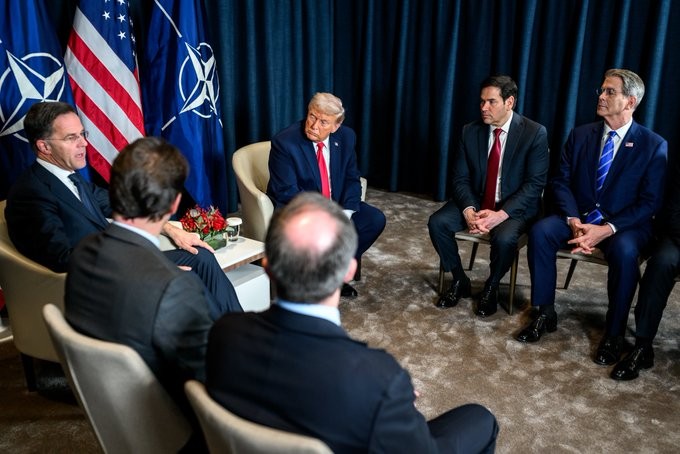
The most important meeting was probably between Trump and NATO Secretary General Mark Rutte. Before their meeting, the former Dutch Prime Minister gave Trump all credit for pushing EU and its Member States to increase their defence spending.
“I'm not popular with you now because I'm defending Donald Trump, but I really believe you can be happy that he is there because he has forced us in Europe to step up, to face the consequences that we have to take care more of our own defence,” he said in an interview for Deutsche Welle.”
"I'm absolutely convinced; without Donald Trump we would not have taken those decisions." He added that both sides are right: "President Trump is right, other leaders in NATO are right: we need to defend the Arctic."
Trump described his meeting with Rutte as very productive. “We have formed the framework of a future deal with respect to Greenland and, in fact, the entire Arctic Region," the president wrote. "Based upon this understanding, I will not be imposing the Tariffs that were scheduled to go into effect on February 1st.”
Rutte himself denied that the Greenland issue came up in his conversation with Trump. “He's very much focused on what we need to do to make sure that that huge Arctic region, where change is taking place at the moment, where the Chinese and Russians are more and more active, how we can protect that," Rutte said.
“Ukraine should be our No. 1 priority, and then we can discuss all the issues, including Greenland,” he said in a panel at Davos. An idea that that perhaps was floating at Davos was granting the US extraterritorial rights or some sort of sovereignty over some land in Greenland needed for its military installations there.
