
The Belgian State Security (VSSE) presented a complex picture of security and terrorist threats facing Belgium in its English version of the 2025 intelligence report published today (22 January), covering Islamic terrorism, extremist movements, far-right and far-left groups, Russia, China, and organised crime.
As already reported, when the report was first published, a new threat in the form of “accelerationism” has emerged as the greatest violent threat from right-wing extremists in Belgium. More specifically it falls under what the report callas “nihilistic extremism” which combines various phenomena, including also anti-Semitism and racism, misanthropy, Satanism and Eastern European skinhead culture.
It is described as a transnational phenomenon, whose exact scale is difficult to determine. A dozen perpetrators, each with multiple victims, have already been identified in Belgium. However, this is likely only the tip of the iceberg, according to the report.
“The report gives us a moment to reflect on the threats we have faced over the past year, both as an organisation and as a society, and to look ahead to the challenges that lie before us in the months to come’”, explained Francisca Bosty, Administrator-General and responsible editor of the report. VSSE declined to comment on the report but it has caught the attention of Belgian politicians.
Minister of Justice Annelies Verlinden confirmed her support for the VSSE: ‘In today’s rapidly evolving geopolitical environment, Belgium must be able to rely on a forward-looking intelligence service. That is why we are investing in the VSSE, with the aim of developing it into the benchmark in the fight against extremism, terrorism, espionage and (election) interference.”
As regards left-wing extremism, the report describes a pattern of vandalism, resistance to authority, and intimidation of political opponents. Left-wing extremist groups made themselves heard on several occasions during last year. In 2025, the VSSE faced the challenge of identifying possible shifts among movements and individuals that could lead to acts of violence.
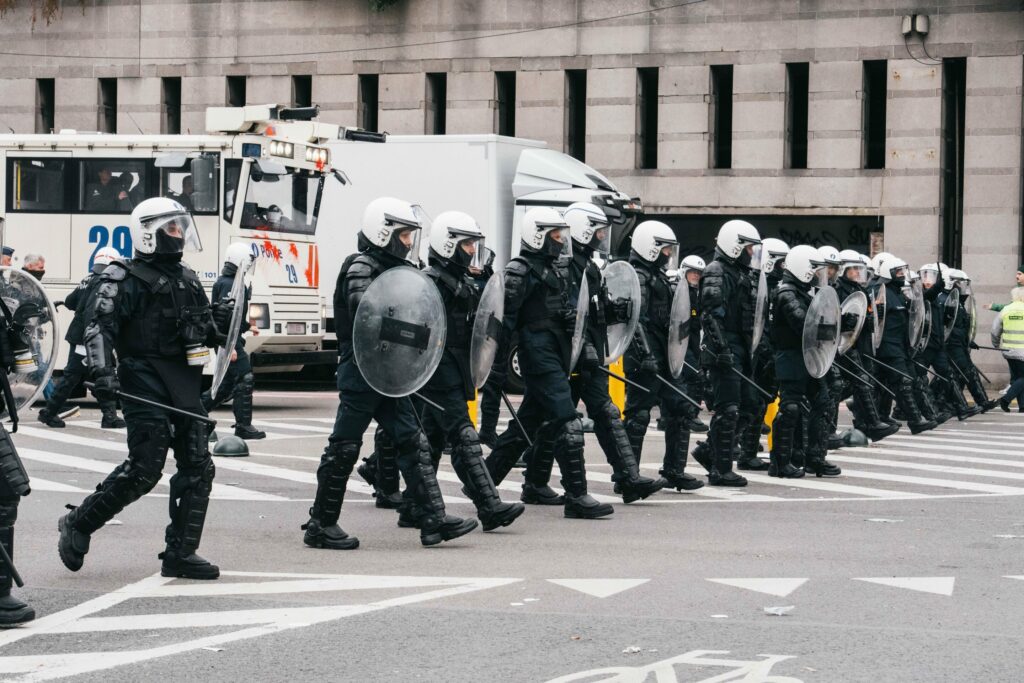
Riots during demonstrations - particularly during “anti-fascist” counter-demonstrations - were phenomena that occurred more frequently in 2025 compared to previous years. Taken together, these elements point to an increased potential for violence from left-wing extremist circles. These violent actions, combined with the justification of violence as a means of action, remain a continuing concern.
In the short term, the VSSE assesses that a terrorist attack from the left-wing extremist movement in Belgium is unlikely. But warns about militant anti-fascism. Denying or underestimating the potential for violence of certain individuals within these circles could result in a significant development in 2025 being missed.
Islamic threats in different forms
As regards radical Islamism, the report writes that it continues to pose a significant threat and remains the principal terrorism-related threat: 80% of the Joint Intelligence Centres set up in 2025 were directly linked to this threat, which continues to originate primarily from the Islamic State (IS) and, to a lesser extent, al-Qaeda.
Most plans for attacks in Belgium in 2025 were made by lone actors or very small cells inspired by their ideology. The individuals involved were often minors and young adults. Worrying is that around one third of cases involved minors, showing that deradicalization programmes introduced after the terrorist attacks in 2016 had not reached them.
The individuals who came to the attention of the authorities in Belgium in 2025 for planning jihadist-salafist-inspired attacks had all consumed propaganda, primarily online, from the terrorist organisations.
Their propaganda also makes clear that IS and al-Qaeda still have ambitions to strike Europe. This was highlighted in December 2025, when IS called for attacks against ‘Jews and Christians’ in Belgium in its weekly digital magazine. While such calls are not unusual, it is rare for attacks to follow. Nevertheless, it underscores that Belgum remains a legitimate target in their eyes, according to the report.
VSSE, is still alert to the situation of Foreign Terrorist Fighters (FTF) linked to Belgium and based in Syria. No major changes were observed in the situation of these FTFs in 2025, who then were still in prisons and camps in northeastern Syria, or who have built their lives in the northwestern part of the country.
But that can change after the recent events in north-east Syria after the Kurdish-led Syrian Democratic Forces (SDF) collapsed under the onslaught of the Syrian national army and Turkish-backed militias. One of the consequences of the offensive was the release or escape of those detained in the camps that had been guarded by SDF.
The report states that the VSSE and the General Intelligence and Security Service (GISS) are closely monitoring this evolving situation.
As regards Hamas, the report writes that it is primarily focused on its own survival (in Gaza) and currently has no capacity to operate outside its immediate zone of influence. According to US President Trump’s peace plan, Hamas has committed to lay down its weapons and disarm. The VSSE considers that violent action by Hamas in Belgium is unlikely. There are individuals in Belgium, however, who can be linked to Hamas.
Hezbollah, the Lebanese terrorist organisation is currently is under pressure by the Lebanese government to disarm. Its activities in Belgium were limited to propaganda. Some mosques organised memorial ceremonies for members of Hezbollah who died in the war with Israel at the end of 2024. Although limited in scope, funds are sometimes raised and collected on behalf of Hezbollah in Belgium.
The Muslim Brotherhood is mainly characterised by its activities aimed at influencing public policy regarding Islam. The VSSE assesses that the threat linked to them will remain stable in Belgium in the years ahead. The threat lies in the organisation’s ideology, which may contribute to a climate of segregation and polarisation that, in turn, creates conditions conducive to radicalisation of individuals.
