
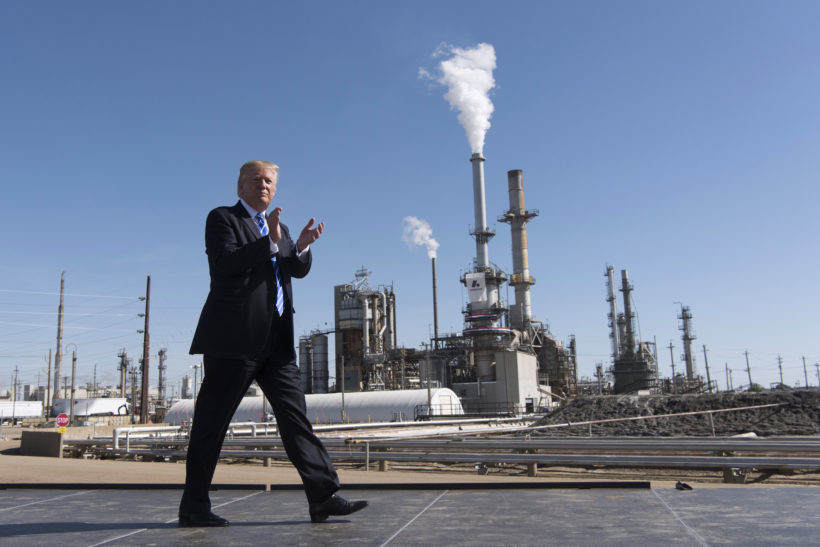
The European Union risks trading risky dependence on Russian energy imports for the same precarious situation with the United States. But what can the EU do if Donald Trump decides to use the trade of energy as leverage to achieve his goals?
The EU’s response to Russia’s illegal invasion of Ukraine in 2022 was, in hindsight, a remarkable course of action to take, given everything we know about the slow pace of Brussels decisionmaking and the difficulties in getting 27 countries to agree on anything.
Oil imports have all but been eliminated and gas has more than halved. A recent agreement between EU countries should see almost all those imports disappear by the end of 2027.
A small part of that reduction has been achieved by being a bit more efficient in how we use energy and some of it is simple demand destruction: businesses or industries closing up shop and no longer being energy consumers.
But the vast majority of that decrease in Russian hydrocarbons is down to finding alternative supplies. The EU has gone cap in hand to gas suppliers in Azerbaijan and Qatar but by far the biggest beneficiary of this diversification is the United States of America.
Imports of liquified natural gas (LNG) have increased fourfold since 2021 and if the current trend continues and agreements are honoured that will rise to around 80% by the end of the decade.
That gives the US unprecedented influence over Europe by granting Washington so much energy policy leverage. It is part of the reason why Donald Trump has in recent months felt empowered to say and pretty much do whatever he likes with impunity.
A line in the sands of sorts was drawn this week when it comes to Greenland and Trump’s insistence that the US has “gotta have it” but what if the president’s mood changes on a whim again and energy supplies are cast into doubt? What can the EU do?
It is not an unlikely prospect. A controversial national security strategy last year spelled out in clear terms that energy supplies will allow the US to “project power”. This is essentially what Vladimir Putin’s Russia did since the start of the new millennium.
There are two options open to Brussels, the first involves sourcing supply from elsewhere. Norway is attempting to position itself as Europe’s primary fuel supplier and is ostensibly keen to expand that role.
The Norwegian government issued 57 new oil and gas exploration permits earlier this month with a view to maximising its production, even though it is widely accepted —although not by Trump— that the North Sea’s reserves are in decline.
It is not much of a long-term option. Even lovable cuddly Norway is not the perfect reliable partner. It is not in the EU, so is not fully bound by any rules, and has in the past flirted with cutting off electricity imports. Dependency is dependency, even if it is on a friend.
The second option is a rather simpler one: use less fossil fuel.
According to a new report published this week, the EU is absolutely working on that second option. Wind and solar power overtook fossil fuels for the first time, even though wind conditions were not ideal in 2025.
Numerous countries set new records on solar deployment, coal phaseout and general clean energy use, so the solutions and technologies are there, they are maturing and they are ready to start solving the Trump problem.
Critics of clean energy and fossil fuel champions will point to the fact that this is just about electricity and that energy demand in general, for transport and heating, are still largely satisfied by oil and gas.
That is true, when you measure primary energy demand. This is the total raw energy fed into the system. It over-inflates fossil fuel’s importance, as it does not account for the incredible efficiency gains offered by renewable replacements.
In the 21st century, that is a completely useless way of measuring how we use energy and of making energy policies fit for modern society.
Ultimately, we have the playbook to negate American influence over Europe’s energy system and yes, Mr Trump, it does involve building more of the ‘windmills’ that you so vehemently hate.
Want more updates and analysis of what is happening in the world of energy and climate? Interested in finding out more information about public tenders and consultations? Sign up to our Energy Rundown newsletter here!
