
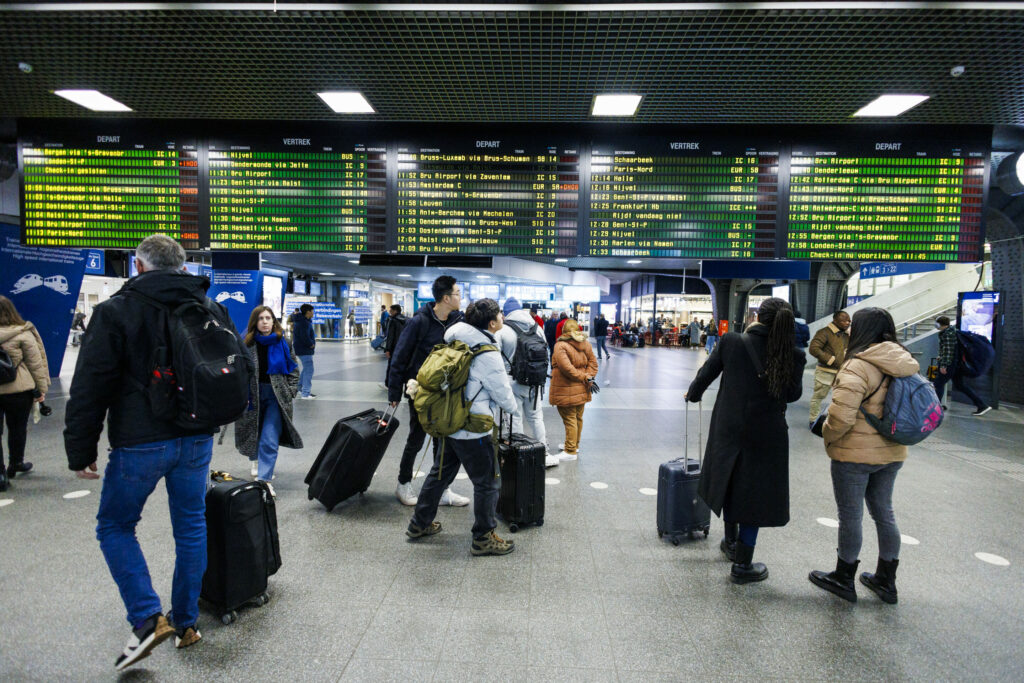
A five-day rail strike is underway in Belgium, bringing severe disruption to rail passengers throughout the country for the rest of the week.
Rail services came to a standstill from 10 pm last night and they are not expected to resume until 10 pm on Friday, 30 January.
There will, however, be a skeleton service in place to ensure passengers can get from A to B.
According to national rail operator SNCB/NMBS, trains will run according to the number of railway staff who are not participating in the strike. Passengers can consult the new timetables via the SNCB app or website.
Today, Monday 26 January, only three out of four of the trains between major Belgian cities (IC trains) will be running, while two out of three of the local and suburban trains (L and S trains) will be operational.
Additionally, there will be only a few P trains throughout the day, SNCB has warned.
According to SNCB, the conditions for train ticket refunds or changes remain the same during strikes. However, passengers with specific questions or concerns can contact the SNCB contact centre for more information.
For Tuesday, forecasts indicate that three out of four IC trains and two out of three L and S trains will be running.
On Wednesday, two out of every three IC trains are expected to run. This represents a slightly lower level of service than on Monday and Tuesday, when three out of four IC trains linking major cities are expected to operate.
Bus and tram disruptions
Travel disruptions are expected to be particularly bad this week in Wallonia as personnel across the across the entire TEC network will be on strike.
Disruptions are expected to impact TEC’s bus and tram services in Wallonia from today for an indefinite period. Passengers are advised to consult the operator's app and website for the latest information regarding its service.
On Wednesday, one out of two local (L) and suburban (S) trains will run. Very few peak-hour (P) trains will operate during rush hours.
STIB network
The Brussels public transport company (STIB) is also expected to experience some disruptions, but to a lesser extent, according to Belga News Agency.
No strike has been called for Brussels public transport, but the company's socialist union has called on its members to support the inter-professional rally, organised by the FGTB (General Federation of Belgian Labour), scheduled for Monday at 10 am near Brussels Central Station.
International travel
Most Eurostar trains are expected to run as normal throughout the week. However, the high-speed train operator advises passengers to regularly consult its website or app for the latest updates.
Similarly, most TGV INOUI trains to and from Brussels are expected to be operational next week, although some trains on Monday and Tuesday have been cancelled ahead of the strike.
Passengers travelling on EuroCity trains are set to face some disruptions. On Monday and Tuesday, only 12 out of the 16 EuroCity trains running between Brussels and Rotterdam will be operational.
On the same days, only half of the EuroCity trains between Brussels and Amsterdam will depart from Belgium, with the majority of trains expected to have their final stop in Rotterdam.
Similarly, almost half of the Amsterdam-Brussels EuroCity trains departing from the Netherlands on Monday and Tuesday are cancelled, with the majority departing from Rotterdam.
Nonetheless, all ICE Brussels-Cologne-Frankfurt trains and OUIGO Brussels-Paris trains are expected to run as scheduled.
Passengers can access an overview of the latest disruptions to international train services via the SNCB online traffic disruption page.
Why has the strike action been called?
Five rail unions have joined forces for the strike action, called in December in protest against a draft bill reforming the railways.
The bill, which aims to modernise the management of Belgium's public railway companies, puts an end to the appointment of permanent roles within SNCB and the rail infrastructure group Infrabel.
"We oppose this vision: permanent civil service status guarantees a quality public service, for both workers and passengers," the unions declared in a press release issued in early January.
The unions are also concerned with proposed changes to the system of labour negotiations, which they fear could allow HR Rail, the umbrella organisation managing SNCB and Infrabel staff, to make decisions without the agreement of at least one of the trade unions.
In addition, union members are striking to denounce poor working conditions, pension reforms and a general deterioration in public services.
Pierre Lejeune, president of the CGSP Cheminots (General Confederation of Public Service Railway Workers) told Belga News Agency: "It's not just about railway workers' jobs. It's an ideological debate about the future of public service.”
According to Lejeune, the public service level that the SNCB is currently required to maintain is falling short by 3% due to numerous train cancellations. "Let's start by stabilising and gradually improving the current service rather than trying to overhaul everything," he said.
Another year of strikes for Belgium?
According to Belga, in 2025, SNCB recorded a total of 27 days of strikes, 21 of which were initiated solely by railway unions.
A strike lasting nine days took place from 22 February to 2 March, followed by another eight days of rail strikes at the end of March.
