
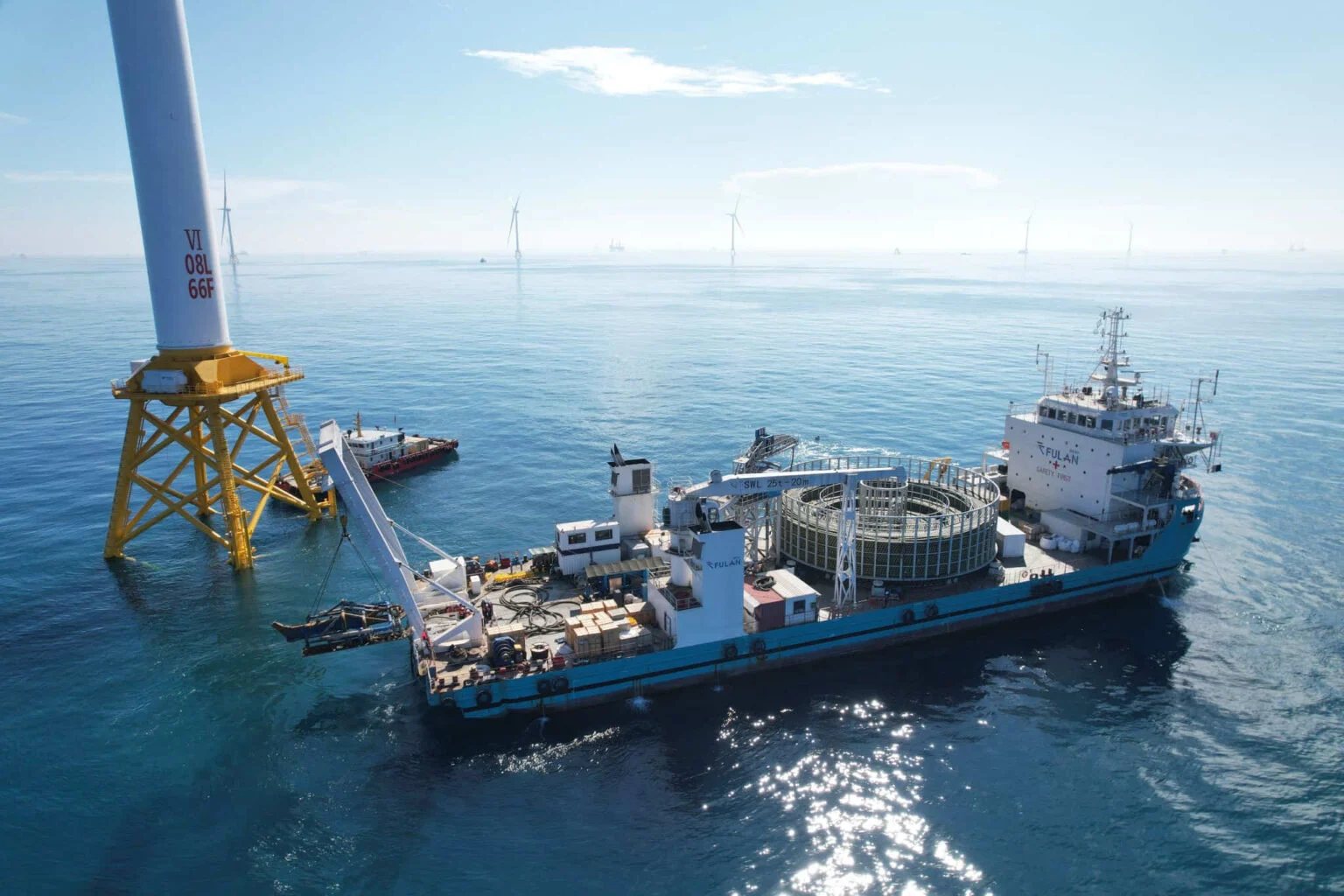
North Sea countries pledged this week to work together on collaborative energy projects, which will rely on long undersea cables to link together power grids and electricity generators. It is a mammoth undertaking but a necessary one.
Countries around the North Sea – including Belgium, Denmark, France, Germany, the Netherlands and the United Kingdom – see a bright energy future in the basin.
United States President Donald Trump falsely claimed recently that there are 500 years of oil and gas left in the North Sea. If he had said “energy”, he might have been close to having a point, as wind power will remain in abundance for thousands if not millions of years.
That is why those countries are spending big on offshore wind farms and working together on a potential 300 gigawatts of capacity by 2050. But you can only achieve so much alone, which is why in Hamburg this week, those countries decided to team up.
By mid-century, those North Sea nations will aim for 100 of those 300 GW to be collaborative energy projects. That means sharing funding, risk, expertise and resources to build as many turbines as possible and integrate them efficiently into the European power grid.
We already got a taste of what this will look like shortly after the Hamburg Declaration was signed on Monday, when Germany and the UK announced an ambitious new undersea power link.
The Griffin Link will be different to the existing connections that already run across the Channel and North Sea between countries, as this one will be a multi-purpose interconnector, the first of its type in the world if built.
As well as being able to transmit power between Germany and the UK, Griffin will also be connected to wind farms en route, meaning a huge cost saving on the infrastructure normally needed to link turbines to the mainland.
Wind farm developers see this as the future and will hope that the feasibility studies now being done by the Germans and British will proceed quickly. Griffin is only supposed to be online in the late 2030s, so there is plenty of work to be done.
Other connection perks
One of the biggest benefits of building these connections is to sell and buy surplus power. For renewable energy this is a great opportunity as in one place the sun might be shining, while in another the wind might not be blowing.
It is particularly beneficial when interconnectors link countries in different timezones, as it means power markets can take advantage of different peak hours, like when people get home from work or when it starts to get cold at night.
This is the logic behind an ambitious project to link the European and North American electricity networks with a cable that would be the longest and deepest of its kind ever built.
Canada is several hours behind Europe, so when the sun is shining over Central Europe and demand is low, those green electrons could theoretically be transmitted across the Atlantic to where there would be a shortfall.
Pessimists will point to the recent spate of sabotage perpetrated against undersea energy connections in the Baltic Sea in particular, as reason not to depend too heavily on them.
But that logic doesn’t hold for a couple of reasons. First, there is no choice in the matter, countries will have to link up their power and gas grids more comprehensively if they want to achieve their energy decarbonisation and security goals.
Second, the more links countries build, the less their energy eggs are all in the one basket. More connections, more safety nets and more ways to divert power flows when incidents occur. The Iberian blackout last April, for example, would have been much worse without Spain's interconnectors. It could maybe have been avoided, if there were more cross-border links.
And third, there will undoubtedly be more attempts to cause disruption to European energy markets. But governments are getting better at dealing with them. Poland recently fended off a cyber attack against its electricity network without any loss of power recorded.
Organisations like NATO are now more on the lookout for the perpetrators of these attacks, both physical and online. Experience, in this case, definitely helps.
Problems below the waves
Undersea cables are expensive undertakings, often costing billions of euros to build. They are resource-intensive and specialist equipment such as installation vessels are not in abundance.
There is also the still-unresolved question of ‘who should pay for it?’ when it comes to many projects.
Greece, Cyprus and Israel are hoping to build the Great Sea Interconnector, which would set a number of milestones. It would be the first European power link with the Middle East, it would be the longest cable in the world and it would end Cyprus’ energy isolation.
But the project has stalled, partly due to tensions in the Middle East and partly because costs have begun to mount up and there are disputes about how to split them.
Greece and Cyprus are adamant that the cable will be built and the Greek side have already made headway by linking the mainland with the island of Crete. But beyond that, the timeline looks shaky.
That is why Athens has decided to bring in outside consultants to give the books a thorough going over and to put to bed the questions around the cost, so that other investors can potentially be found and more progress made.
So undersea connections aren’t easy to pull off but there are plenty of reasons why the effort should be made to build as many as possible.
Want more updates and analysis of what is happening in the world of energy and climate? Interested in finding out more information about public tenders and consultations? Sign up to our Energy Rundown newsletter here!
