

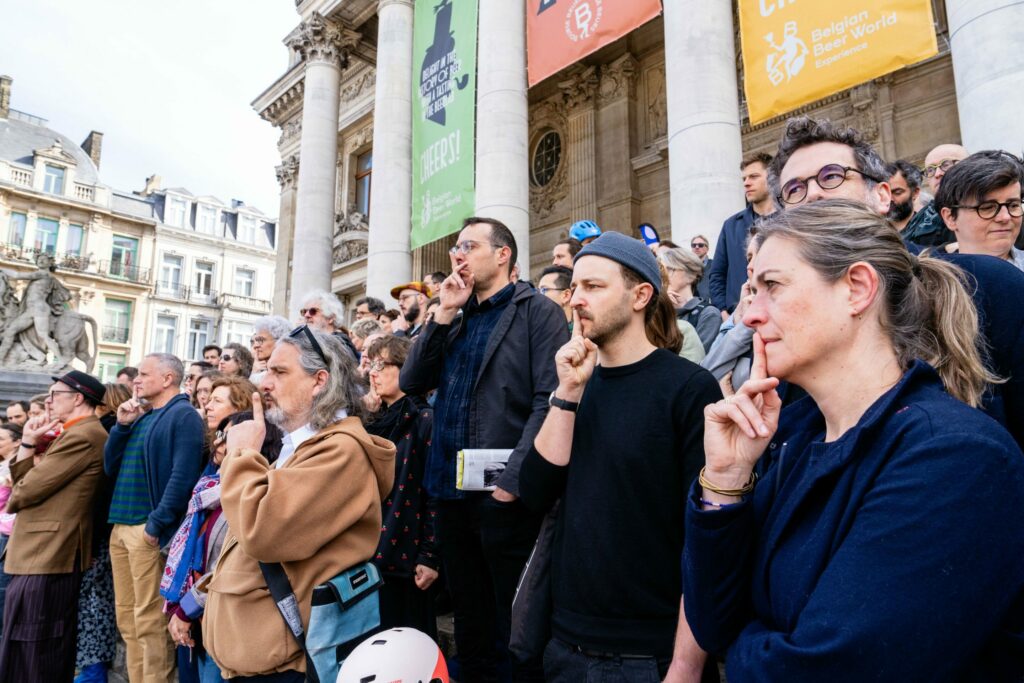
Brussels residents are protesting tonight at Place de la Bourse as the EU capital marks exactly six hundred days without a functioning government and without a minister-president.
They have good reason to distrust the Brussels political class. The record-breaking length of this crisis is paralysing decision-making at a time when the region faces an accumulation of urgent social, economic, and security challenges.
The question is no longer who is to blame, but what political leadership can do to exit this prolonged impasse and finally move toward a functioning government.
Too many political actors remain trapped in a defensive blame game. Party leaders continue to point fingers at one another, each explaining why the failure to form a government is someone else’s responsibility. This narrative may be convenient, but it leads to nowhere.
While elected representatives continue to discuss coalition options, I would suggest starting with something more fundamental: changing the words used to describe the objective. In politics, words matter. A shift in narrative can change the dynamics of an entire process.
The term "coalition" is no longer the right framing for Brussels today. Instead of speaking about a coalition, political leaders should consider speaking about a Pact, for example a Stability and Recovery Pact for Brussels.
The word "coalition" almost always implies winners and losers. It is widely perceived as an ideological alignment. Even when this is not the case, it suggests a shared political project, a degree of ideological coherence, and a long-term convergence. This is precisely what some parties do not want to signal to their voters.
Talking about a coalition keeps the focus on political fragmentation. It automatically triggers questions such as who leads, who follows, who had to concede, and who legitimised whom. This framing hardens positions
and fuels internal resistance within parties, since no one wants to be seen as joining someone else’s majority.
A Pact, by contrast, would imply shared responsibility rather than hierarchy based on electoral arithmetic. A coalition asks parties to align themselves. A Stability Pact would ask them to act responsibly in the face of an exceptional situation.
Moreover, the coalition logic traps parties in full collective responsibility. In a coalition, all partners are jointly responsible for everything. A Pact would allow for differentiated responsibility, sectoral or thematic ownership, and selective visibility. Parties could contribute where they are strongest without bearing the full political cost of every decision.
Finally, a Pact sounds more technical, limited, and pragmatic. This makes internal approval easier and allows parties to tell their voters a clear and honest story: we have not changed our political line; we have simply assumed our responsibilities at a critical moment for Brussels.
Brussels negotiations need a new political narrative. Reframing the objective from a coalition to a Pact would not solve all disagreements, but it could lower tensions, unlock dialogue, and create the conditions for action. At a time of record paralysis, choosing the right words may be the first concrete step toward restoring trust.
