

Behind the acronyms and spreadsheets, the EU’s next long-term budget is already shaping political choices that will affect millions of lives, with consequences far beyond Brussels.
The Multiannual Financial Framework (MFF) is the EU’s long-term budget for 2028–2034. It sets how much the EU will spend, how it will be spent - and on what. This is not an accounting exercise. It’s one of the EU’s most political tools. What gets funded gains momentum. What doesn’t, gets sidelined.
In that sense, the MFF answers a simple but fundamental question: whose lives is the EU willing to invest in? EU budget decisions shape daily life. The MFF funds schools, jobs, housing, healthcare and anti-poverty measures across Europe - often without people even noticing where the money comes from.
Where this money goes and who can access it shape opportunity. Funding choices reveal political values. They show who is prioritised, and who is expected to keep waiting. This is why negotiations on the next MFF matter well beyond Brussels.
For Roma communities, EU funding is decisive. When used effectively, it addresses inequality in housing, education, healthcare, and employment and supports the fight against antigypsyism.
If the EU is serious about competitiveness, it must first be serious about rights. No economy can claim to be competitive while tolerating systemic discrimination that locks people out of opportunity. Equal rights are not a cost to competitiveness; they are its precondition.
Research by the EU Agency for Fundamental Rights shows progress is strongest where funding supports desegregation, inclusive education and community-based services — and where Roma help shape and monitor the work. But this does not happen by default. Too often, the Roma minority is absorbed into vague references to “vulnerable groups”.
While this may appear inclusive, in practice, it weakens protection. When Roma are not explicitly named, funding is not earmarked, and disaggregated data are missing, there is no guarantee that it will reach them. One of the actions in EU’s anti-racism strategy is to improve the collection, analysis and use of data on equality.
Broad categories make it easy to move money away from Roma inclusion. Visibility fades, accountability weakens, and inequality persists. And with results-based financing, this becomes even riskier: if Roma aren’t named, results can’t be measured. Explicit inclusion is not symbolic: it’s what makes progress trackable.
When Roma are explicitly included in funding priorities, projects become more relevant, safeguards against segregation are stronger, and progress can be measured. This is not about spending more, but spending better.
Roma empowerment
This is closely linked to participation. Under the current framework, civil society organisations, including Roma-led groups, are formally involved in the design, implementation and monitoring of EU funds. This partnership principle has been one of the strongest guarantees that EU money does not reinforce discrimination. Remove Roma from priorities, and Roma disappear from decision-making.
However, the proposed shift towards National and Regional Partnership Plans in next MFF weakens binding participation rules. If Roma are no longer recognised as a priority, governments may argue that Roma voices are no longer needed in monitoring committees.
This is not a technical adjustment. It is a political signal. Without Roma expertise and oversight, EU funds risk entrenching exclusion rather than dismantling it. At a time when antigypsyism is rising across Europe, this silence would have lasting consequences.
Next MFF cannot remain silent on Roma inclusion while the EU talks about equality and rights. It would mean that it refuses to embed them in its most powerful funding tool. For MEPs and national governments, this moment is a test of credibility: European values either show up in the budget, or they remain words.
The next MFF must explicitly prioritise Roma across relevant funding instruments. Social spending targets must translate into concrete investment for communities facing the highest levels of poverty and discrimination.
Binding partnership rules must be restored to guarantee Roma-led organisations a role in planning, monitoring, and evaluation. Participation must be a right, not a courtesy. EU funding must also be firmly linked to anti-discrimination commitments, with safeguards to prevent investment in segregation or exclusion.
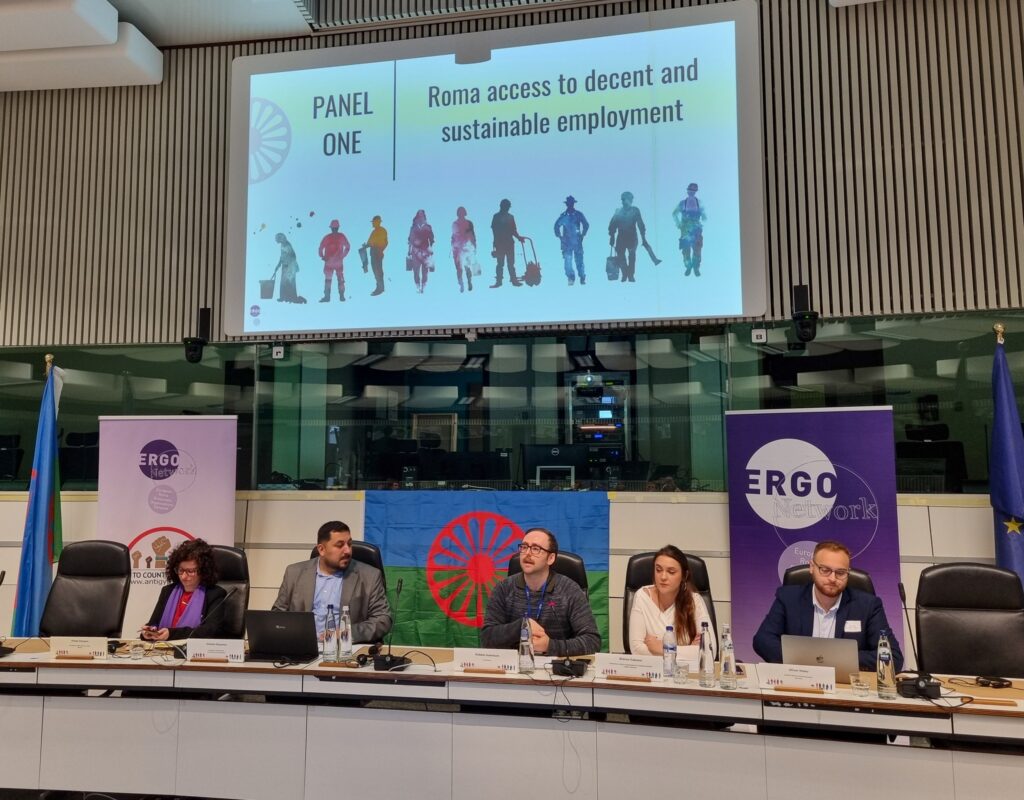
In April 2026, Roma Week will bring policymakers, Roma representatives and civil society to Brussels to debate what the next EU budget delivers - or fails to deliver - for Roma communities. ERGO Network has already published detailed recommendations on how Roma inclusion can and must be secured in the next MFF.
The analysis exists. The solutions are known. For EU policymakers, this is a test of coherence. The EU cannot call for evidence-based policymaking and results orientation while designing a budget that makes Roma communities statistically and politically invisible. Clear priorities strengthen accountability — ambiguity undermines trust.
EU institutions and Member States now face a choice: include Roma as a visible priority in the next MFF, or leave them behind through omission. MEPs and national governments should act now to explicitly name Roma, protect meaningful participation, earmark funding, enable statistical follow-up and ensure that EU funds deliver real results.
