
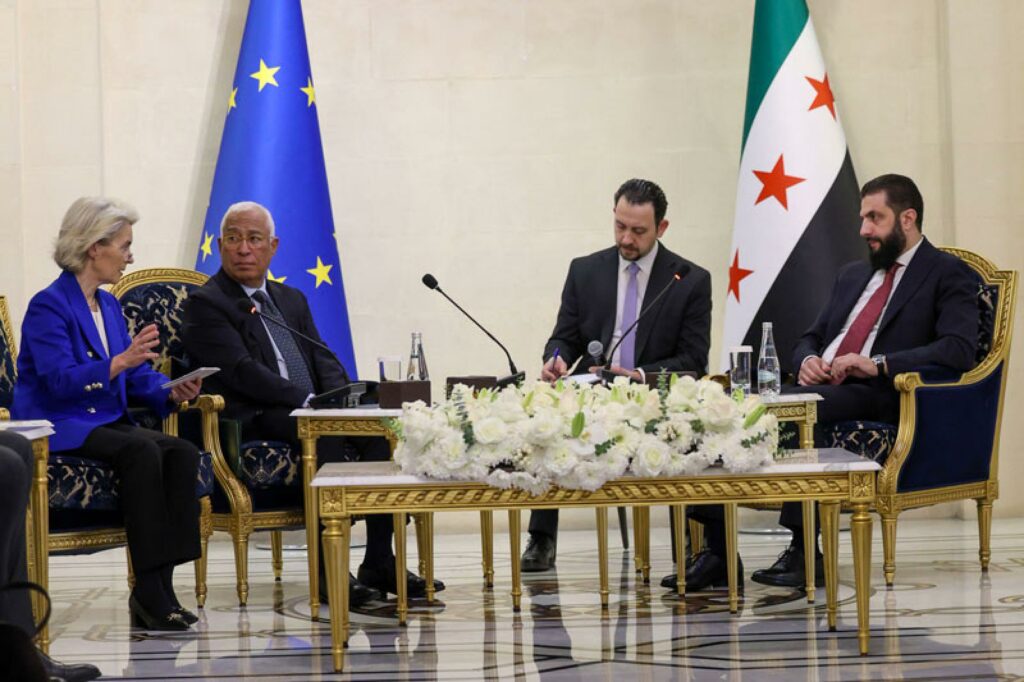
The temporary ceasefire in north-east Syria was the subject of discussion at the EU Foreign Affairs Council meeting last Thursday.
The Syrian government’s military offensive has led to the withdrawal of Kurdish-led Syrian Democratic Forces (SDF) from most of north-east Syria and left the Kurdish local self-government in turmoil and its future at risk.
The EU Foreign Affairs Council was dominated by discussions about Russia's aggression against Ukraine and the EU's contribution to the transition to the second phase of US President Donald Trump’s peace plan for Gaza. Foreign ministers also decided on the EU’s response to the Iranian regime’s brutal crackdown on protestors amid uncertainty about the regime’s survival after a possible US strike, which Iran threatens will ignite a regional war.
Under the shadow of these events, the foreign ministers also exchanged views on the latest developments in Syria. They repeated the EU’s position that an inclusive political transition and national reconciliation process are key to preventing Syria from sliding back into instability.
"Syria remains fragile. The ceasefire and the opening of humanitarian corridors are positive developments, but the country is far from stable. ISIS poses a persistent threat," said High Representative Kaja Kallas, the EU’s foreign policy chief, in her press remarks at the press conference after the council meeting.
According to Kallas, everybody agreed that inclusivity and reconciliation in Syria are problematic. However, no decisions were taken on reimposing sanctions against the regime or using other tools in the EU’s toolbox.
"What more can we do, besides reaching out to regional partners?" she asked, without mentioning names. In addition to the US, Turkey is the most important partner which has exerted pressure on both sides in Syria.
Turkey has occupied areas in northern Syria since the civil war and is still controlling them via a proxy militia. For Turkey, the fight against the terror-designated Kurdistan Workers' Party (PKK), which allegedly infiltrated the Kurdish Autonomous Administration in North-East Syria (AANES), continued despite an agreement last year about reconciliation and disarmament inside Turkey.
Kallas did mention her contact with Iraq concerning the safe transfer of IS fighters from the detention camps in north-east Syria. Iraq itself is a country with several militias which should be disarmed. But this is unlikely to happen with the pro-Iranian militias in the country, whose numbers reportedly exceed the Iraqi national army. In the case of a US strike against Iran, these militias will join the war.
"The EU welcomes the agreement reached today between the Syrian transitional authorities and the Syrian Democratic Forces," said the Commission’s foreign affairs spokesperson in a statement on Friday following the foreign affairs council meeting. "We call on all parties to implement it in a spirit of good faith and compromise."
"A full cessation of hostilities is needed to enable the provision of humanitarian aid, the protection of civilians and the return of internally displaced persons," the spokesperson added. Approximately 170,000 civilians have reportedly been displaced. The SDF’s losses are estimated at several hundred.
The new agreement, replacing previous agreements between the central government and the SDF, would require the SDF to turn over cities still held by them to the government. Kurdish forces would be allowed to join the national army as separate brigades. Syrian President Ahmed Al-Sharaa reportedly issued a decree recognising Kurdish cultural, linguistic and civil rights and making Kurdish a national language.
Uncertainty about self-government
But distrust runs deep. In a statement for the recent UN Security Council meeting on Syria, the Kurdish Autonomous Administration in North-East Syria (AANES) claimed that it was the Syrian military forces that had continued the hostilities and that the SDF had accepted the ceasefire. "It is easy in these circumstances to place blame equally on 'both parties' or call for general 'de-escalation' by both sides."
On the political future of Syria, including Kurdish autonomy or self-government, the statement noted that President Ahmed Al-Sharaa has never been elected as president but took power by force after toppling the Assad regime in December 2024. Some movement towards political freedom has taken place since then, but massacres against the Alawite and Druze minorities have also marked the transition.
"There were no elections in the North East or coastal regions. Power is concentrated in Damascus with no devolution of power to the regions. Islamic law was named as the only source of national laws. Democratic elections were postponed for five years, an inexplicably long period. In short, therefore, Syria now has an unelected president governing by decree and announcement."
Parliamentary elections for the 210 seats in the People’s Assembly were held in October 2025, but did not meet the standards of an inclusive representative democratic system. Two-thirds of the members were selected by electoral colleges, and one-third appointed by Al-Shaara. The transitional government said that the infrastructure for direct elections was not yet in place.
It remains to be seen if Al-Sharaa will keep his promises to ensure stability and enable an inclusive and peaceful transition towards democracy after the latest military offensive against AANES. The eruption of the Arab Spring in 2011 raised hopes that several countries would embark on a similar process, but all failed.
Even Tunisia, not having to deal with the aftermath of a civil war, failed. For some years, it was successful in transitioning from dictatorship to democracy and agreed on a new modern constitution. Then, economic pressures and political instability brought to power a new authoritarian president who sidelined parliamentary and judicial checks and balances.
The Kurdish autonomous administration in north-east Syria appeared to observers as a promising experiment in local self-government after the oppression during the Assad regime and the SDF’s successful fight against IS in partnership with the US. The Syrian Kurds thought that they had earned their autonomy within a new democratic Syria.
But the alleged dominance of the PKK behind the scenes in AANES played into the hands of Turkey and served as a pretext for its interference in Syria. The Trump administration abandoned the Kurds and preferred Syria’s new leader to ensure stability within its recognised borders.
The current borders were drawn up in the infamous Sykes-Picot Agreement in 1917, named after the British and French colonial officials who split the Middle East into spheres of interest after the First World War. A promise of independence given to the Kurds was not kept, and now the perspective of Kurdish local self-government in Syria with a share in state revenues seems to be off the table.
