

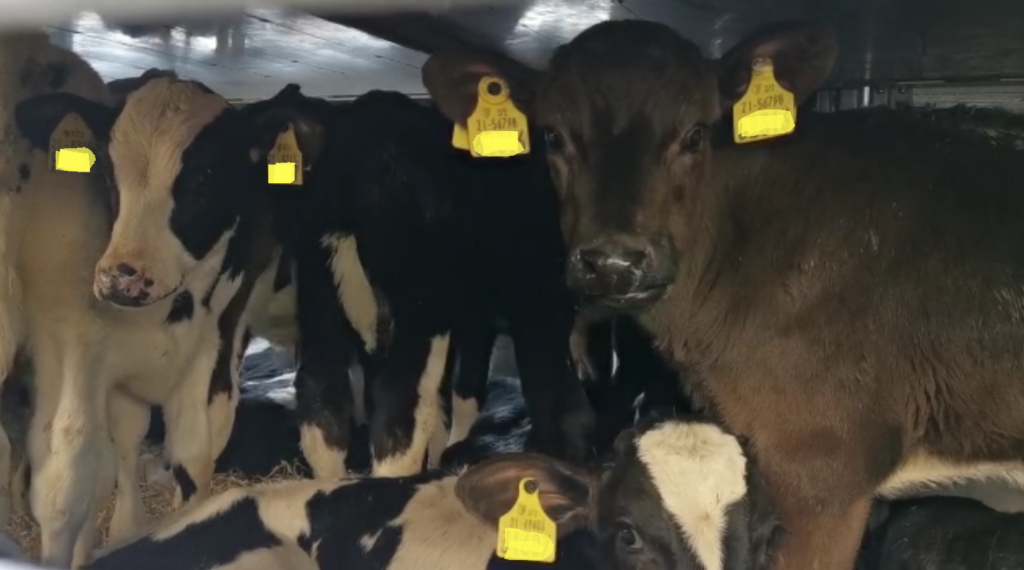
Every year Ireland exports around 200,000 unweaned calves to Europe. They travel by ferry to Cherbourg, an 18-hour journey during which they receive no food, where they spend 13 hours at a control post before continuing the journey to various Member States including the Netherlands, Spain, Italy and Poland.
This live animal transport violates EU’s existing legislation. A week ago, Ethical Farming Ireland (EFI) and 21 other animal welfare NGOs from several EU Member States, sent a joint letter to animal welfare Commissioner Olivér Várhelyi to remind him about the illegal transport and urge him to take action against the Irish Authorities for continuously breaching Regulation 1/2005 on the protection of animals during transport.
The calves are 2 – 4 weeks old, dependent on milk, but cannot be fed during transit as there are around 300 calves in each truck and they must be unloaded to be fed. They have under-developed immune systems and are prone to illnesses. Before export they spend all day at a noisy, stressful mart, mixing with animals from many farms, being exposed to all kinds of pathogens.
After the mart they go to an assembly centre where they do not get fed until the following morning. So even before the long ferry journey to France, the calves are already in a weakened state.
This has been an area of contention for decades and many NGOs have been campaigning against this trade. I have been to marts and seen tiny calves in pens with no straw bedding, no food, sometimes no water. They can be there all day, exhausted, hungry and stressed. I have seen them treated roughly, dragged by their ears and tails. I have returned to marts the following morning to be greeted by the sound of bawling, hungry calves that stayed there all night before export, with no food.
Already in 2021, EFI submitted a formal complaint to the European Commission. The response was that they cannot initiate infringement proceedings as no proof was provided that the calves are not fed during the journey.
Audit confirms non-compliance
In June 2022, the Commission conducted its own audit on the transport of unweaned calves from Ireland. The report was published in December 2023. It concluded that the journeys breach legislation as the calves are not fed within the 19-hour maximum period. The conclusion was that these journeys are not in line with the regulation.
In January 2024, EFI submitted a further complaint to the Commission, this time using its report as evidence the calves are not fed. No response was received so in January 2025 we submitted a complaint to the Ombudsman. They instructed theCommission to give an update, which they eventually did in July 2025.
The update stated the Commission is in regular contact with the Irish Authorities who claim they are close to developing an operational truck with a feeding system. But there is no such truck. Just one trial project has been conducted, in October 2023, but it was a failure.
The Irish Authorities are clearly fobbing off the Commission with promises of trucks with feeding systems that do not exist, and the Commission is clearly falling for it. The complaint is still open. Following a second joint letter of complaint in September, the Commissioner agreed to meet with us. The meeting took place on 24th September 2025 and was positive.
We recall that the Commissioner agreed with us and said that the Irish Authorities have had more than enough time to get this matter sorted. Perhaps he even hinted that an infringement procedure could be launched. When asked whether the Irish Authorities could continue exporting calves whilst conducting further trials the Commissioner said no and repeated that they have had long enough.
However, nothing has happened since then. In the meantime, the annual calf export season has started. Since the audit report was published, over 400,000 calves have had to endure these horrendous journeys. Not all of them survive the journey.
There have been four studies conducted into the export of unweaned calves from Ireland. Each study confirms that health and welfare are negatively impacted, that the calves suffer from dehydration, muscle fatigue, low energy and hyperglycaemia and that they are given courses of antibiotics upon arrival at the veal farms.
Importantly, the study on the trial with the truck with the feeding system states that “the practical use of the on-board feeding system was difficult, perhaps even impossible.” There is no point in having legislation in place if it is not enforced and Member States can pick and choose which laws to abide by and which to ignore.
It’s time the European Commission put its money where its mouth and start initiate infringement proceedings immediately. Words are meaningless if not followed by actions. How many more hundreds of thousands of tiny calves have to suffer, because nobody has the backbone to stand up to the Irish Authorities?
