
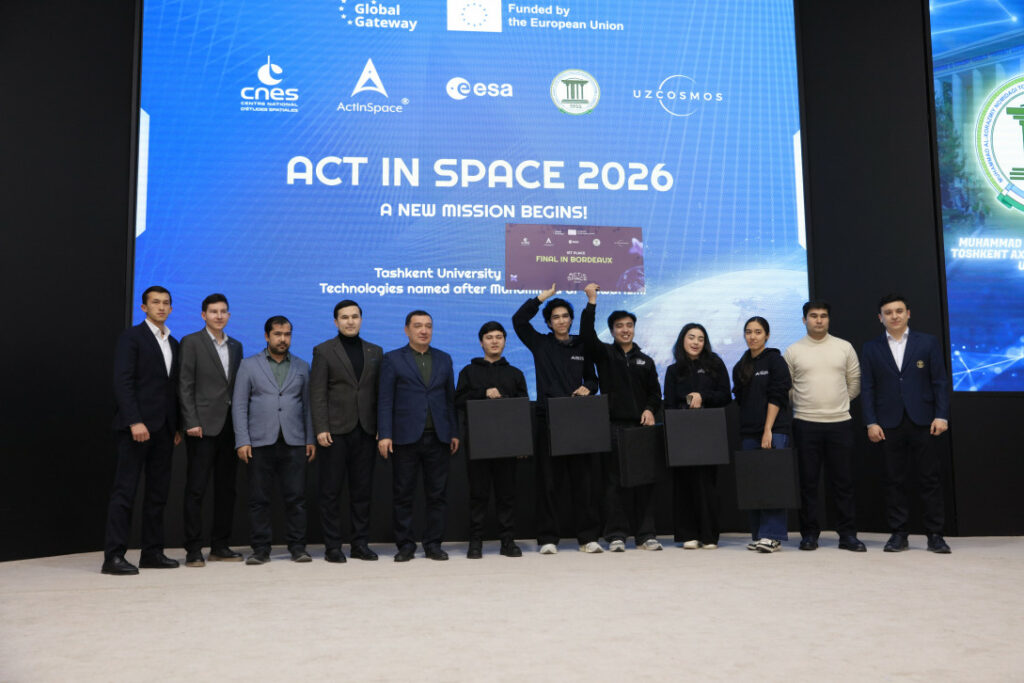
More than 200 people took part in a 24-hour space-themed hackathon in Kazakhstan and Uzbekistan at the end of January, in events organised for the first time in Central Asia by the European Union through its Connectivity for Central Asia programme.
Around 100 participants in each country joined the Act in Space Hackathon on 30 — 31 January 2026, taking part in a mentored competition focused on science, technology, engineering and maths (STEM), the European External Action Service (EEAS) announced on Wednesday.
The national events were supported by government and university partners in both countries, including Kazakhstan’s Aerospace Committee under the Ministry of Artificial Intelligence and Digital Development, the Republican Centre for Space Communication and Satbayev University.
In Uzbekistan, support came from the Space Research and Technology Agency under the Ministry of Digital Technologies and the Tashkent University of Information Technologies named after Muhammad al-Khwarizmi.
Teams worked for 24 hours straight to develop a prototype and a business plan, with remote support from the European Space Agency (ESA) and France’s space agency, CNES, which proposed challenges for participants.
Winners in Kazakhstan and Uzbekistan
In Kazakhstan, a five-person team called SUniverse won first place among 19 teams, while in Uzbekistan the five-member team NazarX won among 13 teams, after a jury selected winners from three finalists in each country.
SUniverse developed a machine learning-based classification system designed to analyse data and support decisions intended to extend a satellite’s lifetime.
NazarX designed a modular platform for building satellites using snap-together components with magnetic connectors, described as a system that could be used to build, upgrade or repair satellites on Earth or in orbit.
The winning teams are expected to present their ideas in a grand finale in Bordeaux, France, alongside winners from other countries.
The event supported youth engagement and cooperation between the EU and Central Asia, Johannes Bauer, Head of Cooperation at the EU Delegation to Kazakhstan, said in the advisory.
The collaboration was expected to contribute to developing workforce pipelines for the space sector, Olivier Stemler, Deputy Head of Mission at the Embassy of France in Uzbekistan, said in the statement.
