
Belgium is stagnating in its fight against domestic corruption, with experts noting a rising trend in Belgium with no effective government action.
As Belgium’s ruling coalition pursues its sweeping public sector cuts, Berlin-based NGO Transparency International released its annual Global Corruption Perceptions Index on Tuesday.
For the 2025 report, the international organisation scored Belgium 69/100, ranking it 21st out of 180 countries. This is the same score as 2024.
Every year, Transparency International interviews business people, risk analysts and researchers to determine how corruption is perceived in 180 countries.
The index is then calculated on a scale from 0 (extremely corrupt) to 100 (no corruption).
Transparency International has warned of worsening corruption in democracies worldwide, giving the United States its lowest score to date. Concerns were also raised about growing risks of corruption in democracies such as the United Kingdom and France.
Corruption rising in Belgium
For Belgium, the report found that most respondents believe that corruption is on the rise, and that there is no effective approach being taken by Belgium’s Federal Government in tackling it.
According to the report, officials fail to uphold fundamental principles of good governance, such as "public interest, equality and fairness", often resulting in harm to people and the environment, undermining fair competition and eroding trust in public institutions.
This is illustrated in Belgium’s score (69/100), which remains the lowest the country has ever had, having first dropped down to 22nd place last year, with the same index score, for the first time ever.
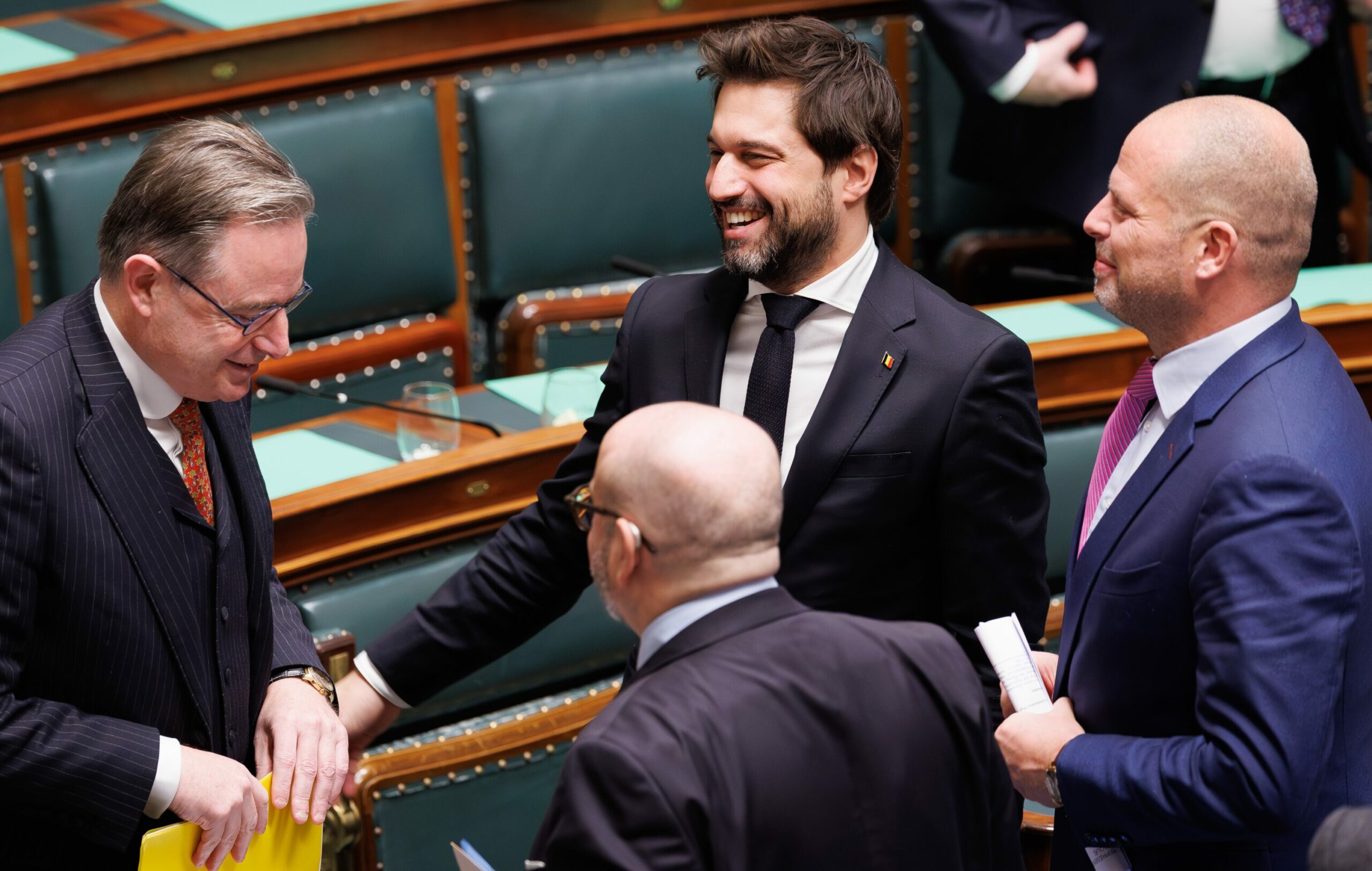
Prime Minister Bart De Wever, MR's Georges-Louis Bouchez, Minister of Interior Bernard Quintin and Minister of Defence and Foreign Trade Theo Francken at the federal parliament, in Brussels, Wednesday 26 November 2025. Credit: Belga
Prime Minister Bart De Wever (N-VA)'s Federal Government has focused its efforts on plugging the financial shortcomings from public spending cuts and socio-economic reforms, rather than combating corruption.
Previous studies have argued that Belgium loses 6% of its annual GDP, equivalent to €4 billion, due to corruption, most notably in public procurement, where the risk is seen as highest.
In its annual index, Transparency International noted that Belgium is lagging in its anti-corruption policy to prevent and detect corruption, much like the report shared last month by the Council of Europe’s Group of States against Corruption (GRECO), which offered wider insights.
This declining score for Belgium "comes as no surprise", the report notes.
"Almost every day, the media reports on powerful people in politics, administration, the judiciary, etc. who abuse their legitimate positions of power for personal gain or to benefit family, friends, a single company, etc," it adds.
What can be done?
Urgent attention is needed in preventing lobbying for personal gain, accepting gifts and presents, combining roles that result in conflicts of interest and creating revolving door arrangements.
"However, it is not sufficient to limit initiatives to regulation and codes of conduct. We must also apply them, monitor the impact of these measures and adjust them if necessary," Transparency International notes.
The NGO has called on Belgium's Federal Government to support and invest in anti-corruption measures, saying a "collective effort" is needed.
For example, on top of government-led measures, there is a need to respect, protect, and support actors who report and monitor corruption, such as civil society, whistleblowers, and the media.
Illustration picture shows rain clouds above the Brussels skyline, Wednesday 23 October 2013, in Brussels. Credit: Belga
There is also hope that the EU’s anti-corruption directive (which still needs to be voted on in Parliament and by the Member States) can be a turning point by forcing EU countries to set up national strategic anti-corruption plans.
Overall, Belgium’s decline was the eighth most significant drop recorded by Transparency International since 2016, dropping by ten points. For the eighth year running, Denmark topped the index with a score of 89.
The UK and the US marked the largest declines this year. Belgium (77 to 69) recorded the same overall drop (-8) as Sweden (88 to 80) and Hungary (48 to 40).
Within the European Union, Bulgaria and Hungary received the lowest scores. Ukraine showed one of the most significant improvements, though its score remains low at 36.
