
Human existence, at least on its negative side, can be described as an oscillation between varying degrees of discomfort and suffering.
From life-changing situations — such as the diagnosis of incurable pancreatic cancer, the sudden death of a loved one, or an unexpected breakup — to trivialities: the frustration of a tomato stain on a fresh shirt, or a colleague in the office speaking louder than we would like.
We are, to a greater or lesser extent, always at war with the present moment. We tend either to dwell on the past or to place our hopes in the future, assuming that if we can change our external circumstances, we could finally come to rest. However, this tug-of-war is largely a product of the mind, and there might be a superpower we ought to seek to break the spell of our own thoughts.
The architecture of psychological suffering
The core of our psychological distress lies in what is described as being 'lost in thought' without knowing it. From the instant we wake until we fall asleep, we are engaged in an incessant internal conversation with ourselves. This flow of consciousness is so constant that we often fail to notice it; it becomes a form of 'white noise' that nonetheless dictates our entire emotional reality. If our thoughts are angry, we feel anger; if they are depressive, we feel depression. We do not merely have thoughts; we become them. Thoughts completely colour our moment-to-moment waking experience.
This identification creates a 'sense of self' that feels like a passenger or a 'witness' trapped inside the head, looking out at a world that is 'not self'. This ego is, at its base, a kind of psychological contraction. We feel like a subject behind the face, a 'hostage' to the world and even to our own bodies. When the body misbehaves — through illness or simple fatigue — we feel as though an external entity is torturing us.
If we look closely at the mechanism of worry, we can see that it is often pointless. In any given circumstance, there is either something to be done to solve a problem, or there isn't. If there is a step to take — for instance, finding a second opinion for a medical diagnosis or fixing a mistake at work — then, by all means, take that step. If there is nothing to be done, then worry adds nothing to the situation but additional misery.
And, even if we've not been diagnosed with a terminal illness, we are all, in a sense, living with a terminal condition. Life itself is finite — we are all going to die, and we are all going to 'get the full tour' of human experience, which includes decay and loss. While it is rational to prefer an orderly, painless, and loving end, reality is often chaotic. The only place where peace can be found is in the present, regardless of external circumstances.
Framing physical suffering differently
It is a common assumption that physical pain and suffering are identical, but they are distinct phenomena. While pain is a physical stimulus — a burning, stabbing, or twisting sensation — suffering is the psychological reaction we layer on top of it.
The intensity of suffering is often dictated by the 'conceptual frame' we place around the sensation. Consider the athlete: a massive sense of soreness in the shoulder is experienced as a badge of honour if it results from a record-breaking deadlift. Contrast this with the patient: the same feeling becomes a source of agony if one suspects it is a malignancy and is awaiting biopsy results. The sensation has not changed; only the relationship to it has.
When we lack understanding of the pain or fear of the future, our thoughts amplify the experience's negativity. We begin to worry about the future — 'When will I get relief?' — rather than simply experiencing the raw sensation of the moment. We are no longer experiencing the pain of the present; we are experiencing the anticipated pain of the next ten thousand moments. In the absence of this 'lostness in thought', even physical pain can be met with an impressive degree of equanimity. We can see this in the context of deep tissue massage; it can 'hurt like hell', yet the suffering is absent because we understand the source and know the pain will cease the moment the therapist stops.
Take another simple example: someone hammering a nail through your knee. The pain is extreme and immediate. While this situation sounds excruciatingly painful and unbearable, in each second that it is happening, you are, in fact, bearing the pain. The idea that it cannot be borne is therefore almost always untrue. What is really unbearable is usually the thought of the last second and the next: whether we will get relief in an hour, in a day or a year; or whether we will be able to walk again.The 'unbearability' is a narrative we construct about the future. We are, in effect, trying to suffer for the next hour all at once.
The Buddhist parable of the two arrows
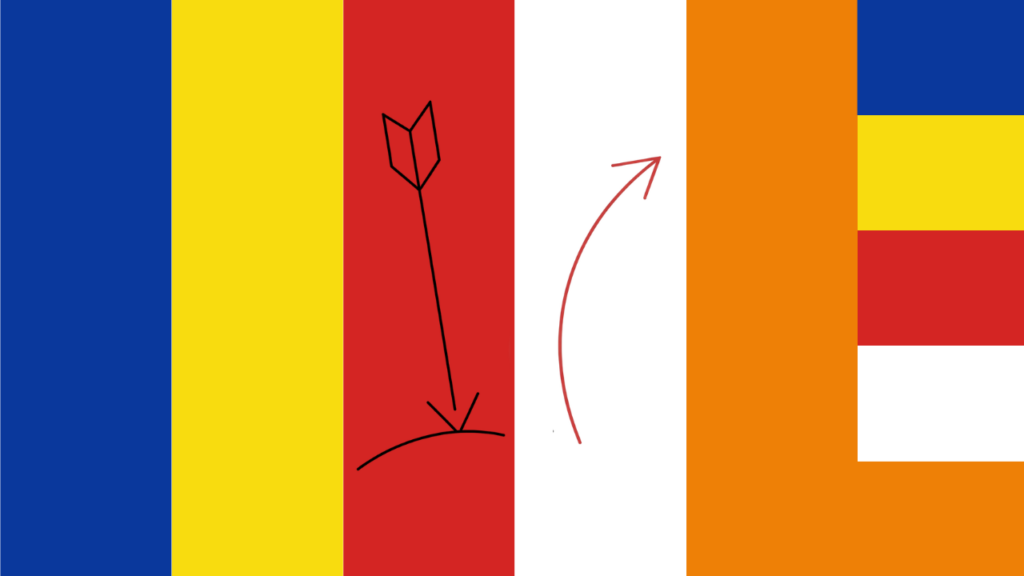
In Buddhist teachings, there is a well-known tale often called the parable of the two arrows. Imagine a man walking alone through the forest when, suddenly, he is struck by an arrow. The wound is real: his arm hurts, he is bleeding, and he is in genuine danger. This first arrow represents the pain that arrives uninvited in life — illness, loss, failure, disappointment. It is immediate and unavoidable.
But what follows is where the arrow appears. Left alone, the injured man's mind begins to race. What if I bleed to death? What if I lose my arm? What will happen to my family? None of these things have happened yet, but they hurt, nonetheless. This second arrow is not fired from outside; it is created by his own thoughts. And while the first wound causes pain, the second multiplies it into suffering.
Buddha's insight is not that we should deny reality or pretend the injury does not exist. Pain is not a failure of the mind; it is part of being alive. The problem arises when the mind resists what is already happening, piling fear, anger and imagined futures onto a present moment that is already difficult enough. The second arrow is made of 'what ifs' and 'this shouldn’t be happening'— reactions that feel natural but are rarely helpful.
We may not have the power to stop the first arrow from striking, but we do have a choice about the second. Suffering begins where resistance begins. When we meet pain with kindness, acceptance and clarity — rather than panic and self-blame — we stop ourselves from deepening the wound.
By practising meditation, we can break the 'automaticity' of thinking. Instead of being swept away by the content of a worry, we observe the process of worrying itself. In that moment of observation, the 'spell' is broken. The identification with the thought vanishes, and we realise that the 'I' who was supposedly suffering was merely another thought appearing in consciousness.
This state of profound psychological release was perfectly described by Padmasambhava, the 8th-century master who helped establish Buddhism in Tibet. He observed that when one truly settles the mind, 'thoughts become like thieves entering an empty house'. It is a staggering metaphor for the end of suffering. In an 'empty house' — a mind that has seen through the illusion of a solid, vulnerable ego — there is nothing for a negative thought to latch onto. A thought of anxiety or regret may enter the room, but finding no 'owner' to terrify and no 'possessions' to steal, it simply leaves.
Whether we are facing a family tragedy or the minor sting of being 'ghosted', the mechanism of suffering remains the same: it is the 'thought about past and future', the regret from the past, and the expectations from the future. Arguably, much of our psychological suffering could therefore be avoided. Suffering may be an inherent part of the biological package, but the psychological torment we build around it is, with enough practice, almost entirely avoidable.
