
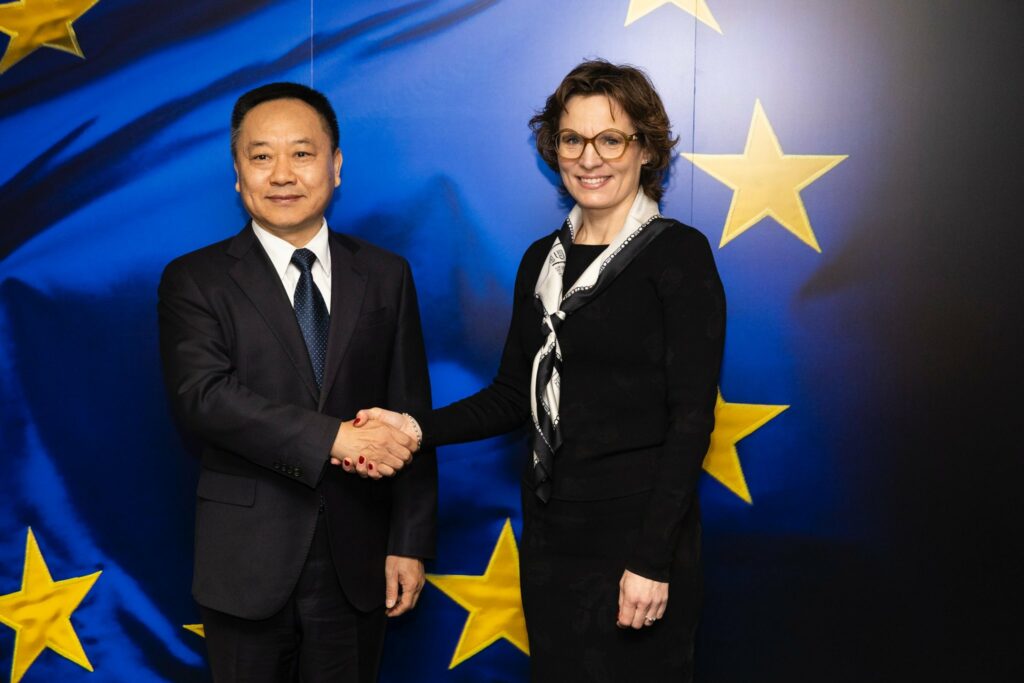
The EU and China have pledged urgent measures to address growing water stress as EU Environment Commissioner Jessika Roswall and China’s water resources minister Li Guoying co-chaired the third EU–China Water Policy Dialogue in Brussels on 2 February 2026.
The talks covered how climate change affects water availability, quality and distribution, and how water systems can support both cutting emissions and adapting to climate impacts, the European External Action Service (EEAS) informed in a statement on Wednesday.
Roswall presented the EU Water Resilience Strategy, which the European Commission says is designed to restore and protect the water cycle, improve access to clean and affordable water and sanitation, and support a “water-smart” economy.
Li outlined China’s water governance approach, including raising agricultural water efficiency, reducing industrial wastewater discharge and cutting water losses from municipal leakage.
Digital tools and UN conference planning
The EU described a “Water Efficiency First” principle that encourages EU countries to prioritise reducing demand and improving efficiency before increasing water supply, according to the EEAS statement.
Digital approaches were also discussed, including EU plans for a Digitalisation Action Plan for the Water Sector and a Copernicus Water Thematic Hub, described as a “one-stop-shop” for water data.
China presented work on a “digital twin” master plan for water management — a digital model used to support planning and operations — with examples cited in flood management and water allocation.
Roswall said global water demand is projected to exceed available resources by 40% by 2030, adding that droughts and floods are becoming more frequent and intense due to climate change.
The two sides also discussed preparations for the UN 2026 Water Conference, including the outcomes of a high-level preparatory meeting held in Dakar, Senegal, on 26–27 January.
They agreed “tangible deliverables” including continued technical cooperation on climate-resilient river basin management, water efficiency and conservation, resilience to floods and droughts, and water restoration, to be carried out with EU member states through the China–Europe Water Platform and the EU–China Cooperation on Water Project.
