
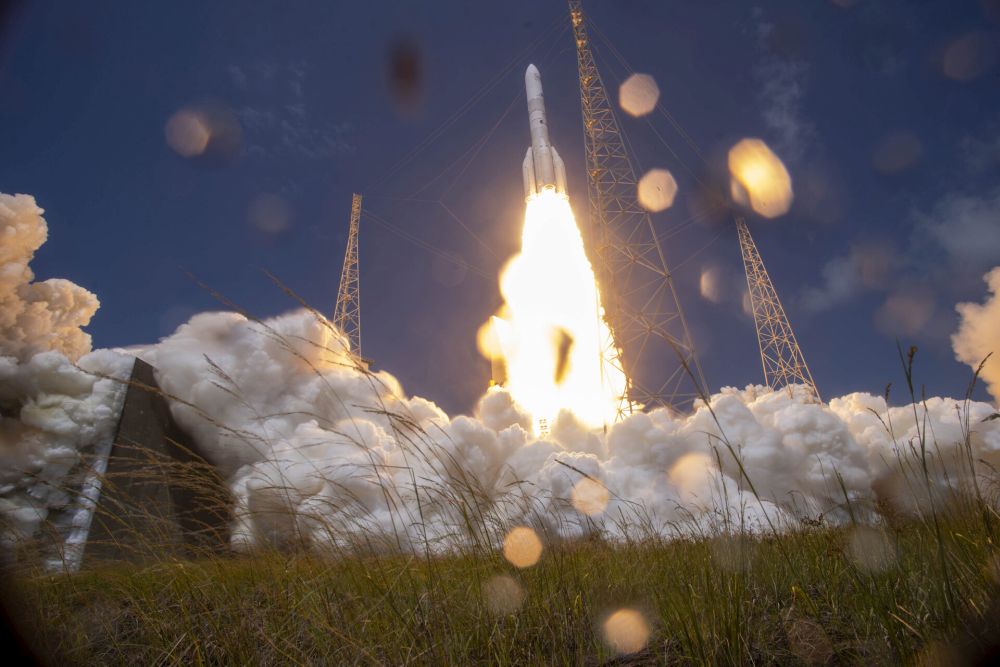
The Ariane 6 rocket has flown for the first time in its four-booster configuration, placing 32 satellites for Amazon’s Leo constellation into low-Earth orbit from Europe’s Spaceport in French Guiana.
Liftoff took place at 16:45 GMT (17:45 CET) on 12 February, and separation of the last satellite occurred after 114 minutes, the European Space Agency (ESA) announced on Thursday.
The flight used four P120C solid rocket boosters alongside the core stage, in a version known as Ariane 64.
Ariane 64 can carry around 21.6 tonnes to low-Earth orbit, compared with about 10.3 tonnes for the two-booster version.
The launcher’s fairing — the protective nose cone that covers the payload during ascent — measured 20 metres, making the rocket 62 metres tall, roughly the height of a 20-storey building.
Satellite deployment and deorbiting
ESA said the upper stage’s auxiliary propulsion unit enabled a “quick deployment” of the 32 satellites, with separation completed in under two hours from liftoff.
The upper stage was then fired a third time to deorbit it, in line with a “zero debris approach.”
Josef Aschbacher, ESA’s Director General, said upgrades were already under way for future flights, starting with the planned launch of ESA’s Plato mission on an upgraded Ariane 6.
Toni Tolker-Nielsen, ESA’s Director of Space Transportation, said the launch showed Ariane 6 in its most powerful version and that Europe’s rocket fleet includes Vega-C, Ariane 62 and Ariane 64.
Arianespace operated the mission, while CNES, the French space agency, manages range operations at the launch site in French Guiana.
