

The flowers are out. The chocolates are wrapped. And, in what may be the most Brussels romantic gesture imaginable, the Brussels-Capital Region has finally gone “official” with a new government—after 613 days of will-they-won’t-they negotiations.
Yet, as tempting as it sounds, this is not your neat, happy rom-com Valentine’s Day story. Brussels doesn’t do neat. Brussels does complicated. Brussels does bilingual, 19 municipalities, and a parliament split into language groups. Brussels does surrealism as a default setting.
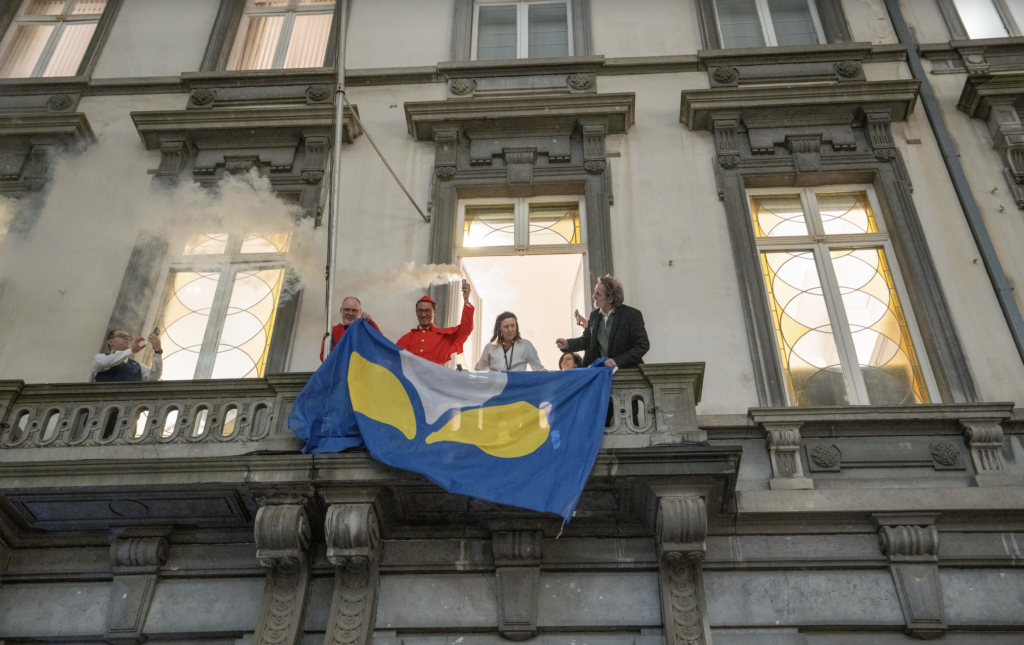
So, of course, when the deal finally landed late Thursday, it arrived with a “conclave,” the promise of white smoke, and even a Belga-shot moment featuring a man dressed as a cardinal. And so, on Valentine’s Day, Brussels didn’t just find love. It found a coalition.
ACT I : The meet-cute that turned into a slow-motion breakup
It started with the June 2024 regional elections. Brussels did what Brussels does—it produced a fragmented political map and then asked it to behave like a stable couple. With 89 seats split into two political worlds—French-speaking and Dutch-speaking—that had to assemble separate majorities and then agree with one another, the Brussels Parliament was designed to guarantee representation for the Dutch-speaking minority in Brussels and protect balance. Yet the same design rewarded stalemates. And this time, with no immediate way of reaching a double majority, it produced one.
ACT II : The “It’s complicated” phase
By late 2025, Brussels wasn’t just without a government. It was breaking records. And not the fun, flattering kind. Brussels surpassed Belgium’s infamous 541-day federal formation record from 2010-2011 and kept going. The pressure kept going, civil society groups and residents protested, and the financial situation kept growing more dire. Caretaker governance and provisional budgets became the norm, with a coalition proposal that would entangle itself at every turn—after months of talks, the same basic coalition formula kept resurfacing like an ex who says they’ve changed. A seven-party constellation was tried three times, each time collapsing under the same structural contradictions.
ACT III : The third wheel named N-VA—and the veto that finally cracked
Brussels became paralyzed by the question of whether the Flemish nationalists N-VA should be part of the Brussels coalition—even though it held only two seats in the regional assembly. For the Francophone Socialists (PS), N-VA was a red line. For months, the Flemish liberals (first Open VLD, later Anders) treated N-VA’s inclusion as the price of entry. This was the Brussels version of a couple arguing about a ménage à trois. And then, this week, it moved. Anders dropped its veto—the “no government without N-VA” condition—and suddenly excitement filled the air.
ACT IV : The conclave, the smoke, the proposal
On Tuesday morning, the seven parties went into conclave under the direction of Georges-Louis Bouchez (MR). The condition was straightforward: no one leaves without a credible path to a balanced budget by 2029. And on Thursday evening, the white smoke went up, and they emerged with an agreement. A double majority—Brussels didn’t just get a government; it got one that actually fits Brussels’ legal architecture.
End Scene : Dilliès I love, Brussels-style
With MR emerging as the largest Francophone force after the 2024 vote, the coalition structure reflected a symbolic turning of the page from the long era in which Brussels’ regional leadership was anchored by Socialist dominance. It is a coalition that screams ideological odd couple—and a deliberate Brussels-first separation from federal politics.
On Valentine’s morning, the last piece fell into place—Boris Dilliès (MR), mayor of Uccle, was named Minister-President, launching the Dilliès I government. The ministers of the Dilliès I government then took their oaths and Boris Dilliès headed to meet the King.
But the hard part isn’t forming the coalition after a 613-day courtship. It is governing Brussels for the remainder of the three-year legislature—and proving it wasn’t just political theater.
A normal love story ends with commitment. A Brussels love story ends with commitment and a governance structure requiring a double majority, language-parity rules, and a carefully distributed set of competencies that everyone insists is perfectly logical.
Still, there is something symbolic about the timing. Valentine’s Day is about choosing—publicly—what you’ll keep working on privately. Brussels, this Valentine's Day, chose itself. Not because it suddenly became easy, but because the alternative was watching the city slide further into dysfunction while everyone argued about who was most to blame.
And that’s the real romance. Not the white smoke, not the theatrics, not the headlines.
It’s whether Dilliès can turn 613 days of drama into the least glamorous form of love there is—showing up, doing the budgeting, fixing the bins, managing the trams and buses, making the institutions work, and keeping the city livable—together.
Brussels didn’t need a perfect match. It needed a government that lasts past the honeymoon.
Today, it finally got the chance to try.
