
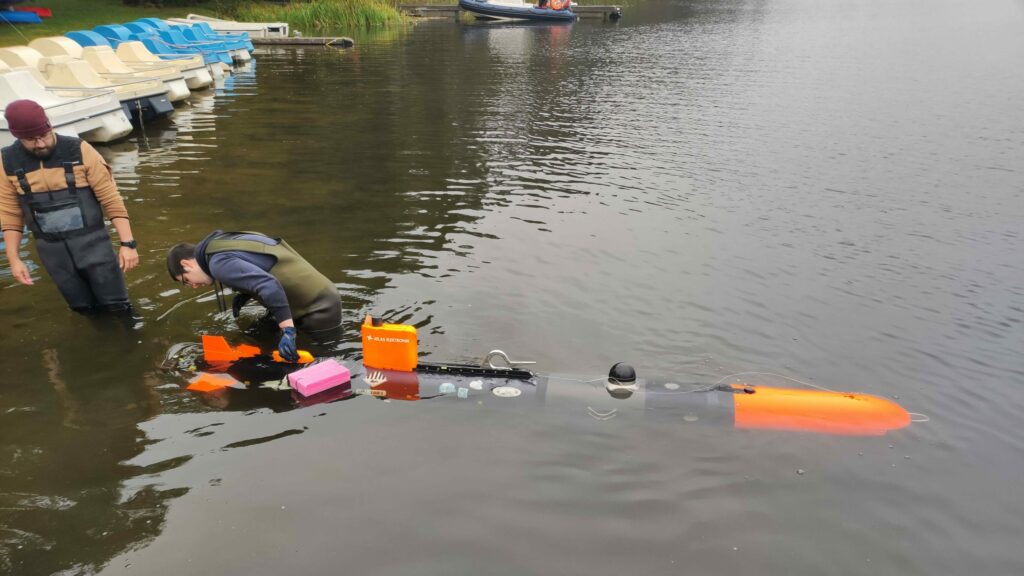
The European Defence Agency has completed the second stage of a four-year project to develop coordinated swarms of autonomous underwater drones, concluding in early February 2026.
The Swarm of Biomimetic Underwater Vehicles (SABUVIS II) project set out to move beyond deploying separate drones by developing autonomous underwater vehicles, known as AUVs, that can operate together as a single system, the EDA said in a statement on Wednesday.
Work was managed by the agency with a budget of €3.7 million and involved four EU member states, led by Poland with Germany, Portugal and Slovenia contributing.
The project focused on challenges specific to operating underwater, including the fact that satellite tracking does not work below the surface, communications capacity is limited, delays are high and conditions can be unpredictable.
Field demonstrations were carried out in Poland, Germany and Portugal during REPMUS 2025, with tests of mixed swarms in real-life conditions.
Those trials tested coordination of swarm movement, data exchange, formation control and adaptive mission execution.
Tests and technologies behind the swarm
The work also included integrating different systems through command-and-control, often shortened to C2, to allow vehicles from different countries and manufacturers to work together, the EDA said.
SABUVIS II built on earlier work including the EDA’s SALSA project, which developed adaptive technologies for underwater acoustic networks — systems that use sound to pass information through water — to support connectivity and data exchange between multiple autonomous platforms.
The project developed and assessed three concepts: scalable lower-cost AUV swarms, biomimetic vehicles designed for manoeuvrability in shallow coastal waters, and mixed swarms combining underwater vehicles with autonomous surface vehicles.
The European Defence Agency declared it considers the results relevant to future naval tasks including intelligence, surveillance and reconnaissance, protecting critical maritime infrastructure, harbour security and high-risk operations.
