
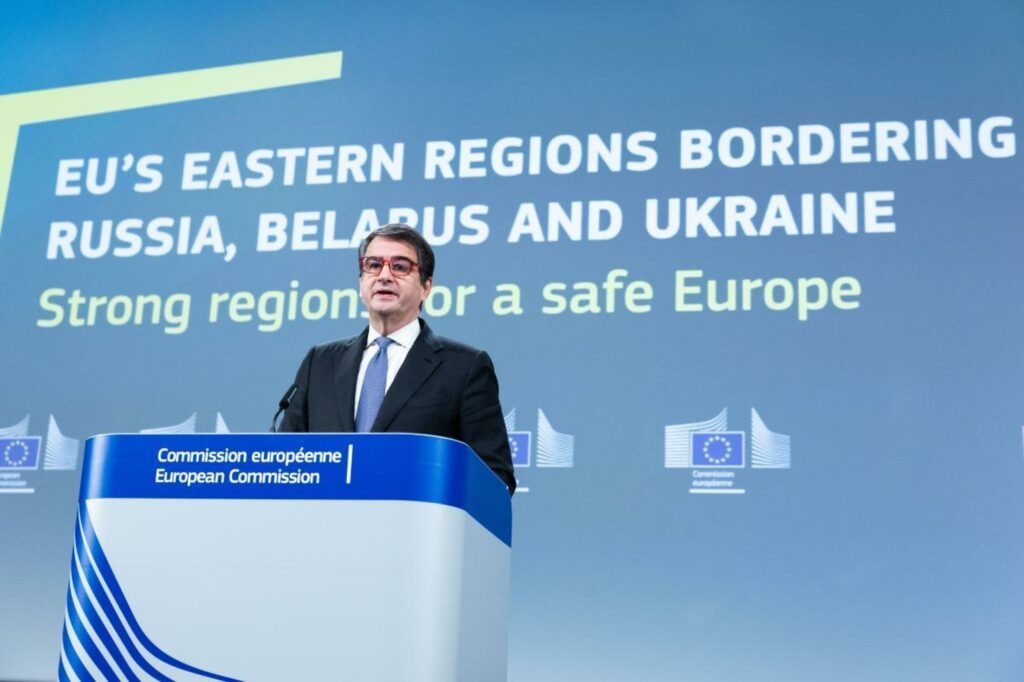
The European Commission has announced a plan to bolster security, economic resilience and living conditions in EU regions bordering Russia, Belarus and Ukraine.
The measures cover parts of Finland, Estonia, Latvia, Lithuania, Poland, Slovakia, Hungary, Romania and Bulgaria, the Commission announced on Wednesday.
Communities in these areas have been affected since Russia’s full-scale invasion of Ukraine, including through security threats, economic disruption, pressure on local services and demographic decline.
The EU has provided political, technical and financial support to its eastern regions since 2022, including work to improve infrastructure, boost economic resilience, develop defence capabilities, and address energy and connectivity challenges.
Trade flows have also been supported through the EU-Ukraine Solidarity Lanes — routes set up to help move goods between Ukraine and the EU.
Five priority areas and new dialogue planned
The Commission’s plan sets out five priority areas, including security and resilience measures such as the Eastern Flank Watch, the European Drone Defence initiative, the European Air Shield and the European Space Shield.
Other areas include improving access to funding — including through cooperation with the European Investment Bank and the World Bank — alongside work on transport and digital connectivity upgrades.
The programme also includes actions aimed at depopulation and labour shortages, including initiatives such as an EU Media Resilience Programme focused on media literacy and resilience to disinformation.
To track progress, the Commission will launch an annual political dialogue on the impact of EU actions on the resilience and development of the eastern regions, with the first event scheduled for 26 February 2026, when financial institutions are due to sign a declaration on the EastInvest Facility.
