

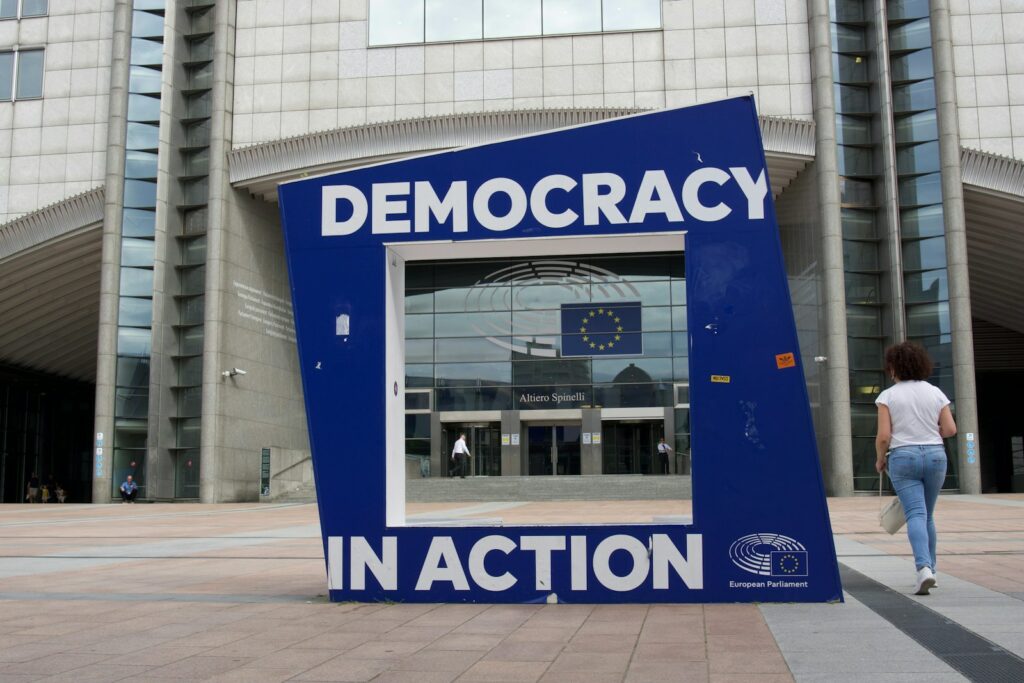
The EU steps up efforts to defend democracy with the launch of a new centre. There is an important opportunity here to scale up what works, and get bang for our buck, but for that policy- makers need to avoid a talk-shop trap.
Every day, the headlines show us a world that is ever more dangerous for democracies. From Russian missiles raining down on Ukraine, to US administration mayhem, to political violence on the streets of democratic countries, extremism has been on the rise. For over a decade, policy-makers and campaigners working in this field talked about “democratic backsliding”. In recent years we’ve gone from sliding to tumbling down a cliff-face. Now is the time for big bold solutions.
And this week, the European Commission has launched the Democratic Resilience Centre, which was promised within the Democracy Shield strategy. The Centre is intended to bring together national governments, civil society, and experts, to be able to counter information manipulation, enforce relevant EU law more effectively, and, as the name suggests, make democracy more resilient.
However, much of the details, and the broad-strokes, still remain to be worked out. The Commission is moving quickly here, which is most welcome given the urgency of the problem. However, many in Brussels and in capital cities are still looking to find out where the move is heading. This is a moment of great opportunity, but also great risk.
What is at stake now?
There is a serious inherent danger in the idea of the Centre: set up a talking shop, have the movers and shakers spend their limited time talking about how this thing should run, about governance, blueprints and fine print, and nothing much will happen. If it rolls out the wrong way, the Centre could become a liability, a distraction, and a time-sink. And again, given the urgency and severity of the problem, that must not happen.
There is however, lots of serious, timely, and crucially important work to do in coordinating democratic resilience. A stakeholder forum for practical exchange between national governments. Civil society, experts such as open source intelligence analysts, practitioners in media, the tech sector, and academia is much needed to make sure best practice is shared and implemented, and to make sure real action is taken in the right directions.
That kind of whole-of-society cooperation is necessary for disrupting disinformation campaigns and influence operation, building up media literacy, and innovating democracy from the ground up. The Centre must become a Scale-Up Centre for Democratic Resilience. Over the years, the EU has spent lots of money on countering disinformation, media literacy education, citizen participation, and more. These have usually been small, stand-alone, time-bound projects.
Some delivered great results, others less so. The key now is not to reinvent the wheel, but to look at what works well, and scale it up strategically. The Centre needs to enable coordination to be able to direct EU and national government funds, across programmes and budget lines, so that resources go where they need to go effectively.
Anyone who looks at the level of organised information threats against European democracy and compares it to the level of resources being spent on concrete timely action to counter them will most likely end up spending sleepless nights with concern. There is no question that in order for the EU and national governments to walk the walk of democratic resilience, more resources are needed.
These include strategically leveraging the EU budget - from the proposed European Competitiveness Fund, to Cohesion Funds, REARM and SAFE, and defence spending at national level, to tech investment, and more. Because resilience is to do with all of those things, and needs to be funded properly - including in the next long-term EU budget.
Spending on defence, countering hybrid threats, and information manipulation, should go hand in hand with investments in media pluralism, and citizen engagement. These might seem like abstract concepts, but they involve every person in Europe who takes out their smartphone to go on social media.
The Centre for Democratic Resilience should play a crucial role making sure money matches expectations, and funds are deployed for maximum impact, scaling up what works, coordinating between national and European levels across different programmes. If the EU achieves that, we might be able to break the democratic tumble, and plot a path upwards.
