
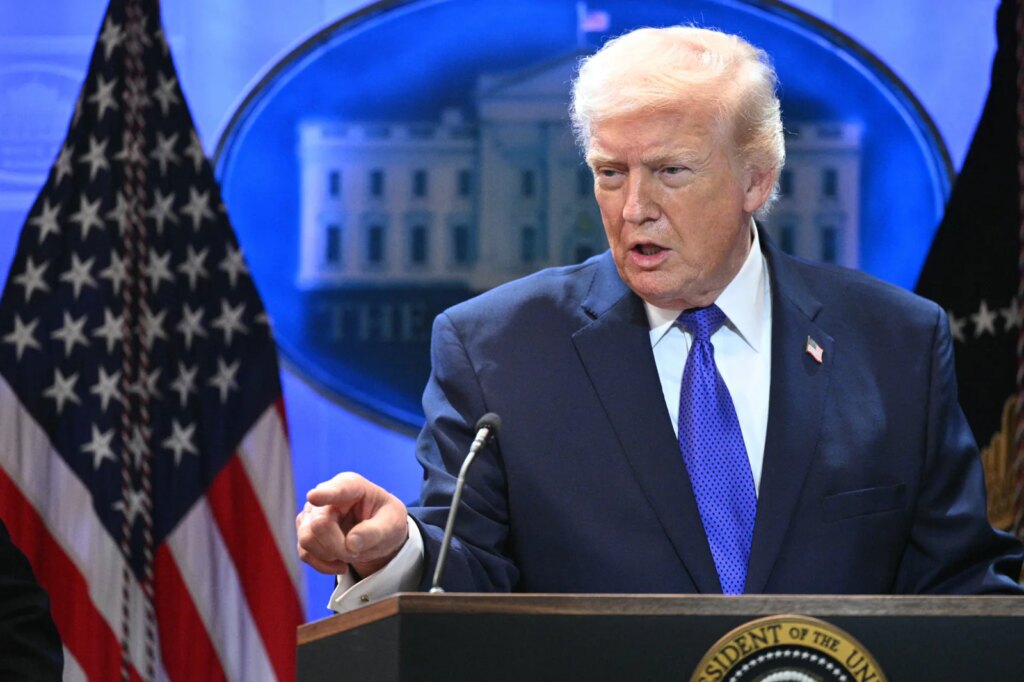
Donald Trump likes to call himself “Tariff Man” and even “king”. And the US president has repeatedly used executive privilege to threaten and impose sweeping import duties at will.
But on 20 February, the US Supreme Court ruled that his use of particular emergency powers to “unilaterally impose tariffs of unlimited amount, duration and scope” on all and sundry was illegal.
That setback throws much of Trump’s trade strategy into chaos, deprives him of his favourite form of geopolitical leverage and constrains his freedom of action going forward. He is not, after all, an absolute monarch when it comes to commerce.
The justices’ ruling also casts doubt on the many trade agreements that are premised on Trump’s unilateral tariffs – not least his one-sided deal with the EU that was struck at his Turnberry golf course in Scotland last August.
But while the Supreme Court’s willingness to stand up to Trump is good news – not least for Americans worried about their country’s accelerated slide into authoritarianism – it does not prevent Trump achieving his protectionist aims by other means. Indeed, if it prompts Trump to lash out and other countries to retaliate, it might even end up making matters worse.
Tariff powers
The US constitution assigns the power to raise taxes – including on imports – to the legislative body, Congress. But Congress has passed various pieces of legislation that give the president powers to impose tariffs in certain circumstances and subject to various conditions.
Until now, Trump’s weapon of choice had been the International Emergency Economic Powers Act (IEEPA) of 1977. This gives the president extraordinary powers to regulate international commerce after declaring a national emergency.
Trump used it to claim that a “public-health crisis” caused by imports of fentanyl, a deadly drug, justified punitive tariffs on China, Mexico and, absurdly, Canada.
He targeted Brazil with an additional 40% levy for “harming US companies, the free speech rights of US persons, US foreign policy, and the US economy.” And he would also most likely have used the IEEPA to impose the tariffs that he threatened against the eight European countries that stood up to his threats to annex Greenland from Denmark.
Above all, Trump used the IEEPA to assert that “large and persistent” trade deficits warranted the imposition of “reciprocal” tariffs on imports from most countries starting from “Liberation Day” on 2 April last year. Trump then used those higher levies as leverage to negotiate trade deals with many US partners, including the EU.
But the Supreme Court has now ruled that the IEEPA, which “contains no reference to tariffs or duties”, does not authorise the president to impose tariffs after all. The justices’ decision thereby struck down Trump’s “reciprocal” tariffs and called into question all those trade deals.
Trump immediately responded by invoking another piece of legislation, Section 122 of the Trade Act of 1974, to impose a temporary 10% global tariff, with some product exemptions. This could potentially rise to 15% soon, as Trump had seemingly announced on the weekend.
The premise for this new levy is that the US faces a “large and serious” balance-of-payments deficit: its current-account deficit was some 3.5% of GDP last year. This too is open to legal challenge, since the act authorises action in response to international payments difficulties that the US does not face. But in any case, a Supreme Court ruling would take time, so this seems set to stand.
The new tariffs will remain in force for 150 days from 24 February, after which they can only be extended with congressional approval. While Trump’s Republicans have a majority in both the Senate and the House of Representatives, the unpopularity of tariffs with American voters, who rightly believe that they push up prices, means that this is not a foregone conclusion, especially with the midterm congressional elections in November looming.
Indeed, as Bill Emmott rightly observes in his Global View newsletter on Substack, “One reason for the unpopularity of tariffs is now likely to come into the spotlight as companies and business associations ready themselves to claim refunds of the $142 billion (€120 billion) in tariffs that was paid out last year, according to estimates from the Yale Budget Lab.”
“It is an open question as to who should receive those refunds, one now likely to be played out over months and years in an array of cases in lower courts: did US importing companies pay the tariffs or did their customers pay them through higher prices?
What is certain is that contrary to Trump’s repeated claims, no foreign country has paid even a cent of these tariffs. They may have suffered some reduction (or likelier diversion) of their export trade, but they have not paid the tariffs.”
In addition to the new 10% global levy, Trump also initiated accelerated investigations under Section 301 of the same 1974 act into “certain unreasonable and discriminatory acts, policies, and practices that burden or restrict US commerce”.
The scope of the new probes is huge. According to US Trade Representative Jamieson Greer, “we expect these investigations to cover most major trading partners and to address areas of concern such as industrial excess capacity, forced labour, pharmaceutical pricing practices, discrimination against US technology companies and digital goods and services, digital services taxes, ocean pollution, and practices related to the trade in seafood, rice, and other products.” The upshot could be a panoply of new tariffs and trade restrictions.
Meanwhile, the sectoral tariffs that Trump imposed using Section 232 of the Trade Expansion Act of 1962 remain in place. This gives him the power to impose tariffs on excessive imports that are deemed a threat to national security.
He has used that authority expansively to raise sectoral levies on imports of aluminium, buses, cars and car parts, copper, furniture, lumber, steel, timber and trucks. Who knew that IKEA tables and chairs were actually a threat to US national security?
He has also launched investigations with a view to imposing tariffs in nine other sectors, including aviation, pharmaceuticals and semiconductors.
In short, Trump is not short of options to rebuild his tariff wall. But Section 122 tariffs are time-limited and capped at 15%, while Section 301 and Section 232 ones require time-consuming investigations. So, what he has lost for now is the ability to threaten outlandishly high tariffs for geopolitical leverage in an effort to bludgeon other governments into quick concessions.
That said, a fallback option is to use Section 338 of the Smoot-Hawley Tariff Act of 1930. This permits the president to impose tariffs of up to 50% if a country “discriminates” against American commerce, a power that has never been used by so far.
International impact
The immediate impact of the new 10% global tariff is to level the playing field for countries that export to the US. The biggest beneficiaries are the likes of Brazil and China, which previously faced much higher US tariffs than the rest of the world. Within Europe, the UK’s 10% baseline rate used to give it a relative advantage over the EU’s 15%, but for now both face the same rate.
There is also renewed uncertainty about how the pattern of US tariffs will evolve. Will the 10% global rate become a 15% one? Will it be renewed by Congress in July? Will the accelerated Section 301 investigations be complete by then? If so, what additional tariffs will be imposed? What tariffs are in the pipeline from the Section 232 sectoral probes? And so on.
In particular, there is fresh uncertainty about the many trade deals that Trump struck last year. Part of the leverage that he used to achieve them – the higher IEEPA “reciprocal” tariffs – is gone. Insofar as countries made painful concessions to obtain a lower baseline tariff – as the UK did to get a 10% rate – they now feel short-changed. The European Commission has requested “full clarity” about the status of the Turnberry deal, demanding that the US honour it.
The broader question is whether Trump’s leverage is permanently reduced – in which case it might make sense to jettison the deals – or whether it is merely temporarily compromised, in which case it might make sense merely to delay them.
India has already decided to drag its feet on ratifying its deal with Trump. The European Parliament also seized on the renewed uncertainty to pause ratification of the Turnberry deal.
The risk with delaying, let alone attempting to renegotiate, is that it will provoke Trump to escalate. “Any country that wants to play games with the ridiculous Supreme Court decision, especially those that have ripped off the US for years, and even decades, will be met with a much higher tariff, and worse, than that which they just recently agreed to,” the US president growled.
After all, the US has many forms of leverage over most countries. These include sectoral tariffs on the likes of steel and cars, financial sanctions, and in the case of traditional allies such as Europe, Japan and South Korea, the threat of compromising their security by withdrawing the US nuclear umbrella and abandoning Ukraine.
Simon Evenett of Global Trade Alert, a trade-policy monitoring watchdog, argues that “In important respects, the Supreme Court’s ruling does not diminish the leverage available to the US administration; it replaces one set of threats with another.”
He adds that “Observers who have followed US trade policy since 2017 will recognise the pattern. Legal constraints are encountered, workarounds are found (eg, resort to national security rationales for tariffs), and the pressure on trading partners to make concessions is maintained by other means… The underlying dynamic of American trade policy – the systematic deployment of uncertainty as leverage as America retreats from the world trading system – remains entirely intact.”
Set against that, some countries may regret their earlier acquiescence to Trump’s bullying and seize the opportunity to take a tougher line in a bid to strike a better deal.
One surprising aspect of the response to Trump’s initial wave of tariffs last year was how few countries retaliated. Only Canada to a certain extent and China to a major extent fought back. Instead, most governments rushed to negotiate flimsy deals in a bid to reduce the “reciprocal” tariffs that Trump had imposed. The Turnberry deal with the EU involves it acquiescing to an additional 15% US tariff on its goods exports while also abolishing its own duties on imports from the US.
If one accepts Trump’s premise that international trade is a zero-sum game in which exports are good and imports are mostly bad, that absence of retaliation was a win for Trump, politically at least. All the deals demonstrated his power.
Only China forced him to back down thanks to its chokehold over processed rare-earth mineral supplies that are essential for many manufacturing processes. Economically, though, tariffs primarily harm the importing country, so the US is actually worse off as a result of Trump’s deals.
Since then, however, the belief has taken hold that “Trump always chickens out” (also known as “Taco”) if markets take fright, or if he faces resistance. Many Europeans seem to believe that their collective stand against his Greenland annexation threat caused him to back down, although Denmark believes the retreat is only tactical.
Indeed, Wolfgang Münchau, the editor of the Eurointelligence newsletter, believes the European Parliament’s move to postpone ratification is merely a pretext – and a risky one at that.
“Whenever you enter a trade agreement, there is always the legal uncertainty that a court might challenge it," said Münchau.
"Imagine a situation where Latin Americans refuses to ratify the Mercosur deal on the grounds that the European Parliament’s recent decision to refer the issue to the European courts created chaos. The chaos argument is a pretext. The EU could have ratified the deal, conditional on the US fulfilling its side of the bargain.
"It would appear to us that they don’t want to ratify a deal they don’t like. It is their right, of course. But the fundamental issues have not changed. The EU is still running a large surplus with the US. The EU member states depend on the US even more heavily for critical defence goods, and that dependency has become stronger as EU member states spend more money on defence.”
Takeaway
It is understandable that Trump’s tariff setback creates the temptation to stall and perhaps even renegotiate the one-sided trade deals the EU and others struck last year.
But the wisest strategy would be for countries to accelerate their plans to reduce their dependence on the US, notably by diversifying their economic relationships away from the US – and in the case of the EU and the UK, by building up their ability to defend themselves against Russian aggression too.
