The EU needs a defence industry that can react faster and produce more equipment to take greater responsibility for its own security and keep supporting Ukraine, a conference at the European Parliament heard.
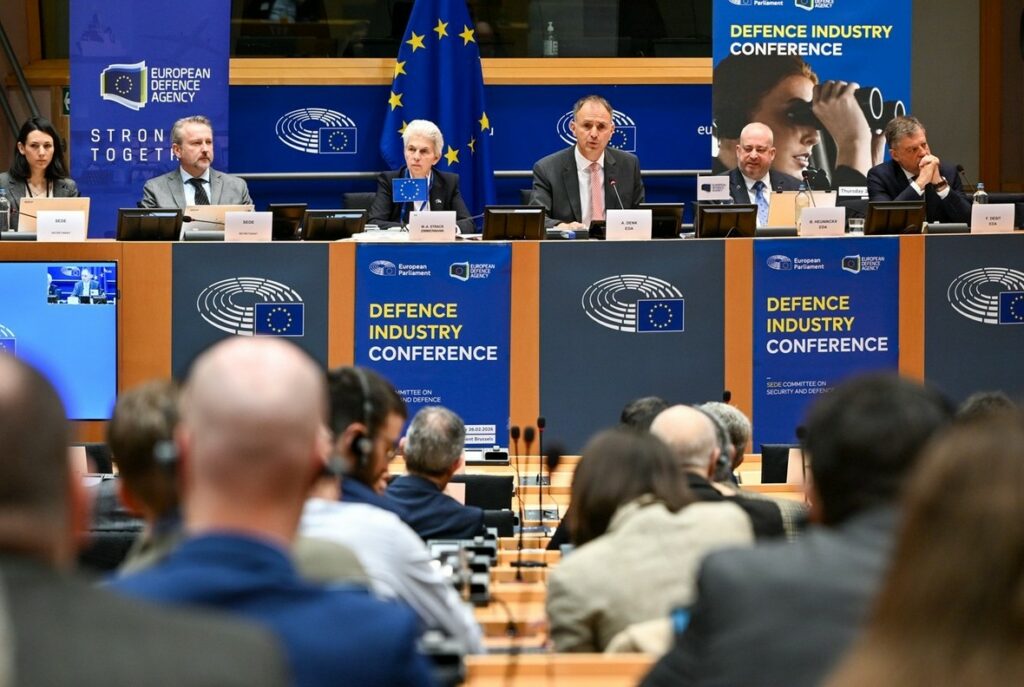
The European Defence Agency (EDA) hosted the defence industry conference in Brussels on 26 February, bringing together EU member states, industry representatives and EU officials to discuss Europe’s defence capabilities, the EDA reported on Thursday.
Talks focused on speeding up work under the Defence Readiness 2030 agenda, including expanding production capacity and placing longer-term orders through joint procurement — where countries buy together rather than separately.
The EU needs “a defence industry that can develop, produce and deliver everything we need”, including ammunition and complex systems such as airframes, EDA chief executive André Denk said.
Calls from Washington for Europe to do more on defence have grown louder, he added.
Since 2022, the EU has introduced measures including the Act in Support of Ammunition Production (ASAP) and the European Defence Industry Reinforcement through common Procurement Act (EDIRPA), alongside Security Action for Europe (SAFE), the European Defence Industry Programme (EDIP) and a new Ukraine support loan.
Spending, joint procurement and Ukraine support
The EU has become the largest provider of military, financial and humanitarian assistance to Ukraine, Denk said, adding that Ukraine’s position is linked to Europe’s ability to produce and deliver equipment.
Higher spending alone would not guarantee security and more cooperation is needed on planning, development, production and procurement, Marie-Agnes Strack-Zimmermann, chair of the European Parliament’s Security and Defence Committee, said.
Delegates also debated a “European preference” approach — meaning member states would prioritise buying military equipment from EU suppliers rather than from outside the bloc.
EU member states spent about €381 billion on defence in 2025, equivalent to 2.1% of GDP, according to EDA figures.
New EU instruments introduced since 2022 are worth a combined €242 billion to support production and joint procurement, the EDA estimates.
The European Commission has proposed a European Competitiveness Fund that would allocate €131 billion for defence, security and space under the EU’s 2028–2034 long-term budget.
Industry is expected to benefit from €150 billion in loans under SAFE in 2026, while a separate €90 billion Ukraine loan would direct €60 billion towards Ukraine’s defence industrial capacity and equipment purchases.
“If Europe wants to deter Russian aggression in a convincing manner, then we have to ramp up our military capabilities,” Denk said, adding that “this comes with a price.”
