
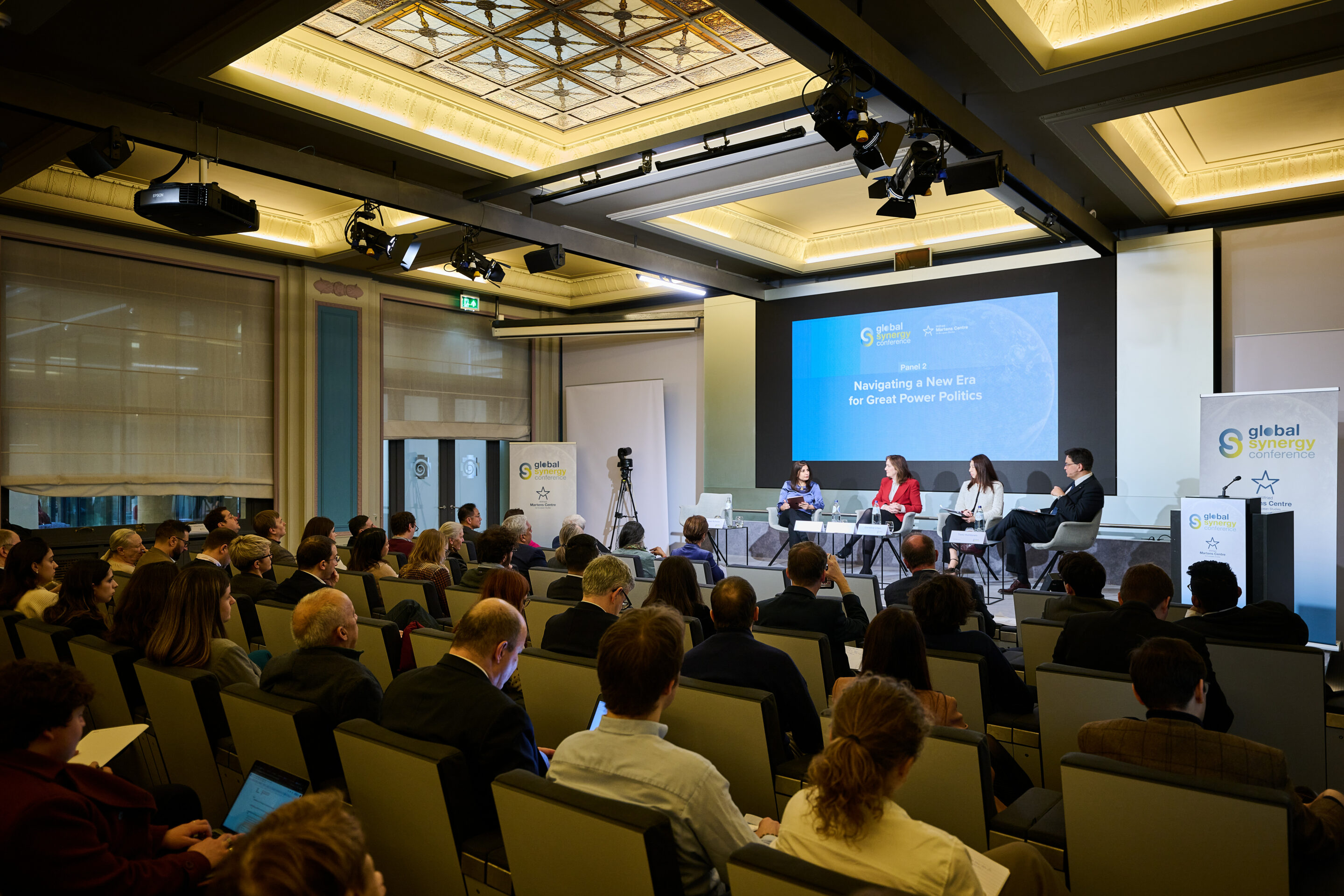
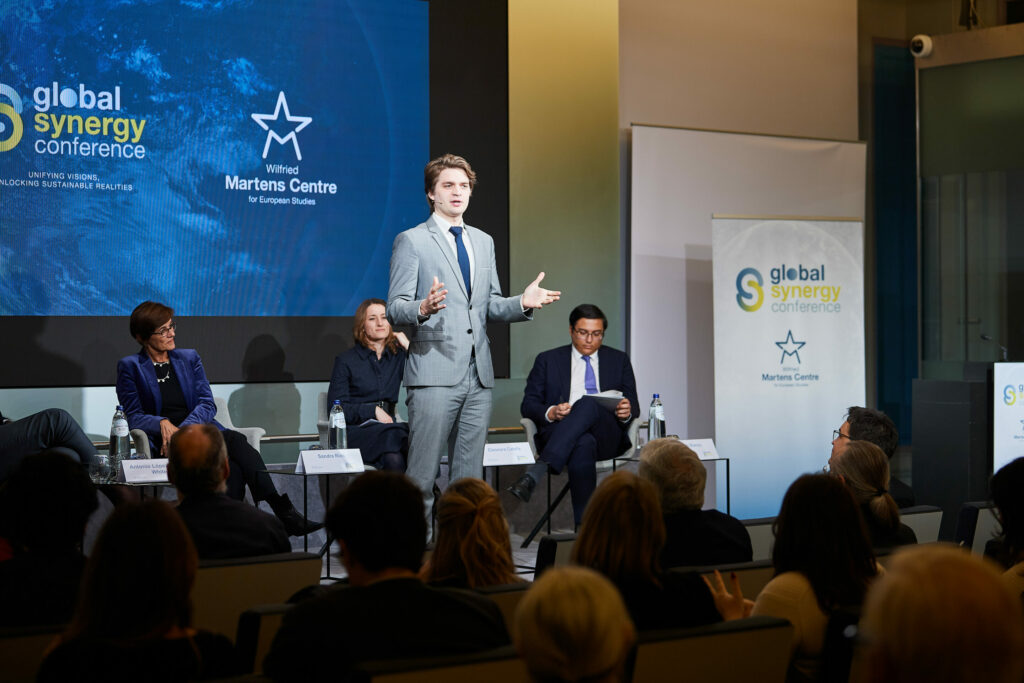
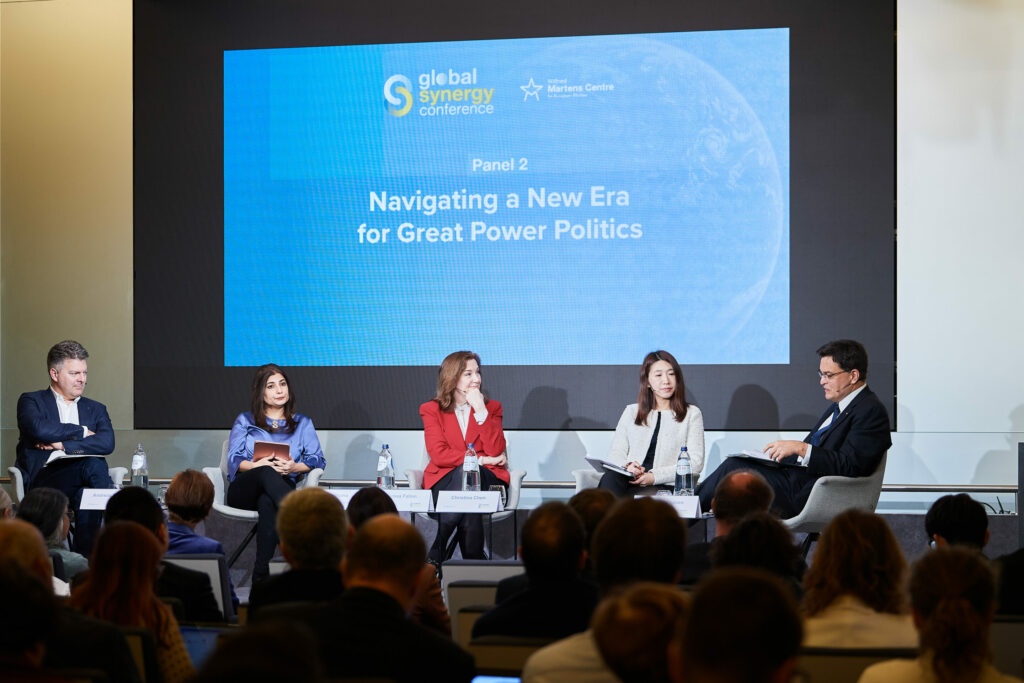
On 18 March, the Wilfried Martens Centre for European Studies is hosting the Global Synergy Conference in Brussels to answer a critical question: how should the EU project power and secure its alliances in this new reality?
The Global Synergy Conference brings together international policymakers, tech experts, and defence analysts to draft a roadmap for global strategic landscape and Europe's place in it.
The discussions will cover the main pillars of this new order:
1. Economic security is a shared global imperative
The global economy has definitively shifted from prioritising efficiency to demanding security. As the US-China rivalry intensifies through tariffs and tech decoupling, middle powers and regional blocs are actively reshaping global trade. Navigating this geoeconomic pressure requires moving beyond traditional development assistance. The new standard relies on forging transparent, high-standard strategic investments between the Global South, Asia, and Europe. Agreements like the EU-India Free Trade Agreement are no longer just bilateral deals; they are critical multilateral instruments for diversifying supply chains and building mutual economic resilience.
2. Expanding security frontiers
Security is no longer localised; it is seamlessly interconnected across land, sea, space, and cyberspace. The recent developments in the Middle East expose the vulnerability of the global commons. Protecting vital maritime chokepoints, undersea cables, and energy infrastructure requires urgent operational coordination across the MENA region, Africa, the Indo-Pacific, and Europe. Moving forward, global stability will depend less on single-state interventions and more on cross-regional alliances dedicated to capacity building, enforcement of norms in the cyberspace, and the protection of shared critical infrastructure.
3. The AI innovation race demands democratic tech alliances
Artificial intelligence sits at the absolute centre of geopolitical power. A new digital architecture is emerging, driven by advanced tech democracies in Asia – including Japan, South Korea, Singapore, and Taiwan – forging partnerships across regions. By aligning on AI governance, industrial competitiveness, and cyber resilience, these tech alliances aim to establish global standards that foster innovation while ensuring the accelerating digital divide does not further marginalise the Global South.
4. The rise of regional anchors in Latin America and the Indo-Pacific
As competing models of governance challenge the established multilateral system, new regional anchors are driving the next global order. In the Indo-Pacific, India has cemented its role as a central geopolitical counterweight and an indispensable partner for sustainable connectivity. In the West, the political shift in Venezuela is radically altering South America's strategic landscape. In this context, finalising the MERCOSUR agreement serves as a vital geopolitical stabiliser. Bridging these distinct economic blocs is essential to securing global supply chains, aligning perspectives from the Global South, and preserving a rules-based international order.
In a moment when geopolitical certainties are fading and alliances are being reshaped, the upcoming Global Synergy Conference in Brussels offers a vital space to think strategically about Europe’s role in a changing world. By bringing together policymakers, experts, and innovators, the conference aims to turn today’s challenges into opportunities for stronger partnerships. In uncertain times, such dialogue is essential to ensuring that Europe helps shape a more secure, resilient, and cooperative global order.
Register for the second edition of the Global Synergy Conference hosted by the Wilfried Martens Centre for European Studies on 18th March 2026 at the The Hotel in Brussels here.
