
What does a city like Antwerp use to build a quarantine facility very, very quickly? Shipping containers, naturally.
This brilliant combination of vernacular object and cutting-edge science gave birth to Poliopolis some 10 years ago. Today, the containers that stood in Antwerp University Hospital’s parking lot have been replaced by a state-of-the-art facility redubbed Vaccinopolis, the second-largest BSL-3 lab in the world.
BSL what now? Get used to it. My visit to Vaccinopolis was peppered with acronyms and numeric designations that poured out of the mouths of scientists like Joren Raymenants, the 34-year-old internist who ran Vaccinopolis’s first-ever quarantine study. Recently completed, the study saw 24 people volunteering to be infected with a flu virus and then entering quarantine for 13 days.
“BSL-3 is the bio-safety level,” Raymenants explains to The Brussels Times. “It means we could work with the tuberculosis bacteria, for example. Covid-19 is considered BSL-3.” BSL-3 facilities are able to fully contain pathogens with pandemic potential. Yes, there are also BSL-1 and BSL-2 facilities – ranking is based on the potential risk that pathogens pose to the environment.
In any case, Vaccinopolis can contain aerosols spewed out from our mouths, ensuring they do not escape the quarantine area. We all learned a lot about aerosols during the Covid-19 crisis. They contain those tiny particles of saliva that spread airborne disease. And they are kept inside the Vaccinopolis containment area through an intricate layered negative pressure design.
“If you breathe out a virus in one of those rooms, it is sucked into the ventilation system and gets filtered,” explains Raymenants.
“The exchange rate is 18 times per hour, and we extract much more air than we bring into the rooms. It’s extremely clean air. The pressure is a bit less in these adjoining rooms and less still in the office areas. This creates negative air pressure, which means the virus can only be passed in this space; it won’t float out of the building. The whole building is designed to keep pathogens out of the environment.”
White rooms
Raymenants and I are sitting in a large, open space littered with neat, round tables, a glass door separating us from the quarantine area. A façade of windows floods the area with winter sunlight. Vaccinopolis – essentially the name of the facility that houses University of Antwerp’s Centre for Evaluation of Vaccination and located just down the street from Antwerp University Hospital.
It is home to 30 isolation rooms for controlled human infection model, or CHIM studies. These are clinical trials that expose study participants to a pathogen under controlled conditions, following regulatory approval.
Participants stay inside Vaccinopolis during the entire period of the trial, so while the interior is startingly white, it is highlighted with peach-coloured accents and plenty of natural lighting. The common room – complete with pool table, ping pong and a workspace – overlooks a large grassy area and, in the distance, the University of Antwerp’s netted aviary for bird research. “That’s where we keep the velociraptors,” says Raymenants, with a straight face (scientist humour is often droll).

Joren Raymenants. Credit: Lisa Bradshaw / The Brussels Times
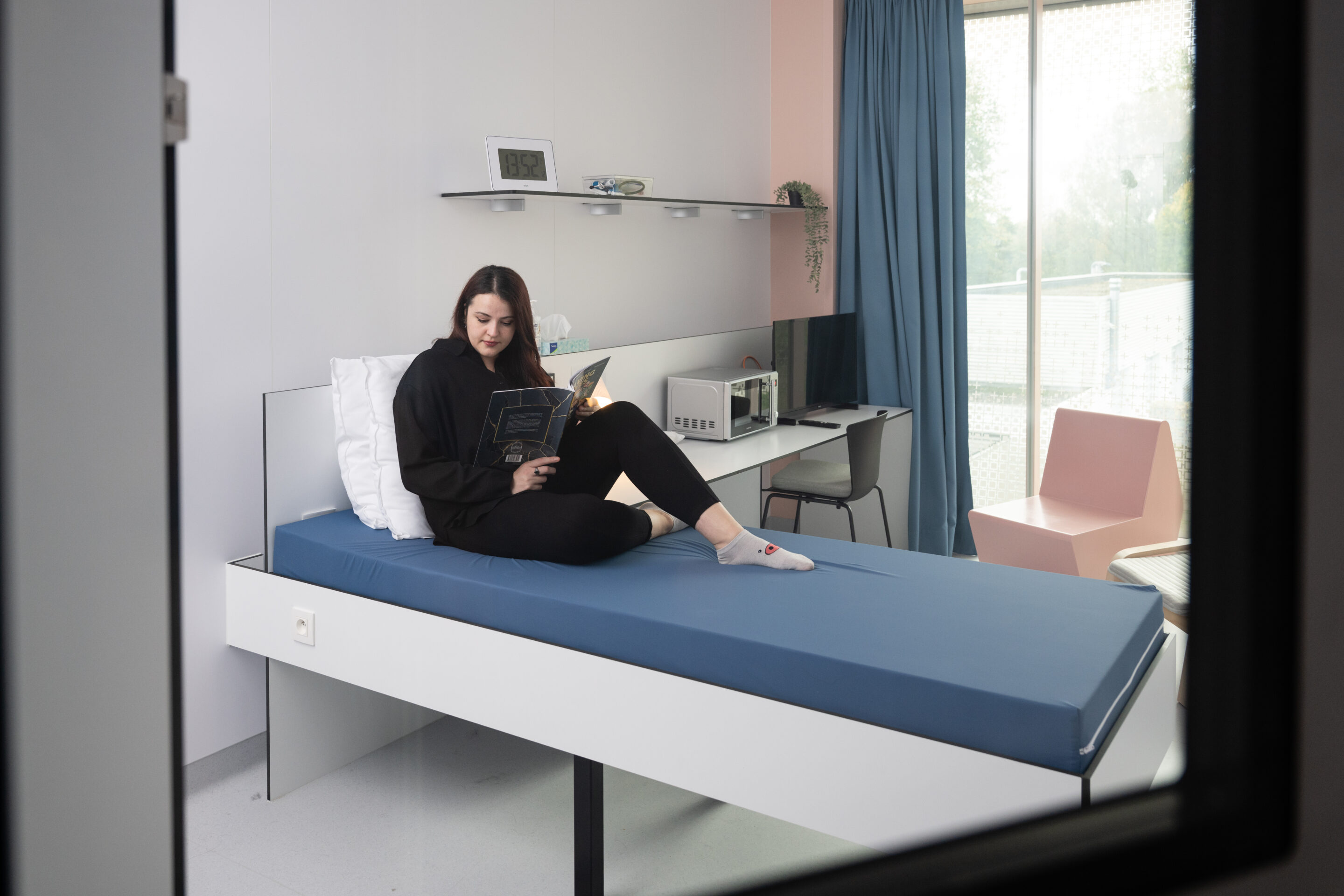
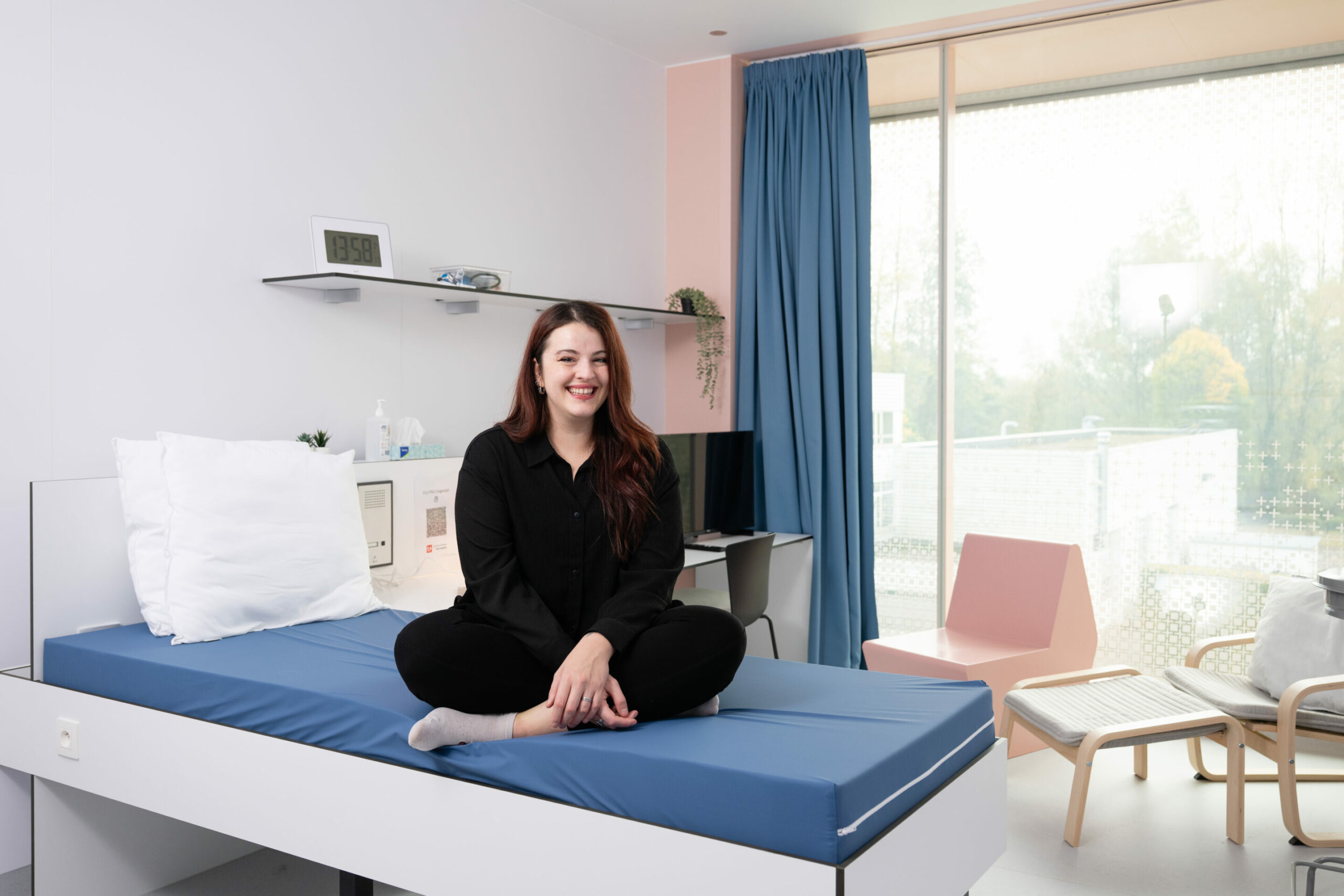
The isolation rooms themselves are like a cross between a hotel room and a hospital room – no frills but not cluttered with medical equipment. Each has its own bathroom, microwave, a TV and a large picture window. And each is separated from the hallway by an anteroom. The sci-fi fan in me likes to call this an airlock – the space where scientists don the protective gear we became so familiar with during the Covid-19 crisis, and where they take it off again before entering the hallway.
The first CHIM study included 24 volunteers. They had to remain in the facility – whether their individual room, the kitchen or the common room – for 13 days, 24 hours a day. All in the name of improving vaccines against the H3N2 influenza A virus, one of the two that comes back every winter, albeit in a slightly different variant.
“The flu vaccines we have lower the risk of getting the flu by 10 to 60%,” says Raymenants. “It depends on how well the strain that’s in the vaccine matches the strain that is circulating. But that’s pretty much what we get. That’s certainly not the 95% we saw with the Covid mRNA vaccines, so there’s a lot of room for improvement.”
The CHIM study’s focus was twofold: figure out which parts of the virus people develop immunity to, and what types of immunity lead to less “shedding”. Shedding is the process by which an infected person releases virus particles from their body – through the air, bodily waste or other fluids.

Professor Pierre Van Damme poses for the photographer at a press conference at UAntwerpen university to present Vaccinopolis. Credit: Belga
“Covid taught us that there is much more airborne shedding than was previously appreciated,” notes Raymenants. “This means transmission by aerosols, which are particles that behave like smoke or gas, as opposed to droplets, which behave more ballistically – like a bullet.
Droplets are large; they shoot out of your respiratory tract and fall to the floor. Aerosols shoot out of your respiratory tract and stay drifting around. This study was focused on airborne, aerosol transmission.”
After being infected with H3N2 influenza A, participants provided blood and saliva samples and underwent lung function tests and ECGs. They also exhaled through a mouthpiece into a device that counted the number of particles emitted. They had to make a sustained eeeeee sound while doing so at a particular pitch and volume; Raymenants calls it “singing”. Most of the participants developed mild flu symptoms, with only one feeling he had to stay in bed – for one day.
Human lab rats
The 24 people selected for the study were diverse in age and background, and in how they spent their time. Some of them simply worked remotely, while others took the opportunity to finish a project they had never gotten around to. “One of them knitted, another developed a personal training course, one guy studied for an exam,” says Raymenants. They could bring stuff with them, as it could be wiped before they left. If it couldn’t be wiped, they had to leave it at Vaccinopolis for a few days, then come back and get it. “Just in case they breathed on it.”
The 24 participants were whittled down from the 1,300 members of the public who applied for consideration. Anyone under 18 or over 55, as well as smokers, was instantly eliminated. Any remote possibility that you could be pregnant is also a red flag. After that, it’s basically first-come, first-served in the initial round of testing of about 200 people.
While it might seem like a bit of a hassle, volunteering for a clinical trial in Belgium pays by the hour. At 24 hours a day, that adds up quickly. Including testing before and after the quarantine, these 24 participants each earned a total of €4,600 – tax-free.
The study was financed in part by Antwerp province, but the lion’s share – €1.85 million – came from the NIVI Research Centre, part of the University of Copenhagen, which collaborates with Vaccinopolis. While this premiere CHIM study at Vaccinopolis made headlines, most of the facility’s trials are ambulatory, or out-patient in nature.
The 50+ employees test vaccines for a wide variety of viruses, such as Covid, respiratory syncytial virus (RSV) and rabies. “Our work on immunity will allow vaccine developers to stop transmission from happening,” Raymenants, “which will be of use in the next pandemic when we need to develop new vaccines.”
Because there will be another pandemic, sooner or later. Vaccinopolis’s rooms are large enough for two people, which increases its capacity to 60 patients if needed. “This is a quarantine facility, and we are ready to accept people when there’s a new outbreak. This is something we didn’t have during Covid.”
Mutating viruses
Covid is to thank for Vaccinopolis becoming a reality – well, that and the Gates Foundation. The latter got the ball rolling in 2015 when the American charitable foundation – then chaired by Bill and Melinda Gates – chose Antwerp to establish a study dedicated to testing a new oral polio vaccine.
“Not only does Belgium have a very high level of vaccine-induced immunity to polio, we also have a solid history of regulators approving vaccine trials,” says Raymenants. “After Denmark, we are the European country with the most clinical trial subjects per capita. Also, Belgium’s price was just much lower than in the US. Trials are more expensive there.”
Polio vaccines shed in human waste and can continue to circulate for months, or even years, in un- or under-vaccinated areas. This is particularly a concern with oral polio vaccines, as the vaccine virus can mutate, become more potent, and actually cause polio. In areas where oral vaccines are used, and vaccination coverage is low, this presents a real danger. “The majority of polio cases worldwide are vaccine-induced,” says Raymenants.
The Foundation needed a quarantine facility that was contained in terms of bowel movements, but they didn’t want to wait around for a brand new building. “So, we made it a temporary quarantine facility built from containers – 66 of them – arranged in the parking lot of the hospital. They had to quarantine individuals for up to four weeks just to wait for the shedding to finish.”
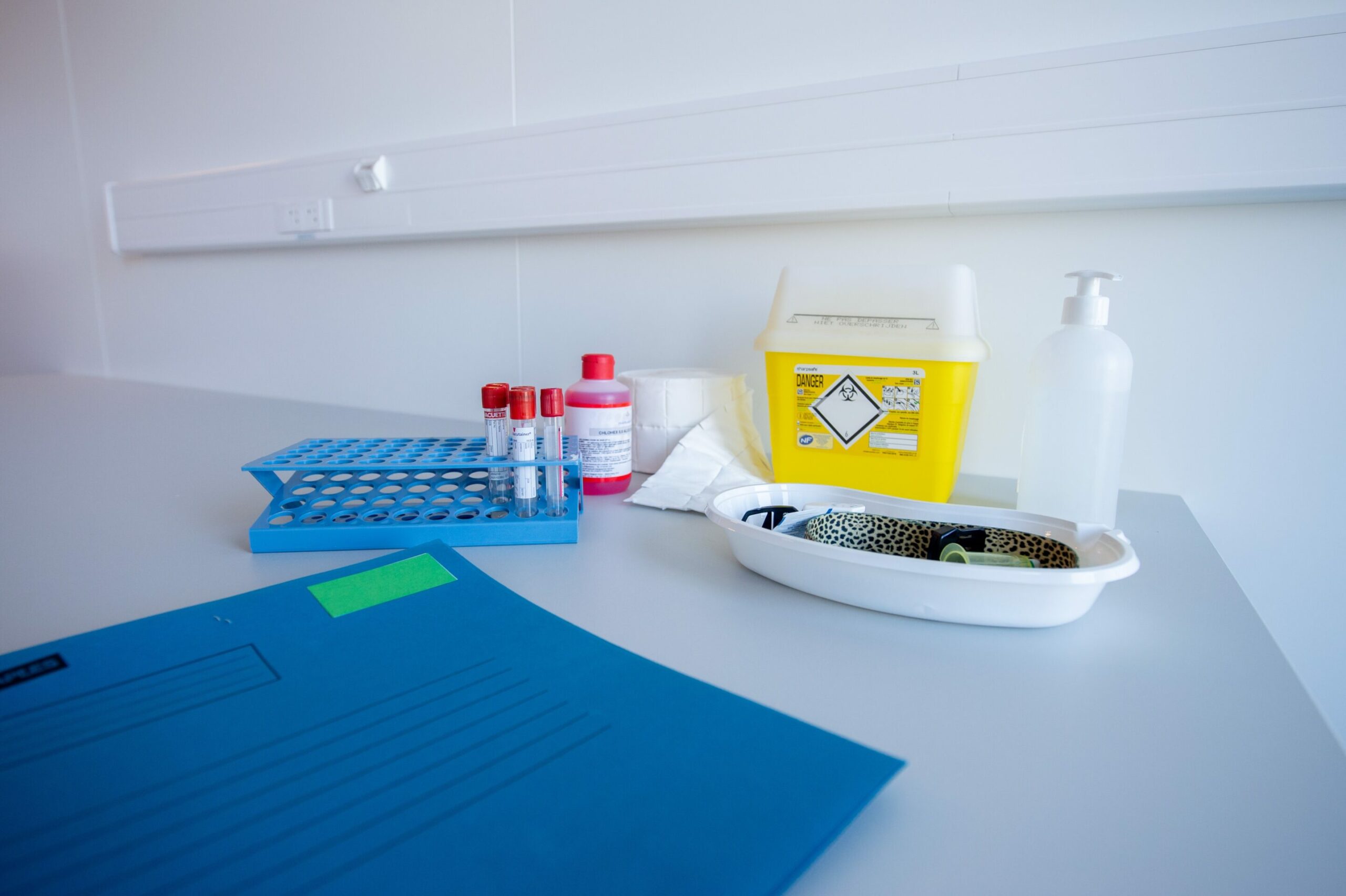
Illustration picture taken during a press conference at UAntwerpen university to present Vaccinopolis. Credit: Belga
That vaccine – Novel oral poliovirus vaccine type 2 (nOPV2) – was rolled out on the market in 2021 in mainly Africa and Asia. Used as a response to outbreaks, it greatly reduces the risk of vaccine-derived polio.
To continue such crucial vaccine testing and clinical trials, the head of University of Antwerp’s Centre for Evaluation of Vaccination, Pierre Van Damme, applied for government funding to create a permanent facility. The timing could not have been worse: It was 2018, and the federal government coalition was busy crumbling in the wake of the infamous Marrakesh Pact.
So the funding fell through, and then a year later, Covid-19 made its debut. “The federal health minister at the time, Maggie De Block, called Pierre and asked, ‘Where is this facility? We need it now.’” Funding came through mighty quick (rocket speed by Belgian standards), and Vaccinopolis was completed in 14 months’ time (rocket speed by Belgian standards).
And in case you were wondering … it is still bowel movement safe. Viruses and vaccines that get expelled in your waste get sent straight to the “kill tank”. “It’s a room-sized tank that takes in all the water from the toilets and heats it up to 140°C. Everything gets killed before it enters the sewer system. So we can also test gastro-intestinal pathogens here.”
As Vaccinopolis is the largest BSL-3 quarantine facility in the world, it hosts a great deal of international visitors and has close ties with the World Health Organization. The day before my visit, they received Mohamed Janabi, the WHO Regional Director for Africa. Van Damme, meanwhile, is still the director of the facility and is instantly recognisable to Belgian residents – one of the experts often interviewed during the coronavirus crisis, a time that saw virologists become celebrities.
Jessica Van Roij at Vaccinopolis
“We have been a collaborating centre of the WHO European Region for the control and prevention of infectious diseases for more than 20 years now,” Van Damme tells me a few days later, returning from abroad. “There are 53 member states in the WHO Euro Region, and we assist them with guidelines, recommendations and missions related to vaccine-preventable infections and immunisation programmes.”
Vaccinopolis also offers a summer school on vaccinology for European students and MDs and works with the region to develop educational activities, like the kids’ video game Immune Patrol. The facility also chairs several WHO Europe meetings. “We recently welcomed the Belgian prime minister and WHO European regional director Hans Kluge to discuss collaboration, pandemic readiness and prevention policies.”
Vaccinopolis is now in the preparatory phase of its second CHIM study, which will involve the assessment of the next-generation Covid-19 vaccine.
