
What does menstruation call to mind? Has its mere mention made you blush and squirm with embarrassment? Do you recall pain, stains, and shame?
Perhaps you don’t menstruate and have never given periods much thought. Or maybe you’re on your period right now; getting ready to go out despite the cramps – at the last minute, you remember to pack extra pads or tampons for the day ahead, phew.
Generally, we don't have open discussions about periods or the menstrual cycle. We bleed in silence, in hushed whispers, behind closed doors and outdated euphemisms. We label supermarket aisles with the polite “feminine hygiene,” as if periods were too dirty even to name. This silence lets dangerous taboos and stigma persist, taboos which have real-world consequences in the lives of people who menstruate.
Menstruositées is an exhibit hoping to fill this void and counter this silence. On opening night, visitors sporting vibrant shades of red, pink, and orange entered the Centre Culturel Bruegel in Brussels city centre. They immediately blended into the room’s swirling colour palette of reds and pinks.
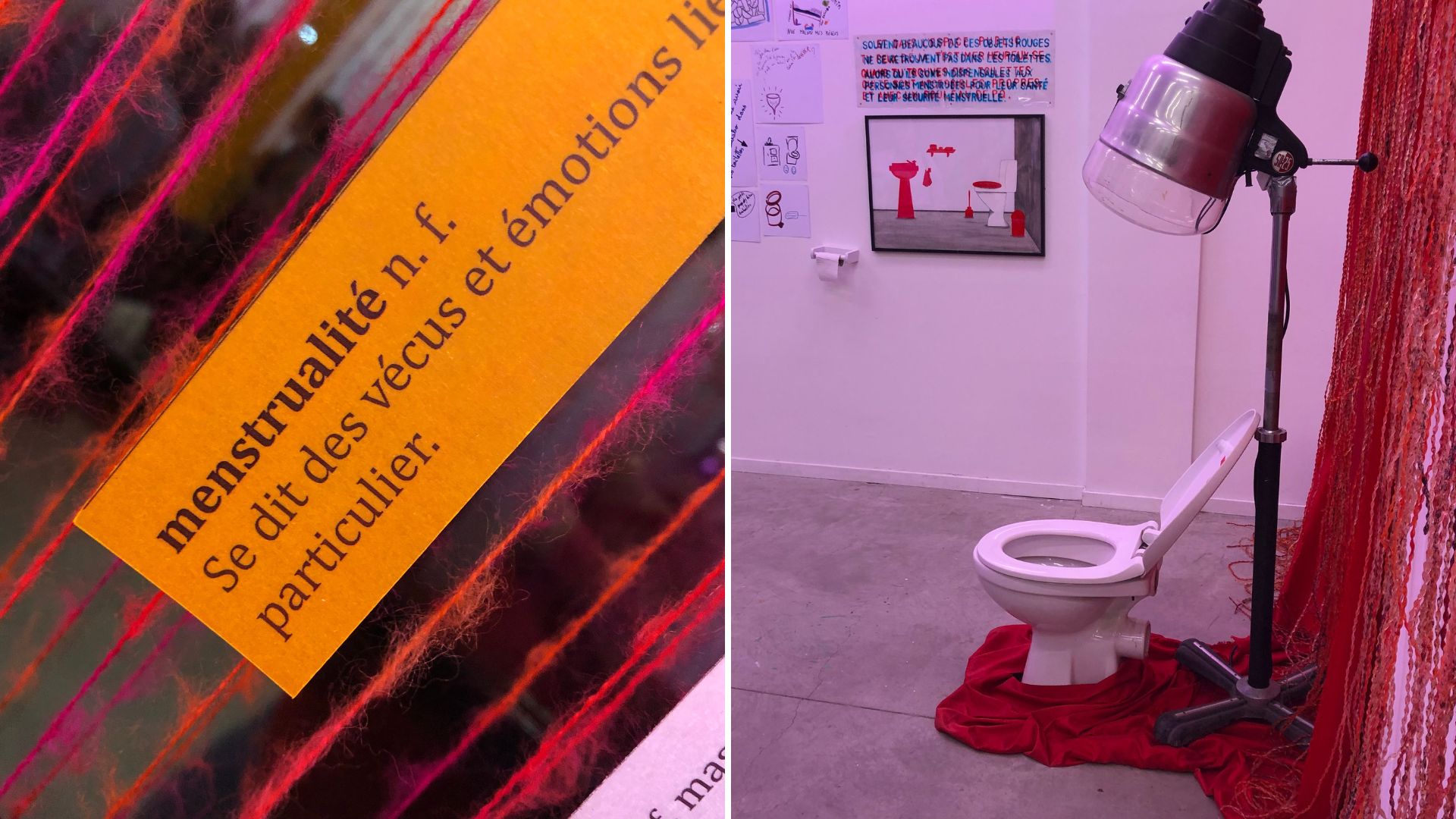
The exhibit has embraced this colour scheme as a badge of honour. Everything is unashamedly pink and red, and everything periods is up for discussion.
Weaving your own thread
Now in its third year, the main belief behind this project, led by Alice Conquand and Coralie Theys from LUC lab, is that public space offers too little room to experience and discuss periods. That’s why the project’s main goal is to raise awareness and showcase period stories and experiences, lifting the veil of shame, mystery, or ignorance.
By showcasing a proud, bold, and educational take on menstruation, they want to normalise the topic; to erase taboos by giving this phenomenon what it lacks: visibility.
Visibility means talking about many aspects of periods: the habits and gestures we acquire in daily life; the mental toll it takes; our emotions and representations; to whom and how we discuss our bleeding; and the knowledge we have about our own bodies.
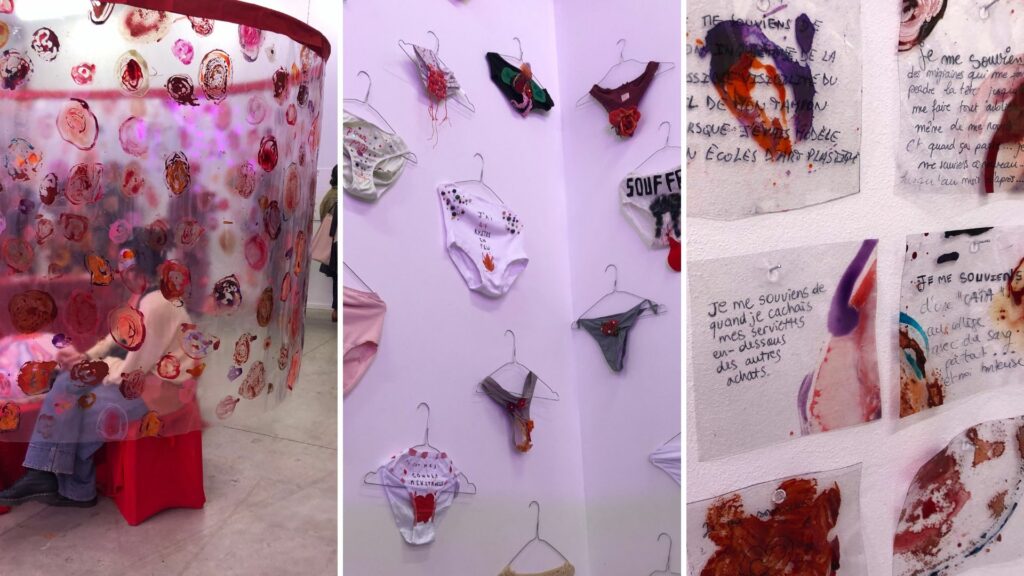
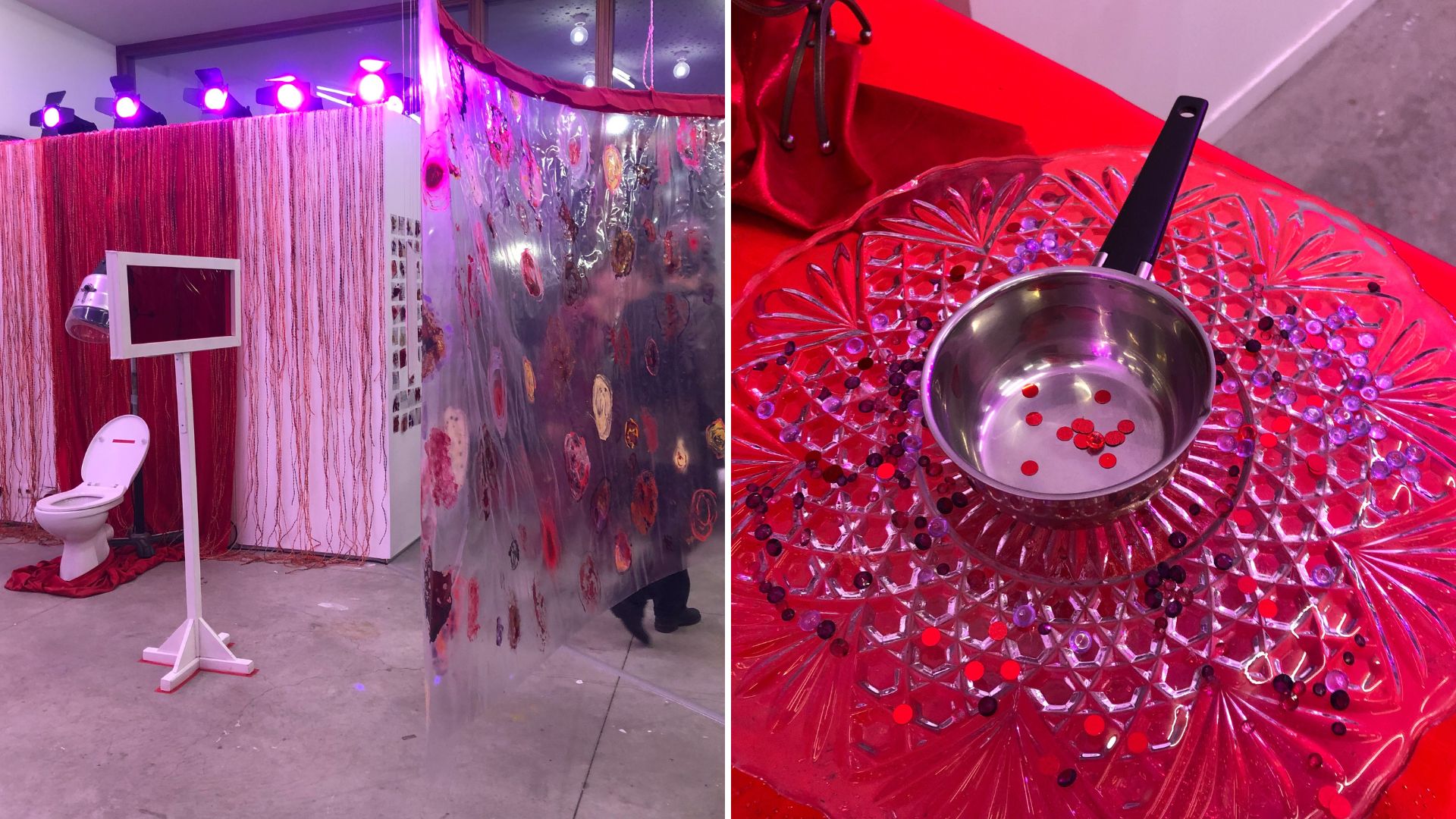
The exhibit offers answers that are a sheer sensory delight. The room glows pinkish-purple. Red yarn and threads run throughout. There is, of course, a model of the reproductive system. A diagram of all the stages of the menstrual cycle, but also a curtain covered in swirls of reddish glitter, which invites you into a space with headphones and recorded stories.
Credit: Allison Ochsenmeier
In one corner, a cabinet of curiosities holds pads, glitter, pain tablets, menstrual cups, and a case of neatly pinned tampons that would put an entomology display to shame. Against the opposite wall, an actual toilet swirling in red fabric invites you to take a seat. Another wall is covered in little squares upon which people have filled in the following: "I remember…"
Many displays are the result of participatory workshops, such as the wall covered in decorated underwear. Then there’s the period glossary, a collection of words – both real and invented – that resulted from writing workshops, and aims to capture unspoken aspects of the period experience.
Along another wall, a wooden panel with hooks lets you wind a thread through your personal answers to questions such as "When did you get your first period?", "How long does your period last?" or "How is your period experience?"
My favourite moment was when I picked up my own thread, ready to weave, and three girls, around eight or nine years old, clustered around me. They asked me so many questions that I ended up talking them through the whole board as I tried my best to answer. It was a beautiful moment of open, unashamed sharing.
I wish younger me could have seen this. I think back to my 13-year-old self, who had her first period and was afraid of bloodstains on her trousers, or 15-year-old me, who wore the same soaking pad for a whole day on a school trip, too embarrassed to ask a friend for a spare one.
'I eat or I bleed'
So much shame, when menstruation is something that roughly half the world’s population will experience for years. In fact, Menstruositées estimates that a woman will spend a total of six years and three months on her period during her life. (Calculations suppose a five-day cycle, and a period spanning from 12 to 50.)
Our unease discussing menstruation can have more severe consequences: it squarely turns it into a topic that is not up for discussion, and therefore receives too little attention. Women’s health is understudied. For example, 10% of women suffer from endometriosis, yet it takes on average seven years for the patient to receive a diagnosis.
Secondly, so reluctant are we to discuss menstruation that period poverty is seldom discussed. I may have felt ashamed at times when I was younger, but at least I knew that at home, I would always have access to the products I needed, whether that was a period pad or a paracetamol.
This is not the case for the many people who face menstrual poverty; they have difficult or no access to the products they need. It implies choices between the latter, or other essential things like food. “I eat, or I bleed” is a good summary of period poverty, says Veronica Martinez, the founder of BruZelle.
What's more, periods are expensive. The French organisation Règles Elémentaires estimates a person will spend between €8,000 and €23,000 on their period over a 38-year time span (this covers products, new underwear and clothing or bedding, doctors’ visits, pain relief medication).
Credit: Allison Ochsenmeier
BruZelle is a national organisation founded nearly ten years ago, which fights against period poverty. Each week, they distribute between 13,000 and 14,000 period pads. Beyond this, the six-person team also carries out prevention and awareness raising, and shares their expertise with other organisations or businesses.
Additionally, they run an education programme, Règles de 3/Regels van 3, through which they’ve reached 15,000 young people throughout Belgium. The team only comprises six people for all of Belgium, but "we have a fantastic network of volunteers," says Veronica.
On a European level, several organisations have joined forces to launch Menstrual Matters, which provides research on period poverty across Europe, but also works on advocacy and education through the Menstrual Education Network, led by the French organisation Règles Élémentaires. Menstruositées will host several school groups, in collaboration with BruZelle, who will manage these workshops.
On Friday 13 March, you can turn up for Period Bingo, and on 17 March, they will host a radio episode with elderly women in collaboration with Radio Mouette.
The exhibition runs from Monday to Friday, 10:00 to 17:00, at Centre Culturel Bruegel, until 16 April. Entrance is free.
