
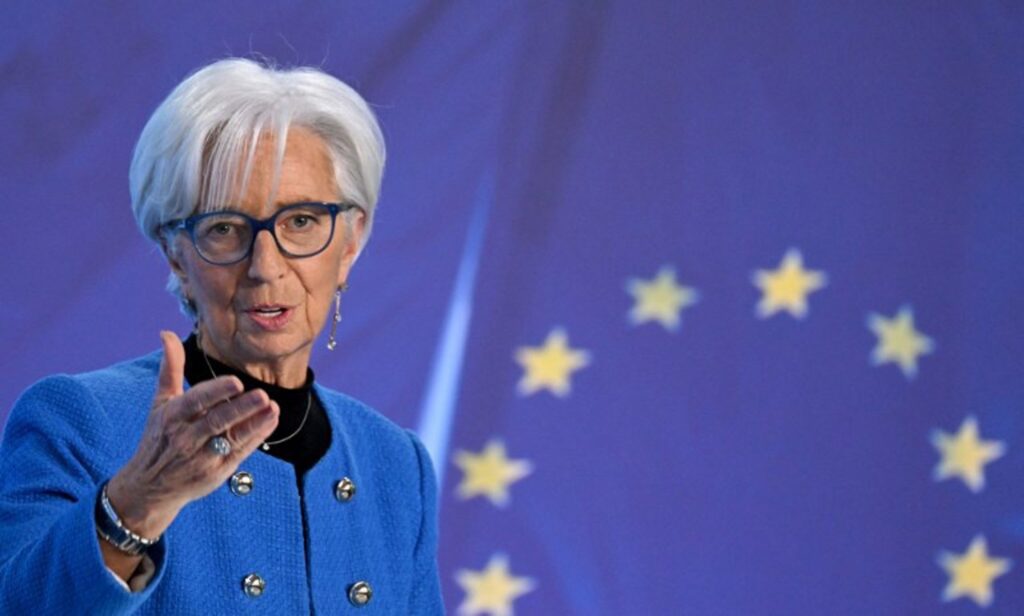
European Central Bank President Christine Lagarde has warned that the global economy is shifting from a period where risks could be modelled to one of “genuine uncertainty”, driven by fast-moving artificial intelligence and growing geopolitical fragmentation.
Speaking at Johns Hopkins University in Bologna on 5 March, the ECB President said recent shocks were changing the underlying structure of the economy, making traditional forecasting less reliable in a world of changing trade relationships and new technology, as cited by the ECB press service.
Lagarde cited World Trade Organization monitoring showing the share of G20 trade affected by new tariffs and import restrictions rose more than fourfold between October 2024 and October 2025 — the largest jump since monitoring began.
She also pointed to estimates suggesting AI could lift annual productivity growth by up to 1.5 percentage points, while severe economic fragmentation could cut global output by up to 7% of GDP over a decade.
Lagarde said the ECB has increasingly used “scenario analysis” — exploring a range of plausible futures rather than relying mainly on past data — and noted that an adverse scenario published by the ECB in March 2022 pointed to inflation exceeding 7% that year, close to the final figure of over 8%.
Why AI depends on global supply chains
Lagarde argued that AI is particularly exposed to disruption in global trade because of its reliance on complex international supply chains for semiconductors — the chips used to train and run AI systems.
China refines around 90% of critical minerals and rare earths used in high-tech manufacturing, the Netherlands’ ASML is the sole supplier of extreme ultraviolet lithography machines used to make the most advanced chips, advanced chip design is concentrated in the United States, and final fabrication is dominated by TSMC in Taiwan, the ECB said.
Building self-sufficient semiconductor supply chains in each major region would cost more than $1 trillion in upfront investment and raise prices by 35% to 65%, according to an estimate cited by Lagarde.
She also cited an estimate that around 42% of the increase in global goods trade in 2025 was linked to AI-related investment.
Lagarde said AI development also depends on access to large markets because the costs of the largest training runs are approaching the billion-dollar mark, while deploying trained models costs relatively little.
She added that the EU accounts for one-fifth of the global AI market and that leading US technology companies derive around a quarter of their total revenues from Europe, according to figures cited in her speech.
The ECB chief also said AI performance improves with larger and more diverse datasets, and that restrictions such as data localisation requirements or incompatible privacy regimes can reduce the usefulness of models by narrowing the data they learn from.
Lagarde outlined what she called a “layered” approach to international cooperation, starting with reforms to global institutions such as the International Monetary Fund, World Bank and World Trade Organization, alongside deeper cooperation among allies on supply chains and “minimum viable” cooperation with rivals on areas such as supply chain stability and AI safety.
