
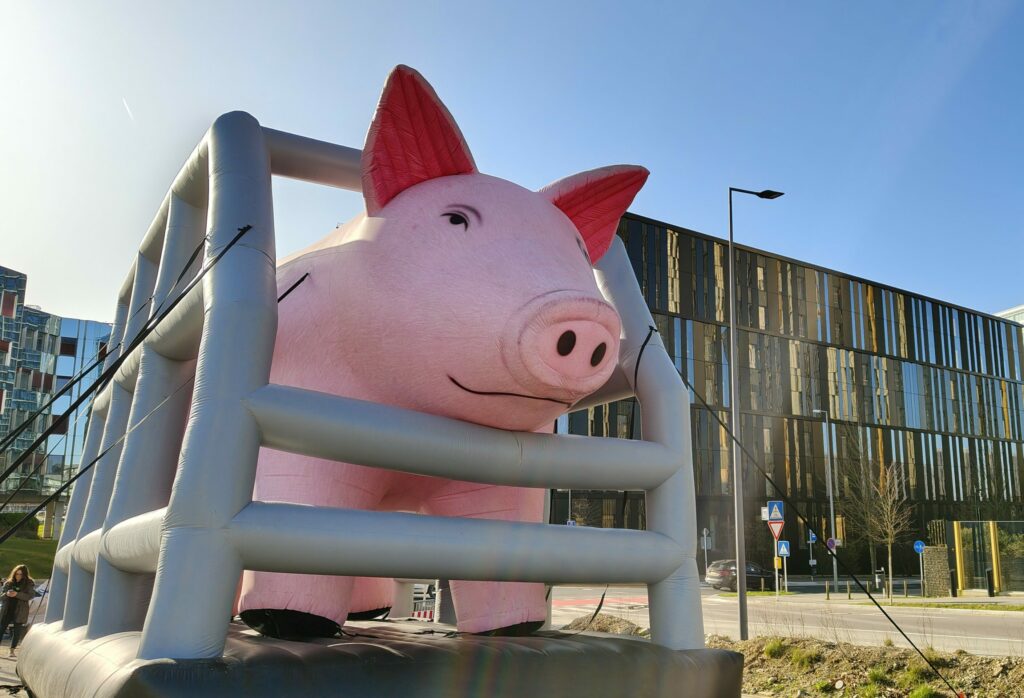
The Citizens' Committee, which has campaigned for the European Citizens' Initiative "End the Cage Age", presented the case for banning cages for farmed animals in a hearing at the European Court of Justice in Luxembourg last Thursday. However, it is still left in limbo.
The initiative was formally submitted in October 2020 to the European Commission after it had collected around 1.4 million signatories across all EU Member States – well above the minimum number of at least 1 million signatories in at least seven Member States. In June 2021, the Commission responded positively to the initiative.
It was the first successful European Citizens’ Initiative (ECI) on farmed animals and at the time the sixth out of 76 initiatives which had been successful in collecting the required number of signatories registered since the instrument for participatory democracy entered into force in 2012.
The initiative calls on the EU to revise the 1998 Council Directive 98/58/EC on the protection of animals and phase out all cages in EU animal farming by 2027. This is earlier than some EU Member States already are planning to do. To facilitate the transition, farmers should be provided with financial support. The EU should also require that imports meet its enhanced animal welfare standards.
In a communication, the Commission wrote that the response would be "included in the revision of animal welfare legislation that it has committed to propose by the last quarter of 2023." The Commission also referred to the ECI organisers who had expressed their ambition for a ban on cages to come into effect in 2027.
To develop the legislative proposal, the Commission would prepare an impact assessment, which was scheduled to be completed by the end of 2022. In no uncertain terms, the Commission stated that it "intended to put forward a legislative proposal by the end of 2023 to phase out and finally prohibit the use of cages for all the animal species and categories referred to in the initiative."
At the hearing, in front of five judges appointed by the Court, the Citizens Committee and the animal welfare NGOs supporting it called for the Commission to fulfil its commitment by presenting a clear timeline to deliver legislative proposals to ban caged animal farming for all farmed species, as well as granting access to its files, including from lobbyists, after the publication of the Communication.
The Commission was also present at the hearing, arguing that the timeline in the Communication was indicative and not binding. It did not claim that more research is required. Asked by The Brussels Times to disclose a copy of its argumentation in the hearing, a Commission spokesperson replied that it does not comment on ongoing court cases.

‘End the Cage Age’ Citizens' Committee and supporters in the court room
"The End the Cage Age European Citizens' Initiative is not an ordinary policy request," commented Olga Kikou, Director of Animal Advocacy & Food Transition.
"It’s the only ECI to date that received a fully positive response from the European Commission on all its asks. It was backed not only by 1.4 million citizens, but also supported in a European Parliament resolution voted by a majority of MEPs and similarly by the Committee of the Regions. That gives it additional and undeniable political weight."
"When the Commission committed to propose legislation to phase out cages, it was not a symbolic gesture," she added. "It was a political promise. A promise made after citizens mobilised across Europe, after EU institutions voted in support, and after scientific evidence clearly showed change was both necessary and possible."
The Commission’s decision not to honour its commitment risks weakening one of the EU's most important participatory tools at a time when trust in democratic institutions is already under strain, according to the Citizens Committee.
"In today’s political climate, with our democracy facing pressures from many directions, European institutions must be especially careful to honour their commitments. When citizens engage in good faith, institutions must respond in good faith."
Bringing this case before the Court is about more than cages, they said. "It’s about safeguarding the integrity of the ECI instrument, securing its future, upholding institutional responsibility, and ensuring that citizens remain at the heart of EU democracy. And of course, it is also about the animals, whose lives and suffering depend on whether political promises translate into real change."
"This historic court hearing marks an important moment for European democracy," commented Reineke Hameleers, CEO, Eurogroup for Animals. "If citizens place their trust in shaping EU policies that directly affect their lives, the European Commission must be held accountable for delivering on its commitments. It’s high time that the promise to end cages in farming systems is finally honoured."
The European Commission published in October last year its 2026 work programme without including any legislative proposals for revising its outdated animal welfare legislation.
Asked specifically about the ECI on banning cages, the Commission replied that "it is carefully assessing important aspects to ensure that the transition to cage-free farming is sustainable for the agricultural sector and for our food systems, including food security."
The Commission referred to the livestock workstream, launched by European Commissioner for Agriculture and Food Christophe Hansen in May 2025, but was not in a position to determine the precise scope the strategy will take.
A presentation by DG SANTE last September mentioned that the work includes a follow-up on the Commission’s commitment to phase out the use of cages for certain farm sector(s). "A first legislative proposal is expected by the end of 2026... but the sector(s) covered remain to be decided based on the stakeholder consultation and what is feasible for the sector(s) covered."
The Court’s ruling is expected at the earliest in six months.
