
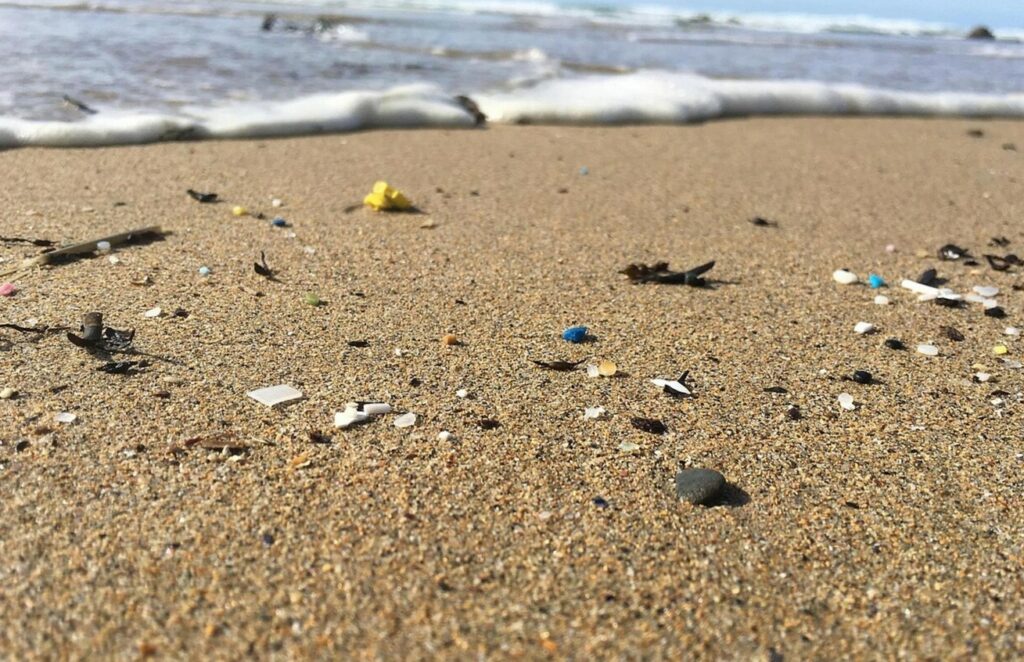
Nanoplastic pollution has been detected at every sampling location and depth studied across the North Atlantic, with researchers estimating that its mass near the ocean surface could be many times higher than previous totals for larger plastic pieces.
Plastic pollution is found in all habitats on Earth and is treated as a major environmental hazard, the European Commission said on Tuesday, adding that the EU has a plastics strategy adopted in 2018 under its circular economy action plan.
Plastics in the environment are often grouped by size, with “macroplastics” larger than 5 mm and “microplastics” smaller than that, while “nanoplastics” are commonly used to describe particles smaller than 1 micron (0.001 mm), it said.
Detecting and measuring nanoplastics reliably remains difficult and requires specialised methods.
Nanoplastics are sometimes made for use in products, but are more often created as larger plastics break down, including particles from tyre wear, washing synthetic fabrics, and the abrasion and sunlight-driven degradation of plastic waste.
What researchers found in the North Atlantic
Researchers from the Netherlands and Germany collected water samples at 12 sites across the North Atlantic, from the subtropical gyre to the southern North Sea, with funding support from the European Research Council, the Commission informed.
Samples were taken near the surface, near the sea floor, and — in deeper waters — at an intermediate depth of about 1 kilometre.
Nanoplastic was found in significant quantities at all locations and depths, with average concentrations highest near the surface at 18.1 milligrammes per cubic metre (mg/m³), falling to 10.9 mg/m³ at intermediate depth and 5.5 mg/m³ near the bottom.
Near-surface nanoplastic concentrations were highest at coastal shelf locations, averaging 25.0 mg/m³, consistent with land-based inputs such as rivers and direct coastal sources, the Commission said, adding that the researchers also noted transport through the air over long distances.
Most of the nanoplastic detected was made up of three plastics — polyethylene terephthalate (PET), polystyrene (PS) and polyvinyl chloride (PVC) — with different patterns by depth and location.
PET levels were similar at all depths, while PS and PVC concentrations fell sharply with depth, with minimal levels detected near the bottom.
Using their measurements, the researchers estimated 11.73 to 15.20 megatonnes of nanoplastic in the North Atlantic’s surface mixed layer between 8.5°N and 55°N.
The researchers compared this with a separate recent estimate for macro- and microplastics in the same surface layer of 0.05 to 0.31 megatonnes.
The findings were published in "Nature" in 2025 in the study “Nanoplastic concentrations across the North Atlantic.”
