
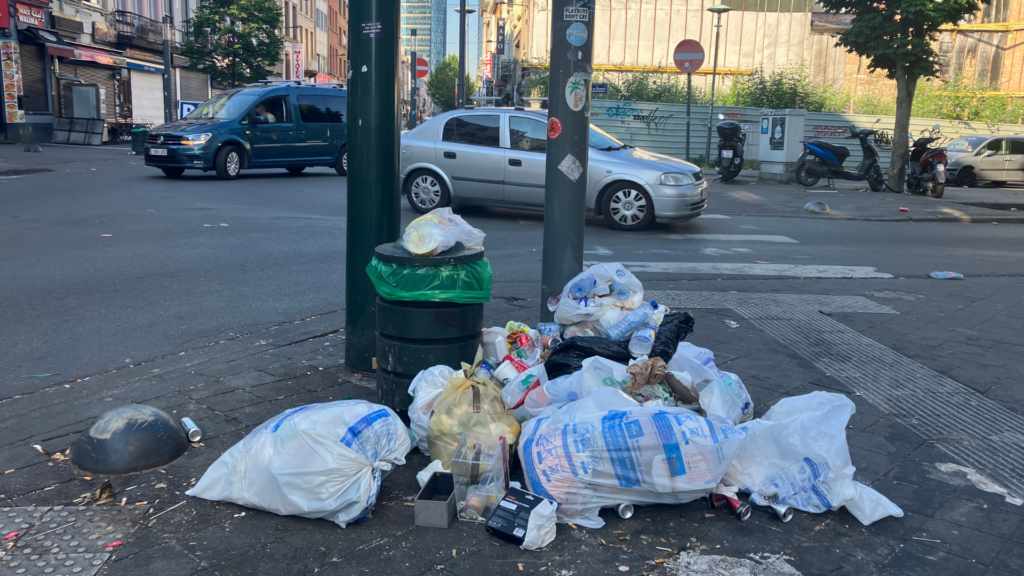
I’ve lived in Brussels long enough to know there is one topic that every visitor wants to talk about. “Why are the streets so dirty?” they want to know.
And there are various responses. It’s the politicians, stupid. Or it’s the foreigners, obviously. Or it’s Brussels, move somewhere else if you don’t like it.
When I put down roots in Brussels 35 years ago, I worked for a weekly magazine called The Bulletin. It had a letters page, where people would write in about things that bugged them. It might be the bureaucracy that was terrible. Or it was the driving, equally terrible. But the most regular complaint was the dog shit in the streets.
The city has changed a lot in 35 years. The traffic has been calmed. The bureaucracy has gone digital. But the streets are just as dirty as ever. Maybe even worse. And that is a pity, because people are walking in this city more than they ever did.
I suggested to The Brussels Times editor that we should hold Brussels' decision makers to account and clean up the city. We’d interview residents, talk to politicians and then come up with some solutions that might finally give us clean streets.
As I left The Brussels Times office on Avenue Louise, I had second thoughts. Maybe I’m exaggerating the problem. There are bigger issues, if you want to get worked up about something in Brussels, like homelessness or drug violence or collapsing infrastructure.
Five minutes later, I realised the scale of the trash problem wasn’t so small. Outside the fashion store Soeur at Avenue Louise 86, someone had thrown away a plastic bag containing two crushed beer cans. One door down, where Ba&sh is about to open a new store, a cardboard box and two drink cans lay abandoned.
A few steps further, on the pavement outside number 90, there was quite a haul – two empty pizza boxes, a paper bag, a food wrapper, the remains of a cardboard box and a coat hanger. And next door, outside the fashion store Pinko, a yellow rubbish bag lay trapped under the wheel of a parked car.
It was a Thursday afternoon, an average day in Brussels. The garbage truck had passed earlier in the day. The street sweepers had done their job. But the avenue was still littered with trash.
I should point out, in case you don’t know Brussels, Avenue Louise is the city’s most prestigious street. I’ve seen it compared to the Champs-Elysées in Paris and Fifth Avenue in New York. It’s where you find the upmarket shops, the legal firms and the expensive restaurants. It’s also where you find rubbish bins on every corner, so why do people not seem to care?
The city does its best to keep the streets clean. During a special clean-up action last December, a team of workers collected 560 kilos of rubbish in the Avenue Louise neighbourhood. But the trash just keeps piling up. Down in the centre on Place Fontainas, where the city has spent millions creating a pedestrian boulevard, someone recently dumped a fridge, several freezers, wooden planks and a pile of gas canisters.
A city spokesman recently told Bruzz that some people had the idea that, “You just dump rubbish on the street, and the city will clean it up.” He pointed out that there are several official rubbish sorting centres around the city, as well as free collections. But nothing seems to work. You want clean streets? Then move to Vienna, or Madrid, or just about any other European city.
But that would be a pity when there are so many features of Brussels that are just fine, or even better than fine, like the restaurants, the culture, the location at the heart of Europe.
Maybe it’s time for a citizen campaign. It seems everyone who lives here wants clean streets. Not just for one day, but forever, so we might feel a bit of local pride when we show visitors around, pointing out the extraordinary architecture, rather than the dog shit.
So how about an action plan? We talk to politicians, learn from other cities, gently nudge dog owners, print leaflets, come up with a slogan (Scoop up the Poop?) and try to find a celebrity to endorse the campaign.
It’s not the biggest problem we face in Brussels. But maybe, if we can solve the problem of trash, we can go on to fix some of the bigger problems.
