
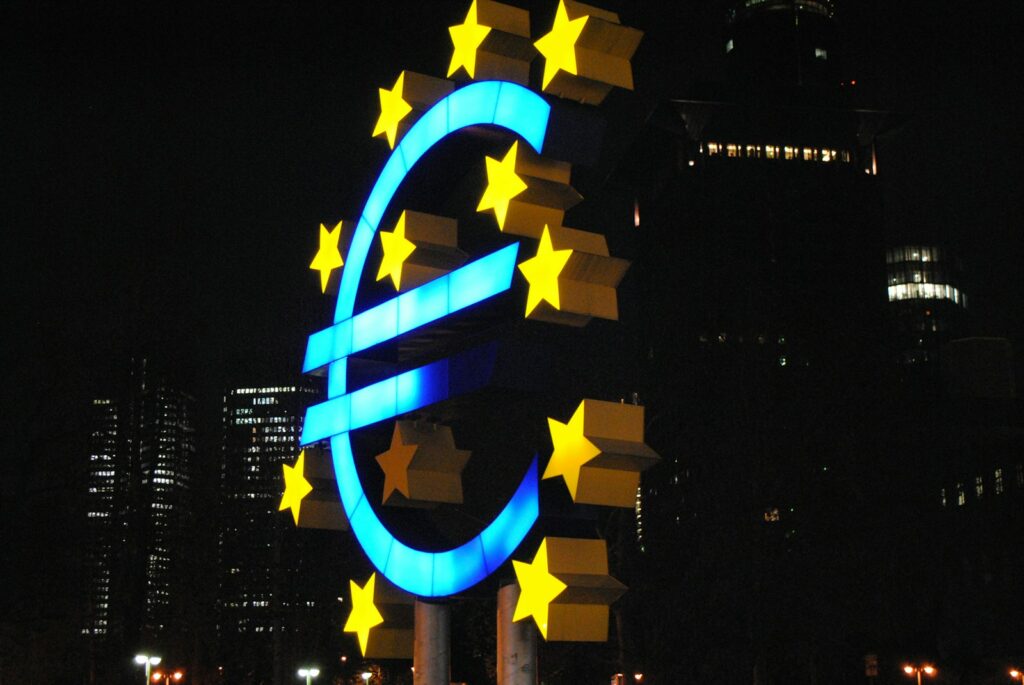
In February, the European Parliament called for the full rollout of a digital currency. This vote could prove very significant indeed. However, it lacked the impact that might have been expected of it, perhaps because it isn’t always clear to many people what a digital currency is.
We can all recognise that less use is being made of cash in the form of notes and coins. Cash cannot be used for online transactions. Without needing to visit a bank, many of us now pay bills or transfer money using smartphones. Indeed, private banks push us to do this all the time, offering financial incentives to those who ‘go digital’ and closing the ATMs whose services can be bypassed.
Just a few years ago Brussels was awash with branches of ING, for instance, where people could use ATMs not only to withdraw cash but to make payments and transfer money. Staff were also available for in-person consultations. Now the branches have disappeared, the consultations are online and the payments are made digitally. For those with bank accounts and smartphones, it is convenient. For anyone else, it is a question of trying to hunt down the few remaining branches or using ATMs in the street, which can be risky.
The use of cash has also declined because increasing numbers of companies no longer accept it. Overall, then, it is no surprise that in 2024, cash accounted for only 24% (less than a quarter) of day-to-day payments. It would be an exaggeration to say that cash is on the way out, and it is obviously essential for people without bank accounts and debit/credit cards. But it is becoming much less common.
The decline of cash
One often forgotten consequence of this is that there is less profit for central banks from ‘seigniorage’, the income they earn by producing currency. They profit by the difference between the value of the notes or coins they produce and the cost of producing them. Hence if cash is steadily disappearing, the profits made by central banks in producing it will fall.
Unsurprisingly, central banks don’t like this. At the same time, they note that private banks have developed digital forms of private money, initially through cards and more recently, as we have seen, through smartphones. Today, more than 85% of the money in circulation in the euro area is private bank money. Central banks know that there is an obvious reason for this. Cash is the only form of public money in the European Union (EU) that is directly accessible to the public. This has obviously led them to wonder whether they couldn’t follow the private sector in having a digital presence. In other words, what if it was possible to have a digital euro, a universally accessible form of public (central bank) money that combined the privacy and safety of cash with the convenience of digital transactions?
There are obvious advantages to this. It would be safer, since the private banks that currently control digital transactions are often non-European payment providers, usually based in the USA, and their services might conceivably be withdrawn at a time of international tension. A digital euro would also save people money, since they would avoid the fees charged by private banks. A third advantage is that the central bank digital currency (or CBDC) would be available to those without smartphones or internet access. It would be accessed using smart cards which would act as digital euro wallets and would be given out for free. You wouldn’t need a bank account to get one; you could walk into a post office or some other easily accessible public distributor of the digital euro and get one as a citizen by showing your ID. The cards and the use of them to make payments could easily be offered for free, because the cost of setting them up could be financed by those seigniorage revenues mentioned earlier, in this case revenues from issuing the digital euro rather than from printing banknotes.
There is therefore much to be said for a digital euro, but it is not always easy to persuade people of its virtues. Some think that recommending anything digital means talking up crypto assets or bitcoin rather than a totally safe digital currency guaranteed by the central bank. At the same time, private banks have been lobbying hard either to prevent a digital euro ever emerging or to limit its value, for instance by demanding a low maximum amount of money that can be held in accounts. They warn of a threat to financial stability – sceptics might see a threat to their currently very high profits – or they conjure up pictures of Big Brother knowing your every payment, though it would hardly be difficult for a digital euro to offer a substantially higher level of privacy than existing digital payment systems managed by private banks.
A digital euro could prove easy and safe to use. It is certainly not a replacement for cash, but it avoids many of the disadvantages that make people stick to cash. It would be obtained for free and wouldn’t require an account at a bank.
Even for those without bank accounts. Yes, the private banking sector would have to get used to it, but it would do no harm for them to learn to live with an alternative to their own digital provision. They might even feel incentivised to lower their fees!
