

After 25 years of intermittent negotiations, the Association Agreement between the European Union (EU) and Mercosur has regained political momentum.
In recent weeks, important institutional progress has been made in South America. On 26 February, Uruguay became the first country to ratify the EU–Mercosur Agreement. The following day, 27 February, Argentina completed its parliamentary ratification. Then, last Tuesday (17 March), Brazil (in a formal session of the National Congress) and Paraguay (in a session of the Chamber of Deputies) formally enacted the agreement.
On the European side, however, ratification by the 27 member states still faces a genuine institutional maze, marked by persistent criticism and protests from civil society—particularly farmers—as well as strong opposition from prominent political leaders such as France’s Emmanuel Macron.
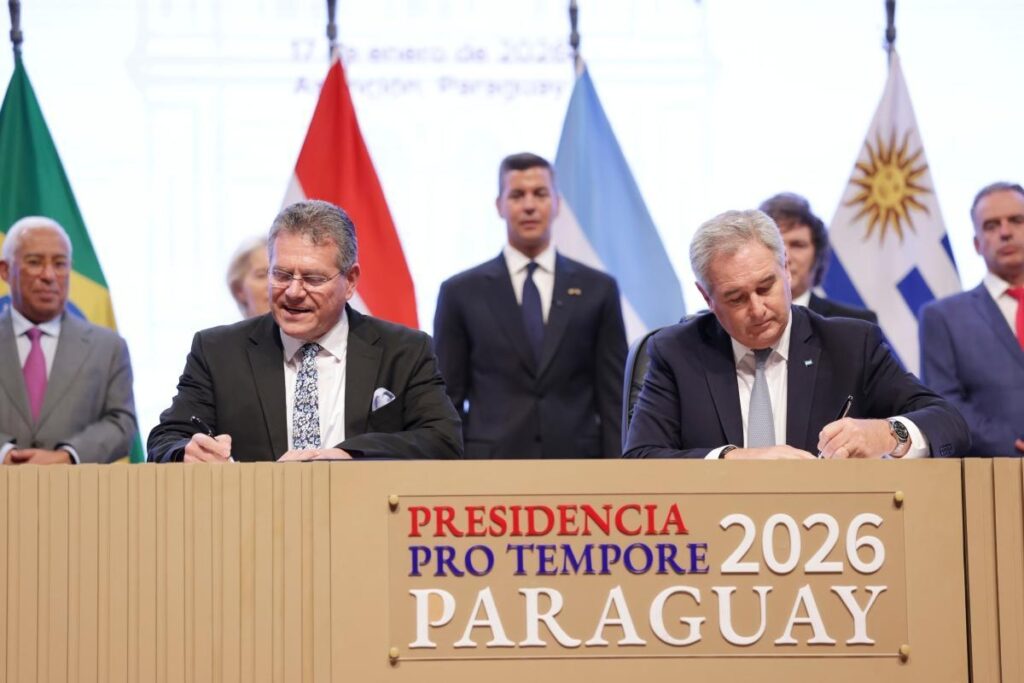
It is worth recalling that, on 9 January, the European Council—bringing together the EU’s heads of state and government—gave its political approval to the EU–Mercosur Agreement, authorising the European Commission, the bloc’s executive arm, to proceed with its signature alongside Mercosur on 17 January, thereby marking the formal conclusion of negotiations.
The difficulty is that, just a few days later, on 21 January, the European Parliament—the EU’s legislative arm—halted the approval process by referring the matter to the Court of Justice of the European Union. In effect, the issue has been judicialised within the bloc’s legal system. In practical terms, this means the process is now stalled and could take well over a year to be reviewed by the Court.
Even so, once Argentina and Uruguay ratified the agreement, the President of the European Commission, Ursula von der Leyen, stated that “when they [the South Americans] are ready, we [Europeans] will be ready”. This signals that the EU intends to move forward with provisional application, despite ongoing legal proceedings and widespread protests within the bloc.
In short, while the agreement has advanced significantly, it remains far from full implementation.
For Europeans, the agreement is more strategic than economic
In two previous articles, we argued that both the validation of the EU–Mercosur Agreement and its subsequent confirmation were driven largely by tariff pressures and the geopolitical context shaped by the United States.
Put simply, the constraining actions of Donald Trump pushed the EU to redirect its diplomatic efforts towards the global stage, accelerating negotiations on a range of trade agreements—with Mercosur, India, Switzerland, Nigeria, Australia, Malaysia and Canada, among others.
From a European perspective, therefore, the EU–Mercosur Agreement is far more political and strategic than strictly economic.
The EU has shown a willingness to absorb domestic political costs—including the largest farmers’ protests in Brussels since the 1990s—in order to consolidate the agreement as a tool of geopolitical rebalancing. The broader aim is to reduce vulnerabilities vis-à-vis the United States and to counter China’s growing influence in Europe.
While it is often emphasised that the two blocs together account for around 30% of global GDP and more than 720 million consumers, caution is needed when interpreting recent data on bilateral trade between the EU and Mercosur.
Figures from the International Trade Center (ITC) for the period 2015–2024 suggest that, from a European standpoint, trade with Mercosur remains relatively modest. Imports from South America accounted, on average, for just 0.93% of the EU’s total imports, while exports to Mercosur represented around 0.85%.
To illustrate, in 2024—the most recent year with consolidated data—the EU recorded imports of US$ 6.62 trillion and exports of US$ 6.88 trillion. Within this overall trade flow, Mercosur accounted for only US$ 121.8 billion.
In the long term, the EU–Mercosur Agreement may well expand the presence of South American goods and services in the European market. In the short term, however, its economic impact is likely to be barely noticeable for firms and consumers in the EU.
This is largely because new trade relationships take time to develop. They require new contracts to be negotiated, commercial strategies to be defined, logistics routes to be adjusted and entirely new business networks to be built.
Moreover, the EU depends far more on intra-EU trade than on exchanges with external partners.
For South Americans, the agreement is clearly economic
For Mercosur countries—Brazil, Argentina, Uruguay and Paraguay—the agreement with the EU carries clear economic significance.
Unsurprisingly, the negotiation process was marked by relatively low domestic political resistance and limited opposition from productive sectors, reflecting a broad consensus around the potential gains in market access and trade diversification.
It is also worth noting that Mercosur relies far more on trade with external partners (extra-Mercosur) than on trade within the bloc (intra-Mercosur).
For every US$ 100 of the bloc’s international trade—whether imports or exports—more than US$ 80 involve external partners. This highlights the relatively low level of intra-bloc trade integration within Mercosur.
In 2024, Mercosur recorded imports of US$ 368.3 billion and exports of US$ 451.8 billion. Within this total trade flow, the EU accounted for 16% of South American imports (US$ 59 billion) and 13% of export destinations (US$ 60 billion).
In other words, the EU is far more important for Mercosur than Mercosur is for the EU.
A note of caution on economic benefits
Despite the current political momentum, the EU–Mercosur Agreement still faces a long and complex path before it can deliver tangible economic benefits.
Moreover, the speed and scale of potential gains for Mercosur remain uncertain. Any benefits will depend not only on the agreement entering into force, but also on the ability of South American countries to adapt to European regulations, diversify their export base and build new commercial relationships.
Rather than a final destination, the agreement should therefore be seen as the beginning of a gradual process—one whose results will only become clear over time.
