
Like most big cities, Brussels has suburbs which were once rural villages.
As Chelsea once provided fresh vegetables to London City (if Shardlake is to be believed), so Auderghem was once a village outside Brussels nestling peacefully, or not so peacefully, athwart the Woluwe valley. I say not so peacefully because warring armies were mixing it up a bit throughout much of its history. Thus war-like Napoleon came along and rammed the three almost contiguous villages of Auderghem, Watermael and Boitsfort into one. Then he changed his mind and split them back into two. Hence Watermael-Boitsfort!
Auderghem has grown from, back when Belgium was formed, a population of 1,600 or so to its current megalopic 35,000. To add insult to injury, the E411 Namur motorway shoots east-west right through the middle, as does, only this time north-south, the Boulevard de Souverain. The two meet at the unlovely, motorway-on-stilts transport hub of Hermann-Debroux right slap-bang in the middle of Auderghem. This leaves a map of the commune looking for all the world like an unfurled cross of Saint George!
And yet, and yet it has somehow managed to maintain its rural character. For a start about 38% of its territory is taken up by dense woodland belonging to the Sonian Forest (Forêt de Soignes). Indeed, this is the only part of the Sonian Forest which impinges upon Brussels territory, at least on a technicality. Where bucolic greenery points a finger into Ixelles, it is known as Bois de la Cambre.
Then there’s the Val Duchesse, a large estate and ex-priory which stretches along the east side of Souverain Boulevard heading north towards the tram museum in neighbouring Woluwe-Saint-Pierre. It was a religious institution founded back in 1262, and then in the 18th century it became a lordly residence. Since World War II, and its current iteration, it has served as a meeting place for high-level political conferences. Here, the metaphorical foundations were laid for the European Union in the 1950s; in the 1960s, the somewhat fractious conference on the federalisation of Belgium took place there; and in the 1990s, the accession of former Warsaw Pact countries to the EU was agreed upon.
We humble plebeians rarely have access to this huge estate. But I do remember walking along its perimeter one ghostly 3am summer’s night and hearing all kinds of small mammals scurrying about on the other side of the fence. The night was hot, indeed muggy, the traffic non-existent, and Brussels suddenly felt like a night visit to Singapore zoo!
Then there’s the Château Sainte-Anne, a private club with extensive grounds; and indeed Rouge-Cloître, complete with fishing lakes, woods galore, a modern playground, a café, painting classes, and various clubs which are, happily, open to everyone!
All of this is to say that, somehow, despite the two massive traffic axes slashing the village in four, Auderghem has luckily, one might say miraculously, managed to maintain that rural touch.
It is also steep, at least in its south-east quadrant. Fortunately, the peripatetic 41 bus carried me up the vertiginous Ave Joseph Chaudron and deposited me not to the left, nor to right, but slap bang outside the main gates of Auderghem’s cemetery in a district called, intriguingly, Transvaal.
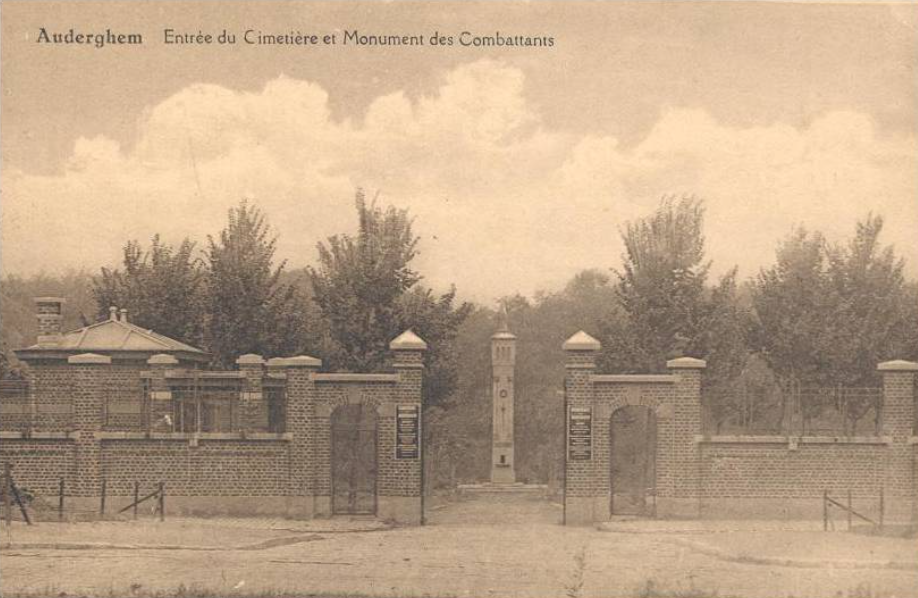
Old photo of the entry of Auderghem cemetery
1943 recurring
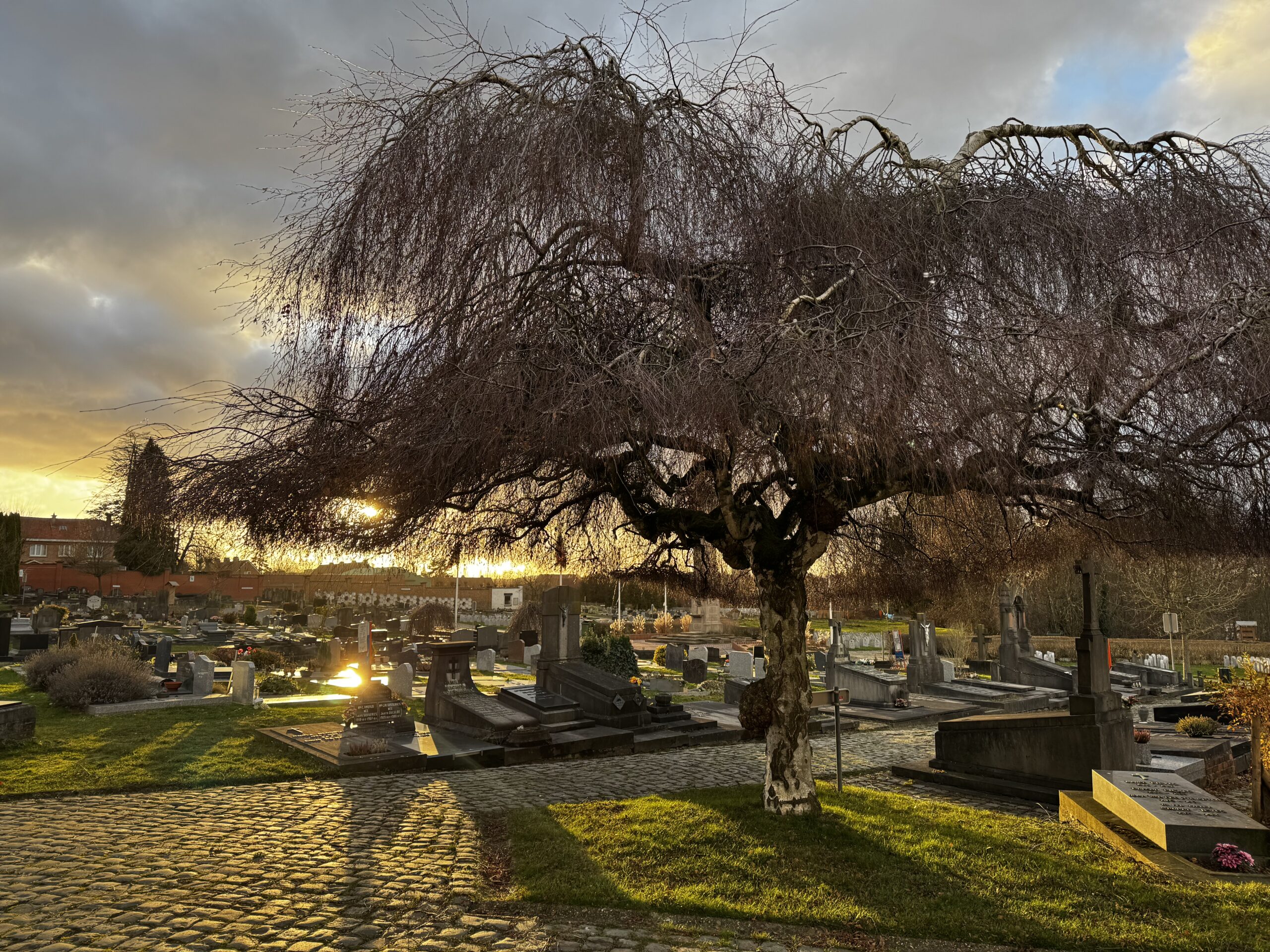
It was a cold, wet, post-snow January Monday when I walked into the smallish cemetery. Sloping gently back down the hill, walled as they all are in Belgium, the cemetery afforded an easy view of the three “specialised areas”, the Jewish cemetery, the stillborn cemetery and the war graves.
The cemetery is relatively new. The basic design was laid out just after World War I. The old cemetery was, logically enough, by the abbey at the Rouge Cloître. A local historian describes the moving of the remains from old to new was done at “un rythme lent”. I’ll say. The last tomb from the old cemetery was finally moved to its new home in 1967.
Behind the cemetery is a school, now called Establishment Sainte-Bernadette. It used to be the Sacré-Cœur institute, which initially took in pregnant unwed mothers and then became a maternity ward – the only such ward in the commune – thus the birthplace of most of Auderghem’s residents.
Auderghem cemetery. Credit: Leo Cendrowicz / The Brussels Times
One can’t help wondering whether the victims of the 1860s cholera epidemic may have preferred their cemetery to be surrounded by cafés, clubs, sports fields, children’s playgrounds, which are a feature of this recreational area contiguous to, and historically part of, the Sonian Forest. But they were in no position to protest. Some of the oldest and most undecipherable tombs are hard against the eastern walls of the modern cemetery.
The first thing to strike my eye, however, was a strange honeycomb effect on the walls both to my left and right. Closer inspection revealed these to be six-sided containers for the ashes of those who have been cremated. They fit together neatly on the walls like a wallpaper pattern. I gather this is referred to as a columbarium - the Latin for dovecot. Quite a few had coloured photographs of the “passed” and they looked, well, recent. This would seem to indicate the habit of cremation to be of recent vintage. I can’t help wondering if it hurts. But then, how much fun is it getting eaten up by worms for a few decades?
Hidden behind its own brick wall is the Jewish cemetery. There are about a hundred last resting places taking up all the available space. It is quite distinctive as the graves are close together and, pretty much, of standard design and stone type. Some are engraved in Hebrew, some French and some both. I went on a little meander to search quixotically for one in Yiddish or Dutch, but no luck. I looked for signs of recent visitors, stones on the graves for example, but found none. The latest death I saw was 1986. So, feeling it was the right thing to do, I picked up three small stones and put them on three separate graves as a mark of respect. Chillingly, the commonest year of death appeared to be 1943.
I find it sad that no more funerals will be happening here. No more formal attire, no more simple unadorned caskets without nails, no more final throwing of earth, no more stones on the grave, no more ritual washing of hands, no more tzedakah or charitable gifts. And, of course, no more flowers because there never were. Flowers are impermanent and thus not part of this tradition. It is the stones that are there to represent eternity.
Fallen in combat
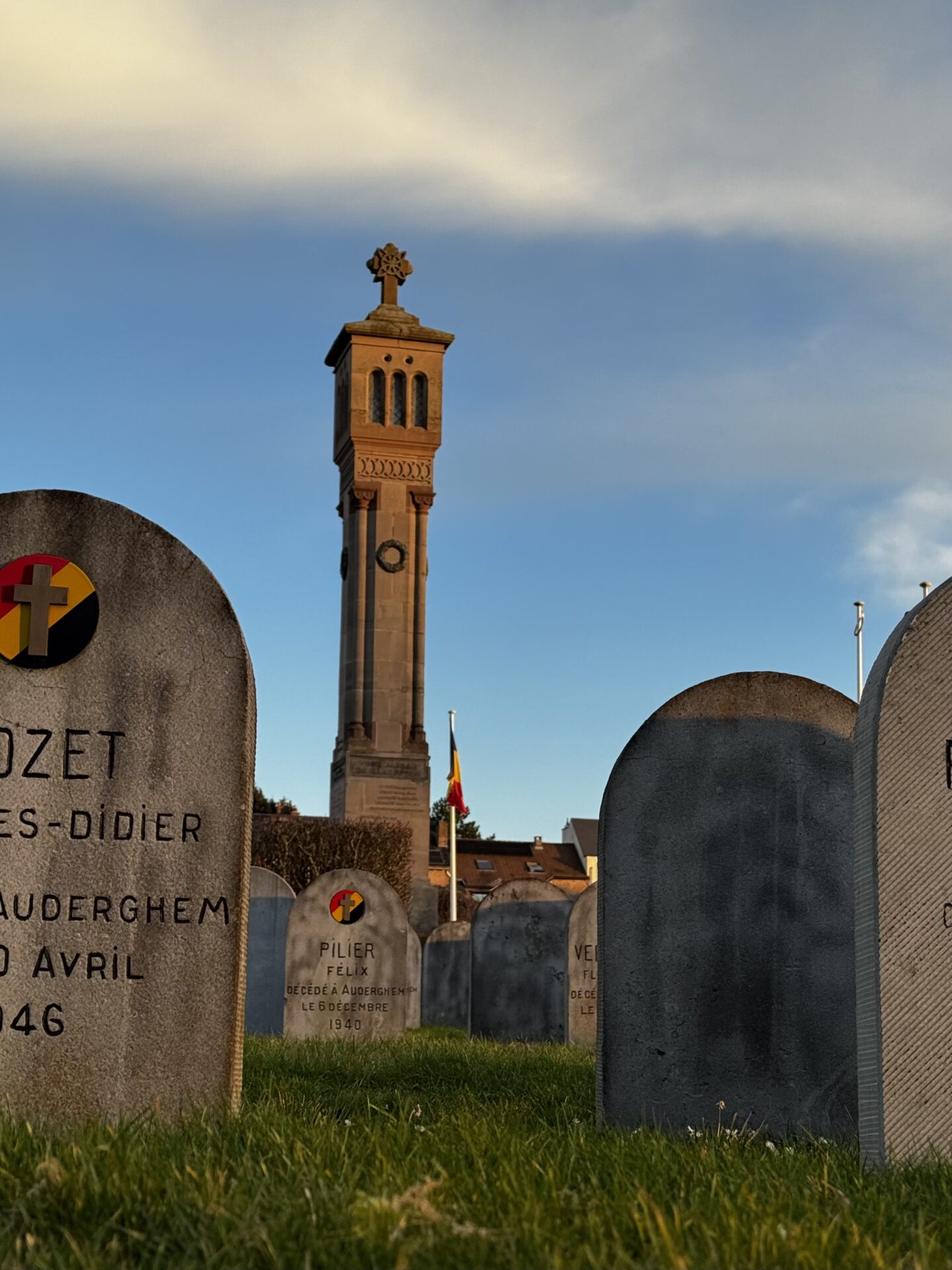
A little further on was the military graveyard. Small identical headstones with name, date of death, but no rank. Each one has a little round plaque in the Belgian colours. I’m guessing there are about 400 of them in a semicircular pattern. None of the occupants that I saw appear to have died in combat, judging by the date of death. I wandered up to the gate-side office, explained my mission to the smiling lady therein, and asked her why these servicemen (I saw no women) chose, if indeed they did choose, to be buried with their comrades rather than, say, with their family. She said, “I don’t know. It’s too long ago.”
She was, however, able to guide me to where some British or Commonwealth airmen lay hidden among all those Belgians. They, by contrast, had clearly died in combat (1944). Intriguingly, the Belgian army had done a little circular Union Jack flag for each stone, the like of which I had never seen before. I touched one of the graves and said briefly that their fight against fascism was still appreciated. I then, guiltily aware I am the proud possessor of two passports, touched one of the Belgian stones and said the same thing in the vernacular.
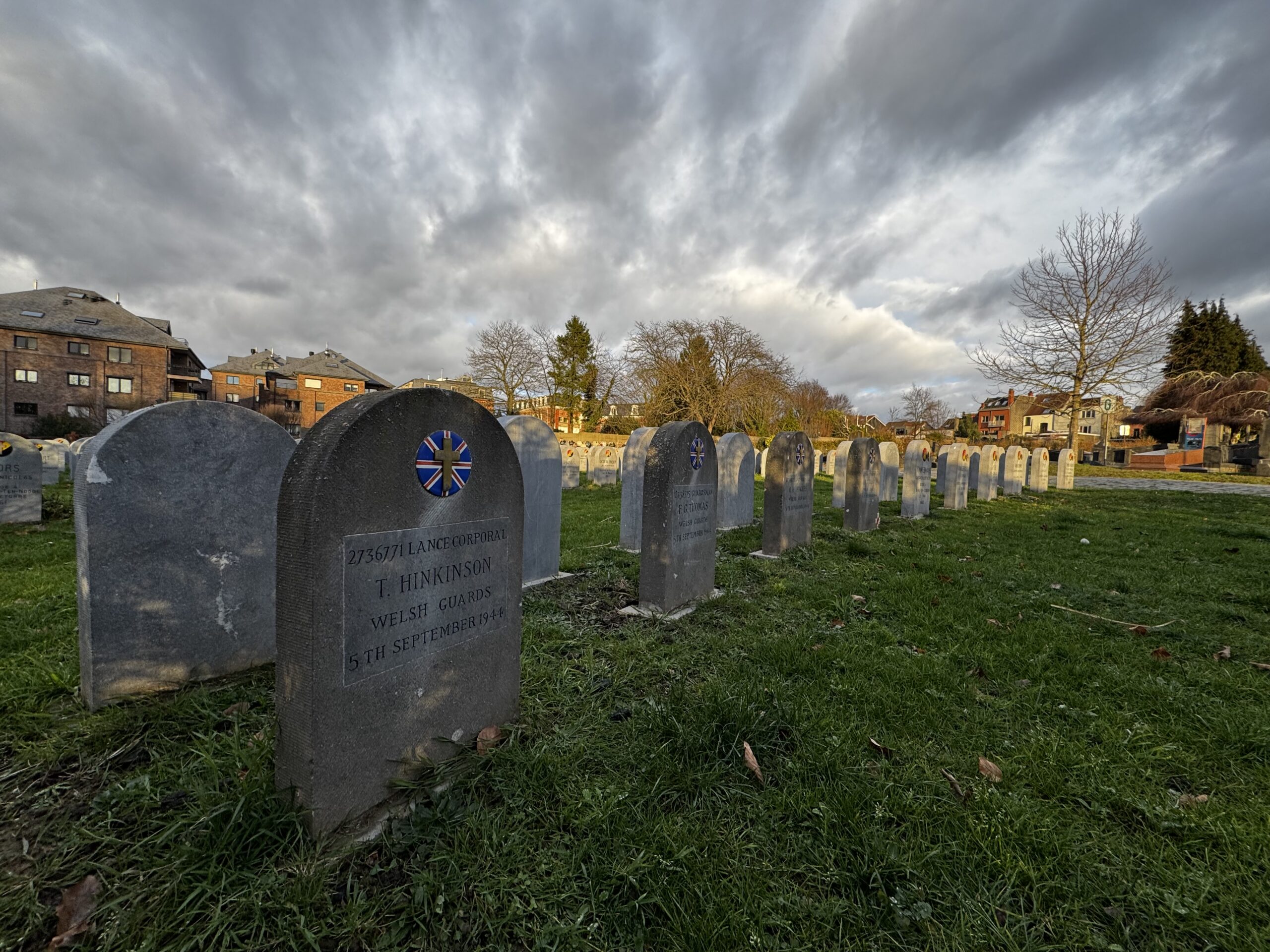
British war graves at Auderghem cemetery. Credit: Leo Cendrowicz / The Brussels Times
The expatriate isolation of the Commonwealth graves reminded me of a gardener in a remote seaside piece of parkland in France long ago. The volunteer, hearing us speaking English, took me firmly by the arm and led us to a leafy, pretty, well-tended area of bushes. There, hidden away, were two RAF graves entirely on their own! The gardener, now realising we spoke French, told us he remembered the plane coming down as a boy and so he personally looked after this spot of land with especial care. His pride was palpable and my wife burst into well-justified tears.
At the epicentre of the Auderghem graveyard is a war memorial. Encircled around its base are the tombs of fallen soldiers from the First World War. The names are almost entirely effaced but I did manage to make out the numbers 1917. Something else I have never seen before, graves around a war memorial!
And there, hard beside “the crosses row on row” is a new initiative for the stillborn, the so-called Jardin des Fleurs. Proudly opened only two years ago, it is an as-yet largely unused piece of ground about 100 square metres which provides a burial space, and a mourning space, for children stillborn in the first six months of pregnancy. Belgian law is clear; the foetus has no legal existence in the first 180 days after conception. It seems, therefore, only kind and civil, if so wished, to be able to bury the remains in a peaceful and, yes, spiritual setting where parents can go and mourn.
When I approached the space there, by the incipient row of crosses, there was a small group of people. They stared at a grave silently and mournfully, and then moved over to the shimmering, I have to say rather beautiful, metallic tree sculpture which stood in the middle. It was like some giant, inverted child’s mobile. The family stood subdued but the shining tree slowly made them smile. I did not feel right intruding on their grief and departed. I felt that that small piece of land is where secularism meets common decency.
Celebrity status
The communal authorities were modest when my esteemed editor consulted them about celebrities who had been buried in their cemetery. However, Belgian singing star Maurane is one such. Born in 1960 of a very musical household, she rebelled against violin lessons and taught herself guitar. Like the great Jacques Brel before her, she sought fame and fortune in Paris. She got a part on the Quebecois rock-opera Starmania and then her sell-out concerts in the Sentier des Halles put her firmly on the map. One of her discs, Ami ou ennemi (Friend or Foe), sold 450,000 copies which, for a French album, is quite something.
She was living back in Belgium in 2018 when she died suddenly at the age of 57. There was a certain amount of irresponsible speculation about the cause of death at the time; but the autopsy deemed it to have been an unfortunate fall while getting out of the bath.
I had a little trouble finding her grave because I didn’t know her real name was the prosaic Claudine Luypaerts! A playful music motif on her well-tended tomb gave it all away. I read that a large number of French superstars took the trouble to make the journey north to her funeral.
I looked her up on Spotify and listened to her. I chose her version of Brel’s Ne me quitte pas and I can confirm that a simple piano backing set off her smoky intensity beautifully.
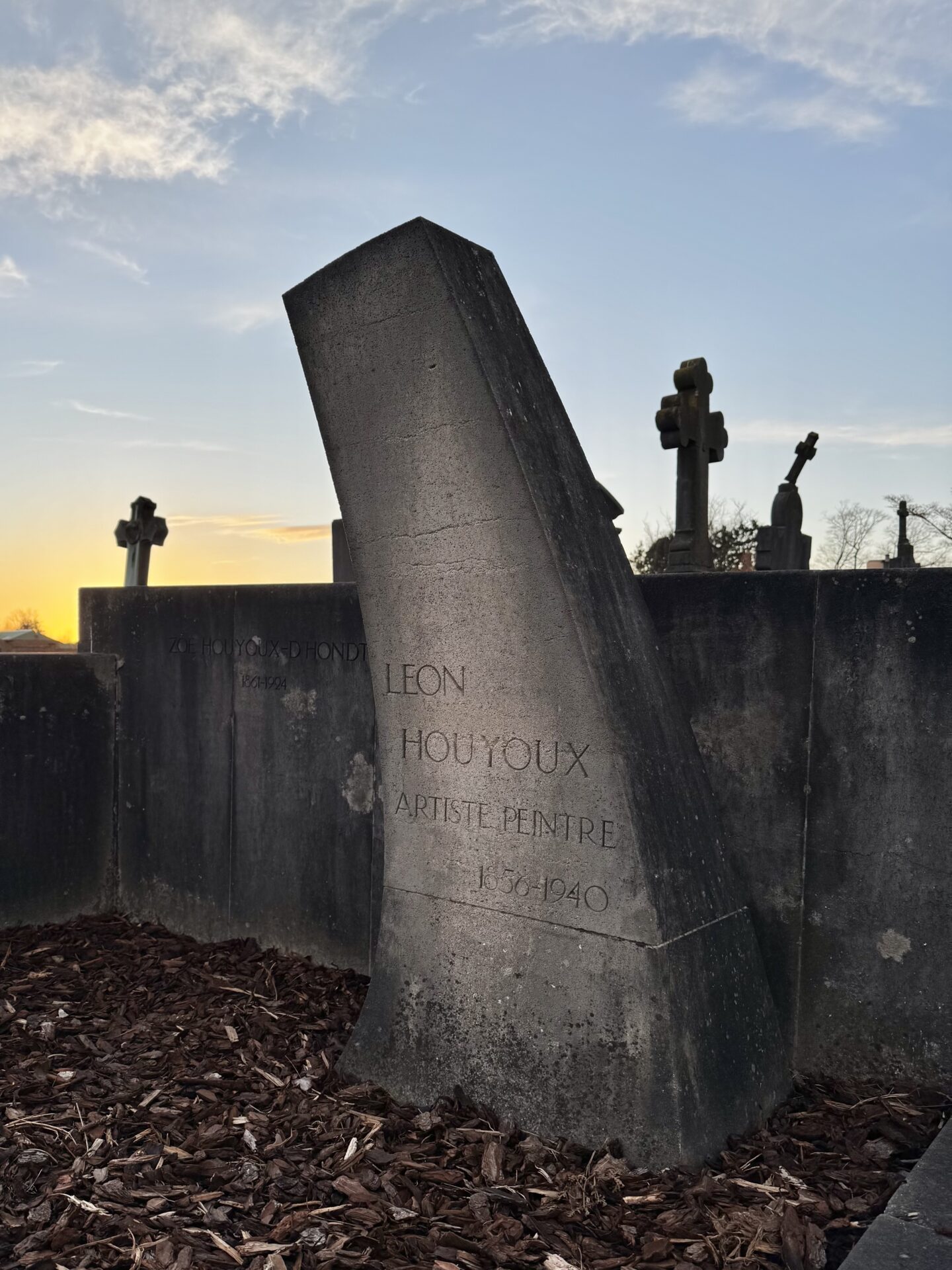
Leon Houyoux at Auderghem cemetery. Credit: Leo Cendrowicz / The Brussels Times
Another celebrity buried here is the painter Leon Houyoux, who lived from 1856 to 1940 and was famous for his nudes and landscapes. He graduated first in his class at art school well ahead of the subsequently better-known James Elsnor. His connection with this commune is profound, as he painted the forest and lakes around the Rouge Cloître.
His international reach was significant, having lived and painted in places as disparate as Menton and Scotland (one of his panels graces St Edward’s University in Austin, Texas), he was invited to join the Beaux Arts in Paris, and he was a co-signatory of the Belgian artists’ letter of support for Alfred Dreyfus. His grave is modernist, arresting, simple. I checked up on the prices of his paintings and was astonished to discover such expertise could be had for the price of a short holiday!
As a footnote, his nephew Maurice was the distinguished architect who designed the Royal Library of Belgium (KBR), the starkly modernist building in the so-called Royal Quarter that houses the state’s book collections.
Abbots and mayors
A grave dedicated to the Famille de Waha intrigues with its unusual name. It springs from a small village in deepest Wallonia. It transpires the name belongs to a family who have been part of the nobility in no less than three different countries: Luxembourg, the Netherlands, and Belgium. It is first recorded in the year 950, a de Waha was abbot of the Abbey Saint Hubert in 1226, and the family has been distinguishing itself in various ways in those three countries for over a millennium. Auderghem has a street named after the local branch of the family.
Alfred Madoux (1870-1928) was a journalist and painter whose most distinguished act, perhaps, was to close the doors of his newspaper (L’Etoile Belge) rather than submit to German censorship in World War I. He also lost a son in that conflict, and the grief never left him. His other son, Charles, subsequently became mayor of Auderghem.
Henri de Brouckère (1801-1891) hailed from Bruges where the name is spelt without an accent. He fought fearlessly to expel the Dutch during the 1830 Belgian Revolution and helped with the country’s foundation. He briefly represented the frontier district of Roermond, which was later split with the Netherlands and, in Belgium, is now the district of Maaseik.
Amongst his impressive responsibilities afterwards were Governor of Antwerp (1840-1844), Governor of Liège (1844-1846) and Belgian Prime Minister (1852-1855). In 1863, he became Auderghem’s first mayor and lived in Château Sainte Anne – no mean gaff – which has since been demolished and rebuilt practically on the same spot. The Ave Henri de Brouckère originally ended at the castle, but the Boulevard du Souverain has since cut it short. Not to be confused with his younger brother, Charles, who became mayor of the city of Brussels, and for whom the metro station is named.
Henri lies along the south wall along with fellow mayors Felix Goevart, Joseph Chaudron (he of the steep street), and François de Waha. There is a little piece of unused land which is marked for a crypt. My friendly local historian speculates that the commune may be intending to build a crypt for its mayors. We shall see.
The day is cold, the wind is biting. Despite, or even because of that, I have enjoyed my little sojourn. After all, I was incarcerated by snow for a week and it’s great to get out and about. Some find cemeteries depressing, intimations of their own mortality. For myself I love the sense of history, where we have come from, what we owe, the shoulders we stand on. And yes, where we are going to. But like St Augustine’s plea for chastity, “Not yet, Lord, not yet!”
