
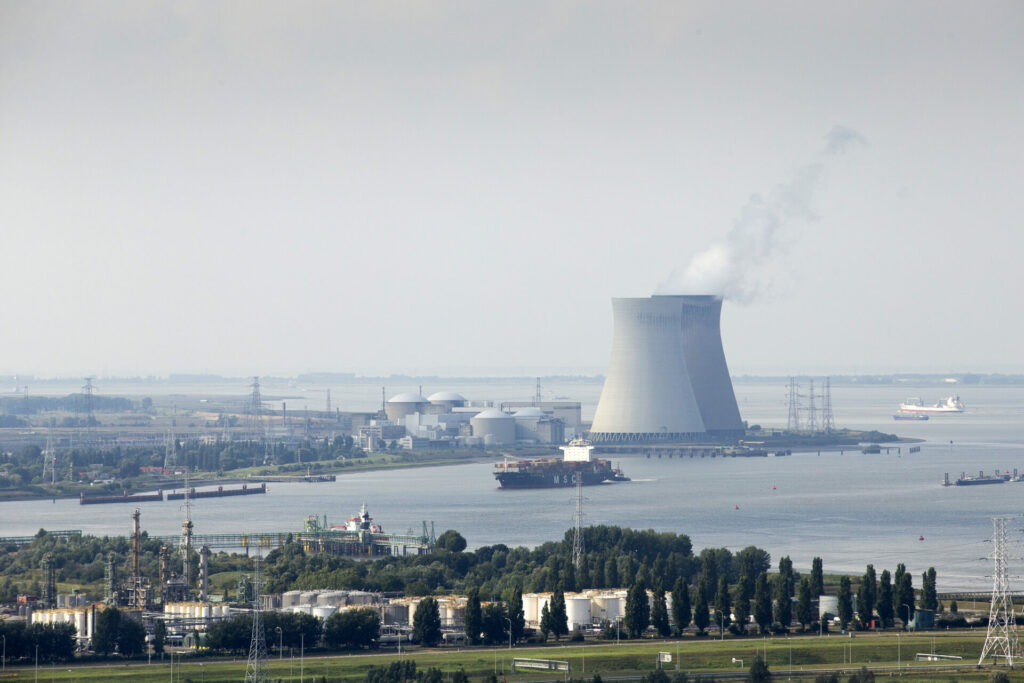
The renovation of two nuclear reactors will have "no impact" on security of supply, but the Belgian grid will be more dependent on France during that period, Belgian transmission system operator Elia has announced.
Belgium will have to do without nuclear energy for the next three summers, between 2026 and 2028, as the power plants need to be prepared for an extended lifespan.
As part of the 10-year extension of the operating licenses for the Doel 4 and Tihange 3 reactors, the two plants will undergo refurbishment between 1 April and 1 November for three consecutive years.
Elia has analysed the impact on grid stability of this temporary absence of nuclear power, combined with an increase in renewable energy production. The company does not anticipate any impact on the security of supply.
"The conclusion is clear: grid stability will remain under control, even if pressure may increase in certain situations," Elia stated in a press release.
During periods of nuclear power plant refurbishment, collaboration with neighbouring countries will also be intensified, particularly to better coordinate maintenance programs and exchange real-time data, Elia said.
In the meantime, together with producers and major grid users, Elia is examining how they can contribute more to grid stability.
Elia is also working with market players on a new study aimed at further anticipating the stability challenges of tomorrow's energy system, in which the share of conventional power plants, sources of stability, will decrease, while decentralised renewable energy production, batteries, and data centres will become increasingly important.
Depending on France
At the same time, Elia's study stressed that while the reactors are renovated, the Belgian electricity grid will be more dependent on France to keep it stable.
Elia concludes that grid stability can remain under control thanks to the strong interconnection with neighbouring countries. Therefore, the grid is prepared for unexpected shocks.
However, dependence on France increases, and the stability margin becomes smaller. It will be necessary to closely monitor operations in cooperation with foreign grid operators and users, according to Elia.
The study indicates, among other things, that grid voltage could exceed limit values at certain times, for example, when solar panel production peaks during off-peak hours.
In such cases, it may be necessary to switch off a large volume of cables and lines as a measure. Careful planning will be required for this, Elia stressed.
