

The future of the fur industry in Europe will soon be decided by the European Commission.
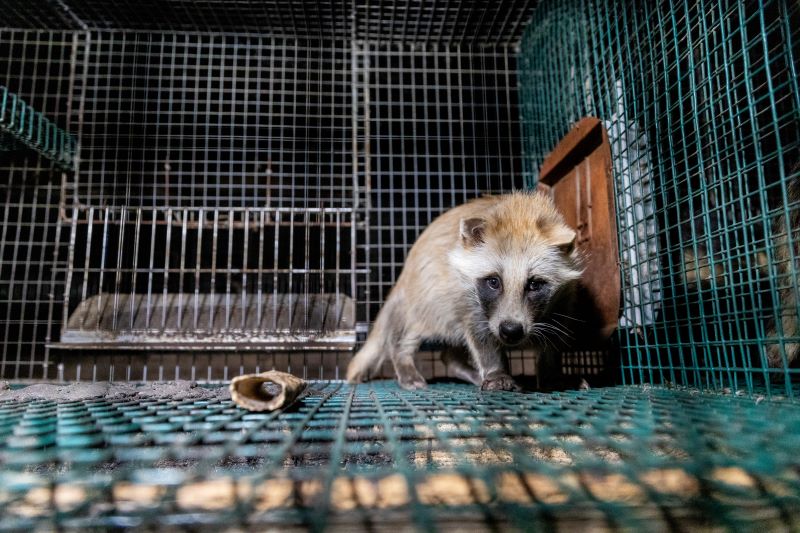
They must choose either to respect public opinion, which overwhelmingly favours an EU-wide ban on fur farming, or to establish minimum ‘welfare standards’ that would permit a small minority of producers in a few Member States to continue caging mink, foxes, raccoon dogs, and chinchillas for their pelts.
Finland, my homeland, remains one of the few remaining Member States of the European fur farming industry, yet even here, its foundations are rapidly eroding. Since 2017, the number of active fur farms there has plummeted from 1,015 to 430 in 2024 - a staggering 57 percent reduction.
This sharp decline can be attributed to several factors, chief among them the outbreaks of avian influenza in 2023 and 2024. Transmission of the disease from fur farms threatened nearby poultry operations, also raising the spectre of zoonotic spillover events. Ultimately, these episodes resulted in the culling of 500,000 animals on 72 fur farms, with the Finnish government spending €42 million on compensation.
Finland is not alone in witnessing the downturn of its fur industry; across Europe, the sector is swiftly losing its economic viability. With global demand dwindling, market prices becoming increasingly unstable, and the proliferation of national production bans, the future of fur farming in Europe is bleak.
A recent report A full-cost account of the EU fur industry by economist Griffin Carpenter lays bare the true cost of fur production. Carpenter’s findings reveal that fur farming is far from the lucrative venture its advocates suggest, highlighting the irrationality of sustaining the industry given its substantial economic, societal, and environmental burdens, in addition to the ongoing suffering of animals.
Grim realities of fur farming
According to Carpenter, the EU fur industry has been unprofitable for several years, experiencing a dramatic contraction over the past decade with the number of active fur farms declining by 73%, pelts produced falling by 86%, sales revenues plummeting by 92%, and employment levels dropping by between 86% and 92%.
He anticipates that production will fall by a further 15–20%, as six Member States continue to phase-out fur farming. Significantly, this forecast was made prior to Poland - currently the EU’s largest fur producer - implementing its own ban on the industry.
Carpenter’s most striking finding is, however, that fur farming in the EU results in a negative gross value added of €9.2 million, meaning it detracts from, rather than contributes to, the overall EU economy.
On top of this, the sector is burdened by annual environmental costs - stemming from inter alia particulate matter, pollution, acidification, and eutrophication - amounting to around €226 million. Public health costs add a further €211 million each year. When combined, these figures far outweigh the fur farming sector’s total annual revenue of €183 million, underscoring the industry’s net drain on the EU economy.
The fur farming industry does not even provide substantial employment, supporting only 2,048 full-time equivalents (FVE). Overall, the whole EU fur industry - including both fur farming and product manufacturing jobs - employs an estimated 3,313 to 5,522 full-time equivalent jobs. This accounts for a mere 0.002% to 0.003% of the total EU workforce, placing it on par with niche sectors, such as wallpaper manufacturing.
Why, then, is the European Commission even contemplating the introduction of animal welfare standards instead of simply advancing a ban on this loss-making industry?
This approach would be all the more illogical when considering EFSA's recent scientific assessment, which unequivocally found that the caged confinement systems currently used on fur farms are fundamentally incapable of meeting the animals’ welfare needs.
According to EFSA’s scientists, if animals are to be afforded sufficient space and a stimulating environment to fulfil their basic behavioural needs, the existing cages must be replaced with entirely new types of enclosures. However, these alternative housing systems are not currently employed in commercial fur farming, nor have they undergone scientific evaluation.
Put simply, the Commission would be requiring fur farmers - already facing economic adversity - to invest in unproved and commercially untested housing systems. There is no assurance that such investments would lead to genuine improvements in the welfare of mink, foxes, raccoon dogs, and chinchillas; indeed, it is highly probable that these would merely become stranded assets.
Rather than delivering half-measures and further driving up the costs for an industry that is already economically unsustainable, ethically indefensible, environmentally damaging and a growing threat to public health, the Commission should instead move swiftly towards an EU-wide ban on fur farming.
Such a measure would not only end the needless suffering of millions of animals, but also free up resources for more productive, humane, and sustainable forms of agriculture. It would protect public health, bolster rural economies, and reflect the values of a modern, compassionate Europe.
If the Commission listens to its citizens and decides to consign fur farming to the past, it must also ensure that those who depend on it are not left behind. Pairing a ban with a just transition that supports farmers to move toward sustainable, future-proof livelihoods will be vital part of achieving a Fur Free Europe.
