
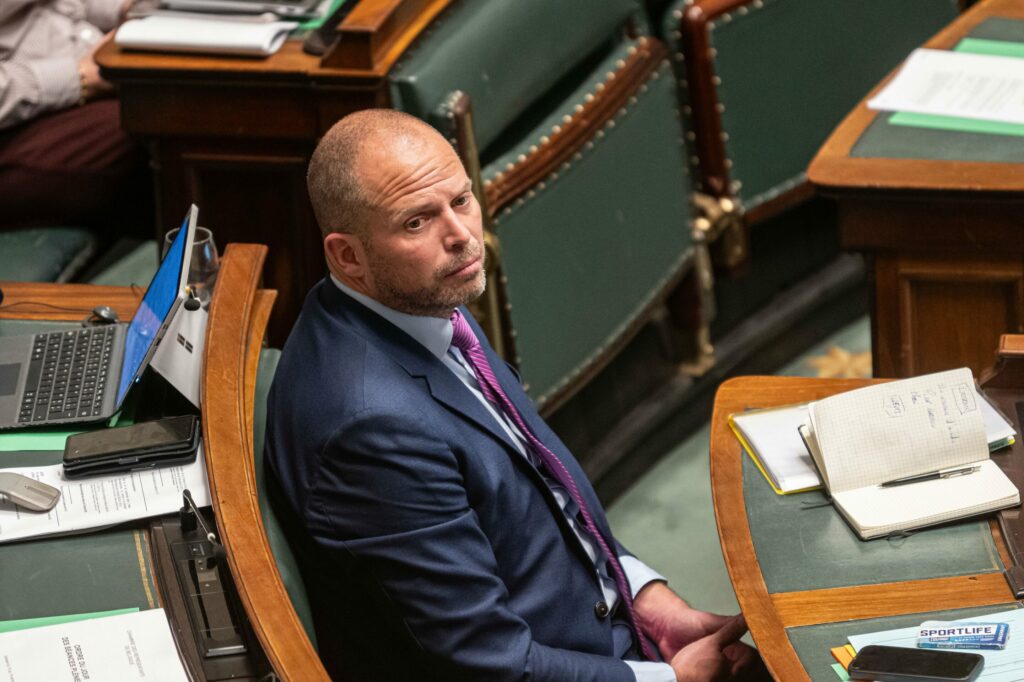
Belgian Defence Minister Theo Francken (N-VA), is under fire after an investigation lambasted his response to a series of drone sightings over Belgium in the autumn.
In October last year, a number of drones were seen above the Elsenborn military base. Over the next few weeks, drones were regularly reported above Belgian military bases and airports, causing flight disruptions. Francken called the situation a "military crisis" and pushed to accelerate Belgium's action plan against drones, launching a €50 million anti-drone scheme.
On Wednesday, Flemish public broadcaster VRT's investigative programme Pano claimed that the minister exaggerated the drone sightings, attributed them to Russia without evidence and launched his anti-drone plan without a public tender that was too expensive and ineffective.
The minister is also alleged to have leaked footage of such a drone above Zaventem airport to HLN, while he had stated in parliament that he had not communicated "proactively" about the sightings.
Suspicion of overspending rises
As part of its investigation, VRT claimed to have found no evidence of hostile drones over Belgian military bases and airports at the end of last year.
Furthermore, according to VRT, Francken’s fast-track anti-drone procurements – without public tenders and without quantified price control – were financially unsound.
The ministry reportedly proceeded with a €50 million spending plan despite receiving negative advice from the Finance Inspectorate in October 2025, VRT wrote.
The investigation has questioned whether Belgium may have paid over the market price for drone detection systems, and if those systems were the best choice to begin with.
The Ministry of Defence paid €10.4 million (excluding VAT) for the supply, installation and service of 84 radio frequency (RF) detection antennas of Hasselt-based company Senhive, VRT reported.
However, Pano’s market research alleges that the same antennas were available from other sellers for roughly one-quarter of that price.
The Ministry of Defence has also purchased 300 Latvian kamikaze drones BLAZE via Belgian company Cobbs, paying around €7.8 million, while Pano’s market research showed that the actual market value for 300 units is approximately 1.8 million euros, indicating potential overpayment of €6 million.
The report also questioned the decision to invest heavily in RF detection, since hostile or Russian drones often utilise GPS, satellite, 5G, or fibre optic technology.
Backlash in parliament
The report sparked a heated questioning of Francken at the Federal Parliament on Thursday, as N-VA kept resisting energy cost relief measures, citing budgetary restraints.
"Pensions are being cut, as are wages, subsidies and benefits. At the same time, it can't go fast enough for defence equipment," said Groen MP Staf Aerts, member of parliament and chairman of the Army Procurement Committee. He also called out Francken for refusing to cooperate on the Pano report, while “at other times he could not be removed from the press”.
CD&D MP Koen Van den Heuvel was critical but called for calm. "This causes frustration in times of budget deficits. The prime minister says every day that the money has run out, then spending on defence must also be done wisely," he said.
Vooruit MP Axel Weydts called on Francken to provide “absolute transparency". He also noted that, “investing in our security is necessary, but in a fair, correct and transparent way”.
Anders MP Gwendolyn Rutten also lashed out at Francken in a post on X, saying: "Minister leaks images to a newspaper. A big, dangerous drone. In reality: a police helicopter. Dramatically steps out of a TV programme, only to dig into the bin with army purchases."
Vlaams Belang has called on an independent audit committee, criticising N-VA over "dubious army purchases" at a time when "supposedly no money for affordable energy, for our social security or for the purchasing power of the Flemings," said MP Annick Ponthier.
"There are ministers who have already had to resign for much less," said PVDA MP Peter Mertens.
'Law was followed,' says Francken
Francken did not cooperate with the VRT report but defended himself during question time in parliament on Thursday afternoon. He said "not a single law was circumvented" in the purchase of the anti-drone equipment.
Speaking to VTM Nieuws about the Pano report, Francken said: "The law states that urgent purchases must follow a certain procedure and it has been followed." He also said that the House Committee on Army Procurement has approved the plan, with the exception of one abstention.
"The rest were all in favour, including the opposition, which is now making such a fuss," he added.
The Belgian Ministry of Defence also defended the €50 million purchase of anti-drone equipment. In a written response released to The Brussels Times, the ministry said it regrets the "insinuations and sensationalism" in the Pano report, noting that it was not given a right to respond via VRT channels on Thursday morning.
According to the ministry, the prices charged are in line with market rates and have been audited, and the expedited procedure was conducted correctly and legally. It stated that Pano's comparisons to other suppliers are "by no means correct."
The ministry said that the Senhive RF antennas do not concern the basic version, but a professional military version (SEN PRO), used within the Belgian-French CAMO project and whose price was verified via the partner country.
Regarding the BLAZE kamikaze drone, the ministry referred to a price check at the end of 2025 in the context of the Belgian support package for Ukraine. It argued that apart from drones themselves, the unit price includes control consoles, ammunition, training, and command and control systems.
The ministry also defended the assumption that drones were linked to Russia, referring to Belgian security services, which considers it to be "the most plausible hypothesis," even without formal evidence.
It cited Belgium's role in the dispute over frozen Russian assets held in Brussels-based company Euroclear as a possible catalyst.
