
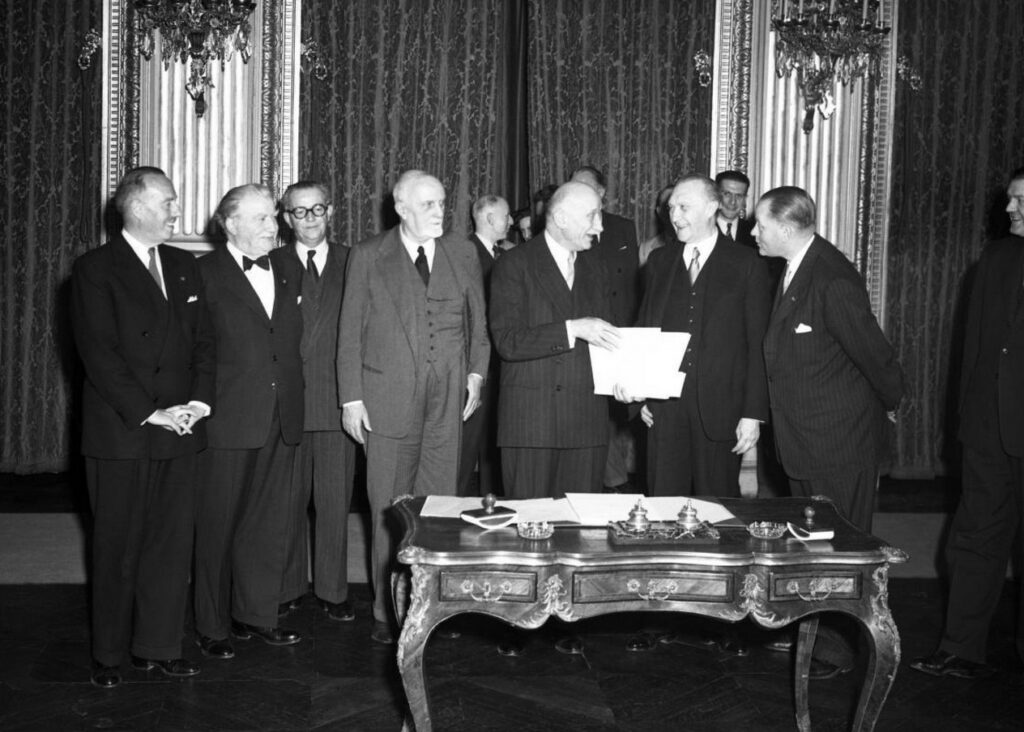
Europe is marking 75 years since six countries signed the Treaty of Paris on 18 April 1951, creating the European Coal and Steel Community, the first treaty that later led to the European Union.
The treaty was signed by Belgium, the Federal Republic of Germany, France, Italy, Luxembourg and the Netherlands, the European Commission said in a statement on Friday.
The agreement helped pave the way for the European Economic Community, created by the 1957 Treaty of Rome, and the European Union, established by the 1992 Treaty of Maastricht.
French foreign minister Robert Schuman had set out the idea of a coal and steel community in the “Schuman Declaration” on 9 May 1950.
Schuman said “solidarity in production thus established will make it plain that any war between France and Germany becomes not merely unthinkable, but materially impossible.”
Why coal and steel were chosen
A year after Schuman’s declaration, the European Coal and Steel Community was launched, with the primary aim of organising the free movement of coal and steel, opening access to sources of production and ensuring price transparency, the Commission said.
Coal and steel were vital industries in the early 1950s, it said, adding that pooling French and German resources was intended to mark the end of rivalry between the two countries.
The Treaty of Paris also laid foundations for several EU institutions by creating an executive body known as the “High Authority” — described as the predecessor of today’s European Commission — alongside a Parliamentary Assembly, a Council of Ministers, a Court of Justice and a Consultative Committee.
