

Europe was reborn in 1951. Europe’s governance system has to date saved millions of lives because no further war occurred in Western Europe after World War Two.
Wars were the common expectation in Europe before the creation of the predecessor of the European Union. But European politicians are studiously burying any trace of this epoch-changing event of reconciliation.
A few years ago, Brussels spent millions of euros celebrating the much later Common Market. Its institutions, such as the European Commission, were founded, not by the 1958 Treaty of Rome, but by the Treaty of Paris in 1951. Its architect, Robert Schuman, said that it created Europe as a political entity. It hadn’t previously existed.
The founding treaty had a far more important task: to bring peace to the entire Continent. With that first act of creating the European Community, its institutions became Europe’s instruments to construct Europe as a place of peace.
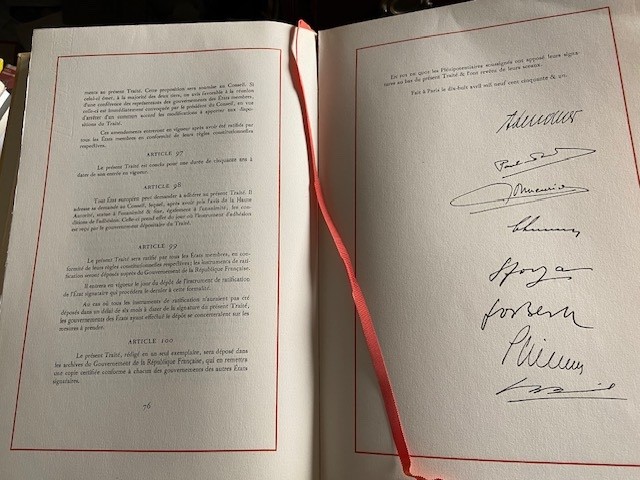
The signature of the Treaty of Paris, 18 April 1951 reconciled France, Germany, Italy, Belgium, the Netherlands and Luxembourg. It created a solidarity of fact and common democratic management of the strategic materials of war, steel and energy, then primarily coal.
Over the following decades the peace process expanded. The UK, Ireland and Denmark, Greece, Spain, Portugal, Austria, Finland and Sweden joined their voices for peace. Central and Eastern European nations were freed from Soviet dominance. Cyprus and Malta joined and expanded the Community of peace to the far reaches of the Mediterranean.
For the early decades, the European peace process prospered. So did the economies. It fulfilled its promise of the Schuman Proposal to ‘make war not only unthinkable but materially impossible.’ It gave western Europe the longest period of peace in its entire, recorded, two-millennium history.
All five of the European institutions in operation today were born that day in Paris. The press witnessed the signatures in the French Foreign Ministry. This year should have been the year of festivities as the European Community celebrated its 75th anniversary. Instead, the European Union, as the transformed entity succeeding the European Community, has chosen to bury this birth history.
Why? Birth of what?
The European institutions
The European Commission was created firstly under the name of High Authority, a supranational body, designed to be totally impartial, to act as the arbiter between democracies in the coal and steel sector.
The European Parliament was created as the European Assembly. It was scheduled to be elected, based on full universal suffrage, not restrictive, national rules.
The Consultative Committee provided a balanced, legislative forum for industrialists, workers and consumers. It was created by the same measure. Its functions were later taken over by the Economic and Social Committee. The Committee of the Regions is a separate body.
The Court of Justice was formed to guarantee rights of individuals, organisations and States. The judges were to be supervised by a democratic assembly.
The Council of Ministers provided for the national interests of democratic Member States and as such the discussions and deliberations were to be as open as the Parliament to press and public.
All these bodies were born at the same strokes of the pens of the following persons: Robert Schuman of France, Konrad Adenauer of West Germany, Count Sforza of Italy, van Zeeland and Meurice of Belgium, Stikker and van den Brink of the Netherlands, and Joseph Bech of Luxembourg.
Thanks to the European Community’s supranational synergies, Europeans effectively banned war between Member States. Europeans gained new freedoms, safeguarding the future from wars, and providing freedoms of speech, religion and trade. The Community targeted these previous causes of war and discrimination. It made them assets.
Schuman provided a plan to unite the whole Continent. Free speech in a European Assembly would dissolve the corrosive ideologies of Nazism and Communism. Human rights would be reinforced by law and public opinion. Trade of strategic materials would benefit wider construction and employment. Europe, based on its foundational Judeo-Christian culture, could unite from the Iberian South to the high North of Russia.
Europe divided by war and danger
Both Adenauer and Schuman saw this happening before the year 2000 with the inevitable collapse of the Soviet Union. Schuman warned younger politicians: ‘It is our duty to be ready!’. He said: ‘We must construct Europe, not in the interests of the free peoples alone but also to be able to welcome in it the peoples of the East, who freed from … their present repression will ask to join and for our moral support.’
Today that dream seems to be in shreds. Russia invaded Ukraine in 2022 and the war drags on. China looks on while still accounting for half of the world’s coal demand. The European economy is running on empty as the Gulf of Hormuz is blocked because of the conflict with Iran. Iranian missiles and drones attack Gulf State energy infrastructure, which supplies Europeans with vital energy. Tankers are still blocked.
The Community’s goal was to make Europe the master of its own destiny. The five institutions were the means to achieve it. Do Europeans have faith in Brussels today?
The important question is: are our politicians faithful to the Schuman plan for peace?
In inaugurating the five bodies that helped unite Europe in peace, the founder nations also agreed to the democratic governance system: above all, elections, transparency and human rights. An anniversary is the occasion for EU supporters to reflect and congratulate the EU on its accomplishments and achievements.
Five bodies have their own experiences to tell the public. However, the five bodies somehow coordinated to keep silence about this history and the present Democratic Deficit. They also made sure to ignore the anniversary together. It was not to be celebrated by any of these supposedly independent bodies.
While this year America celebrates its achievements of the 250 years since 1776, many people will ask: why is Europe silent?
