
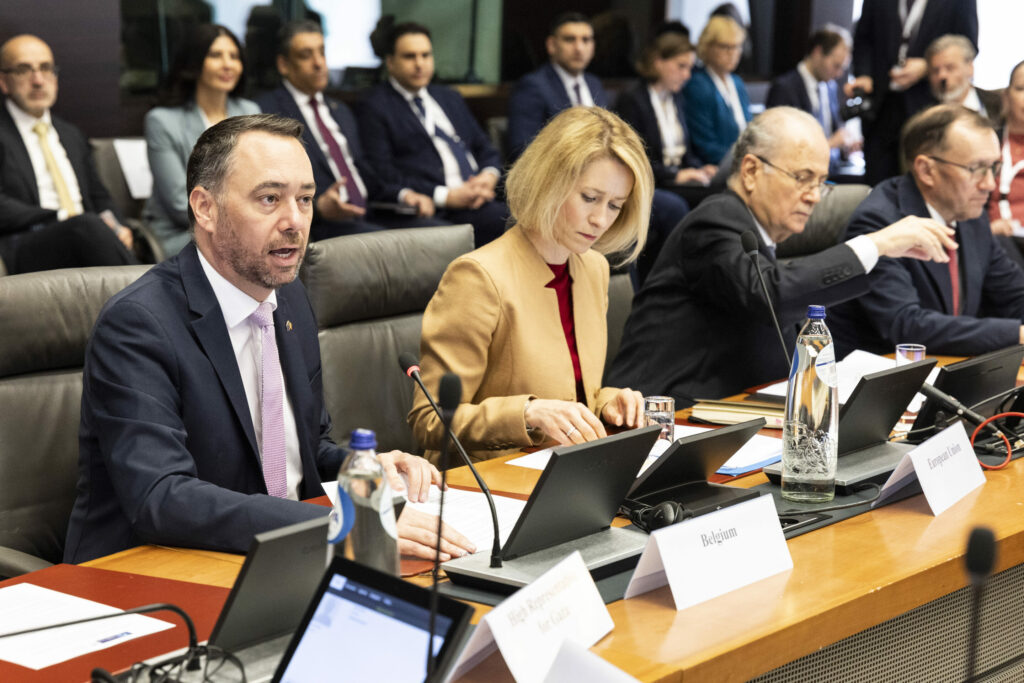
Belgian Foreign Minister Maxime Prévot was joined by the head of EU foreign affairs Kaja Kallas in Brussels on Monday in a call to bring the two-state solution "as the only realistic" conclusion to the Israel-Palestine conflict.
The EU and Belgium organised the ninth meeting of the Global Alliance for the Two-State Solution on Monday, which took place at the illustrious Egmont Palace in Brussels.
The meeting discussed the two-state solution, a proposal to end the violence in the region by recognising Palestinian statehood alongside the State of Israel, with a view for peaceful coexistence. While the Palestinian Authority is supportive, Israel currently rejects this.
In recent years, the two-state solution has dropped off the international agenda, but it was revived at the UN General Assembly in 2024 by a joint French-Saudi initiative. However, hopes for its success remain muted.
"First and foremost, it is good that the meeting is taking place and that the two-state solution remains on the agenda," Foreign Minister Prévot (Les Engagés) told The Brussels Times on Monday after the meeting. "And yet it is, in a way, a positive sign that Israel is participating for the first time in nine meetings."
Israel sent a diplomat working at the country’s EU mission to Monday’s meeting, which is received in EU diplomatic circles as a positive step.
'Middle of a storm'
On Monday, the opening remarks were delivered by Prévot and the EU High Representative for Foreign Affairs and Security Policy, Kaja Kallas.
"We meet in the middle of a storm. We must hold the course, because the Israeli-Palestinian issue is affecting the Middle East, and also the rest of the world," Prévot told attendees.
"Today, we have to answer difficult questions. The most fundamental being: how do we ensure that short-term stabilisation actually connects to the political origin of a Palestinian and Israeli state living side by side in peace and security?" Prevot stated.
"I will not pretend the path is easy. The two-state solution is not a dream for idealists, it is the only realistic destination," he underlined.
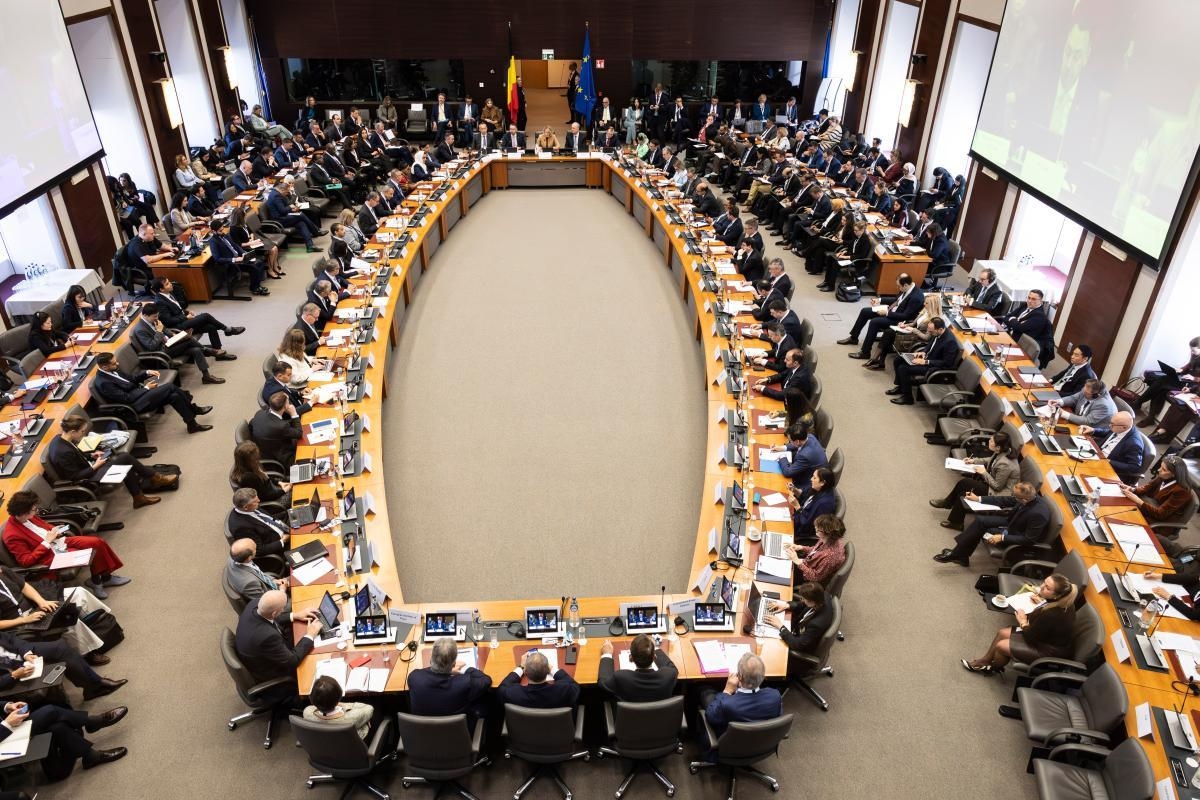
Meeting of the Global Alliance for the Implementation of the Two-State Solution meeting in Brussels on Monday 20 April. Credit: EU
In her remarks, Kallas admitted that the EU and the international community "can and must do more to respect human rights and accountability to protect the Palestinian people and the two-state solution."
She condemned Israel's illegal settlement expansion "that undermines the two-state solution" while reiterating her call for the Israeli government to reverse this decision.
Monday's meeting is mainly a forum for discussion. It focused on possible security measures for Gaza and the West Bank, and on how these connect with the governance and reform efforts of the Palestinian Authority (PA), which Belgium actively supports.
Taking the floor, Kallas called on Israel to reverse its decision to withhold funding from the Palestinian Authority, which is seen as central to establishing a Palestinian state within a two-state solution. She also reiterated that the EU is also the PA's biggest financial backer.
"The lessons of the recent years are very clear to me," Palestinian Prime Minister Mohamed Mustafa told attendees.
"War has not produced peace. Siege has not produced security. Occupation has not produced stability. Forced displacement will not produce legitimacy. Annexation will never produce coexistence. Only a just and lasting peace can do that," the Palestinian leader said.
He also stressed the importance of "gradual and responsible" disarmament of all armed groups, such as Hamas, and a complete Israeli withdrawal from Gaza.
Association agreement
On Tuesday, EU foreign ministers will meet in Luxembourg, amid calls for the EU to push ahead with sanctions on Israel. It comes after a European citizen’s petition calling to suspend the EU-Israel association hit one million signatures across the EU last week.
Pressure is growing on European leaders to act at the Foreign Affairs Council on Tuesday. The ongoing energy crisis triggered by the conflict in the Middle East is soon expected to hit European citizens' wallets.
The Knesset’s approval of the Death Penalty for Terrorists Bill, which reportedly only applies to Palestinians, has also been likened to an apartheid law by critics, with calls from organisations like Amnesty International to immediately suspend the EU-Israel agreement on these grounds.
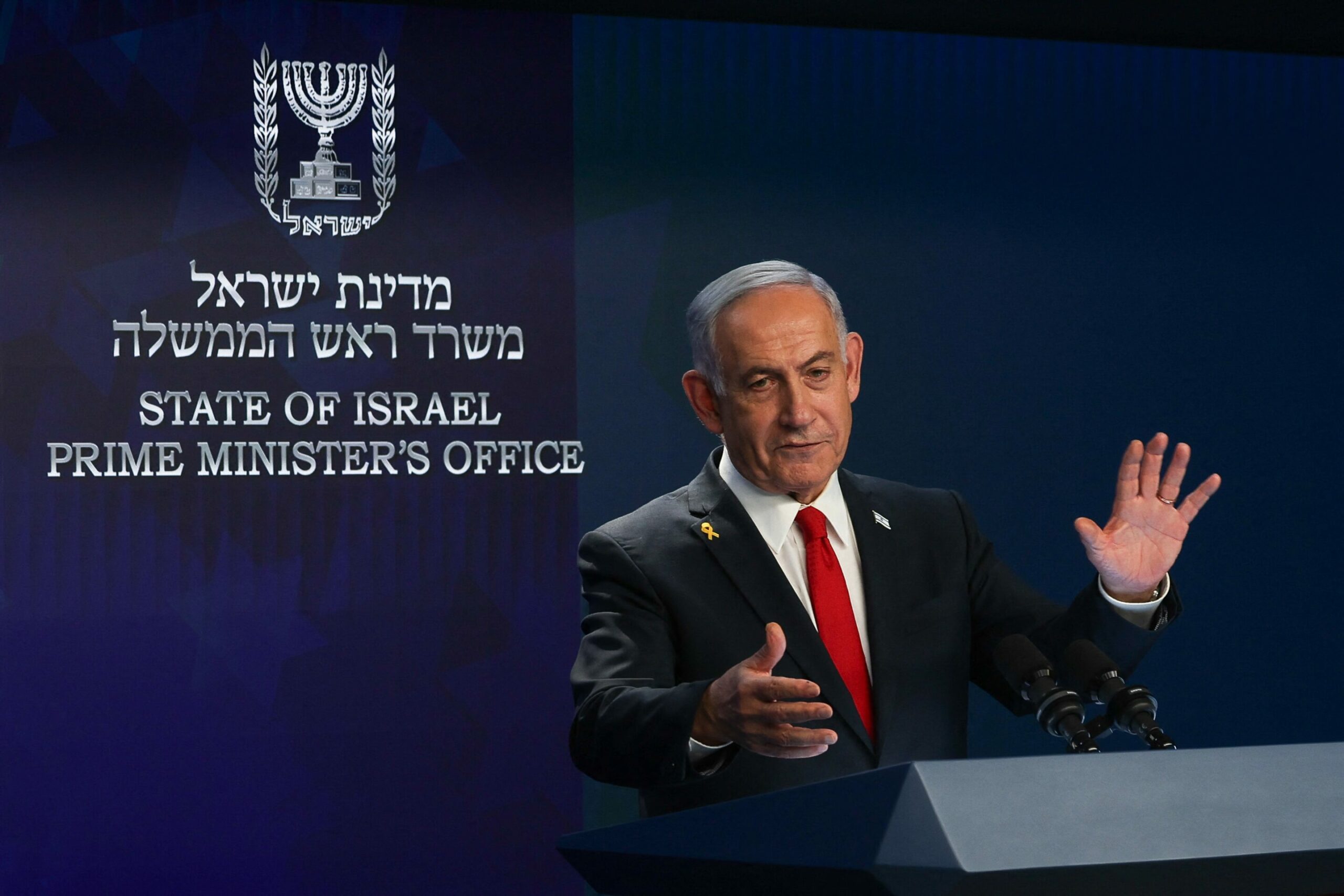
Israeli Prime Minister Benjamin Netanyahu gives a press conference in Jerusalem on May 21, 2025. Credit: Belga / AFP
Over the weekend, Spain indicated it will argue for the deal's suspension during Tuesday’s meeting, with support expected from countries like the Netherlands, Slovenia and Ireland. Article 2 of the agreement allows for any unilateral suspension in the event of human rights abuses. However, this has rarely been applied by the EU in practice.
Furthermore, the lack of a qualified majority among EU Member States would make any suspension of the trade deal, which is worth €1 billion a year, extremely unlikely without Germany and Italy turning on Israel.
That said, German Chancellor Friedrich Merz has spoken in harsher terms towards the violence in the West Bank, and Italy suspended its defence pact with Israel last week "in light of the current situation". Both countries are the biggest arms exporters to Israel, after the US.
The election loss of Hungary's previous Prime Minister Viktor Orbán has also left Israel more exposed to sanctions inside the EU, even if the new Prime Minister Peter Magyar has indicated that he will maintain Hungary’s special relationship with Israel. It is unclear whether he will block EU sanctions against Israel, like his predecessor did.
