
Belgium's National Crisis Centre has launched a campaign encouraging people to prepare for a crisis: citizens must be able to cope independently for 72 hours.
One year ago, the EU warned its citizens to put together an emergency kit with "war supplies" to last for three days – raising eyebrows at the time. While it is not uncommon for experts to advise keeping such a kit at home, the Federal Government is now making it an official recommendation.
"Have water, some non-perishable food, a stock of medicines, torches... It is not something dramatic or anxiety-inducing; it’s simply about being prepared," said Security and Home Affairs Minister Bernard Quintin (MR) on Tuesday.
Now, the National Crisis Centre (NCCN) is launching a four-year campaign under the slogan 'Prepared Together' to inform the public about the correct actions to take and to help them get started on being better prepared for an emergency.
'Don't panic, prepare'
While there is "certainly no need to panic", Quintin stressed that it also "never hurts" to be prepared. "We lack a culture of safety in Belgium; we must realise that we do not live in the same world as we did 20 years ago. We do not want to scare people, but we must not bury our heads in the sand either."
"In our part of Europe, we have been fortunate enough to live in peace for 80 years – the longest period of peace on the continent – but the situation has changed. And we must be prepared," he added.
Although Belgium is not at war, it has for several years faced a threat and hybrid attacks, affecting, for example, public IT services, hospitals, and so on. Five years ago, the country also suffered flooding on an unprecedented scale – resulting in 39 deaths.
"Every citizen should take responsibility and ask themselves: if, by some extraordinary chance, I have to stay at home with my family for three days, do I have enough to last me those three days?"
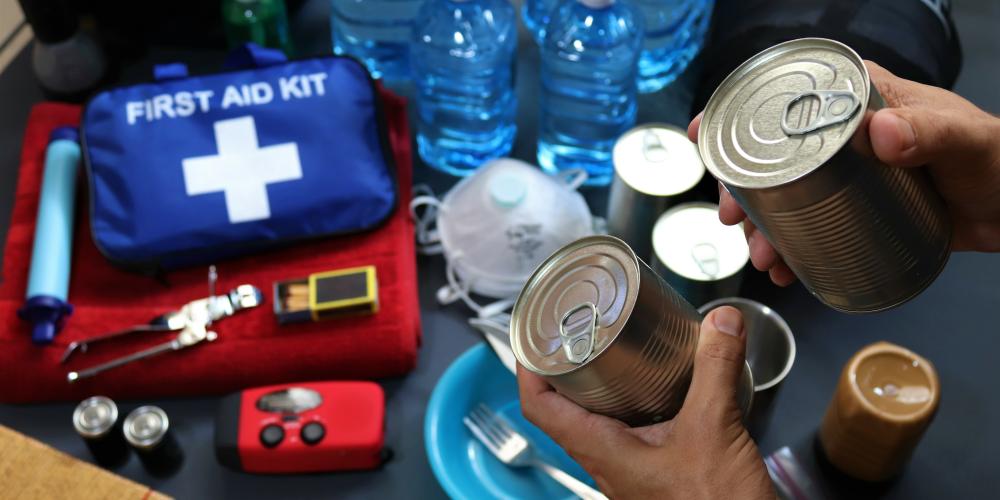
Emergency kit. Credit: Crisis Centre
The aim is to help everyone in Belgium develop the right habits. To achieve this, the Crisis Centre has set up several phases.
The first phase focuses entirely on finding the right information quickly during an emergency. This includes signing up to the BE-alert warning system, local communication channels and the Crisis Centre's own website.
Knowing where to find reliable information in the event of a disaster is crucial. "At such times, fake news spreads quickly, and some people even try to profit from it."
"In an emergency, reliable, accurate information makes the difference between ignorance and taking appropriate action," they added.
'Close and local'
When people are sufficiently resilient during the first few hours of a crisis, emergency services are given the space to focus on those who are most vulnerable. They stressed that preparing oneself means acting for one's own sake, but also for the sake of others.
The Crisis Centre's campaign deliberately takes a "close and local" approach, directly on the ground and among the people. Over the next four years, various themes will be addressed (including the risk of nuclear and chemical disasters).
The campaign relies on an extensive local network comprising, among others, local authorities and local organisations – places where people meet, exchange information and work together to build a strong community.
Through these local partners, the campaign aims to "connect as closely as possible" with people's daily lives.

King Philippe during a visit to a crisis centre in Diksmuide. Credit: Belga/ James Arthur Gekiere
Solidarity is also central to the campaign, the Crisis Centre stressed: being prepared also means considering the needs of vulnerable people in one's own community.
By talking to neighbours, family members and acquaintances, people can identify who might need extra support during an emergency and how they can help.
"The unstable international context and the various disasters that have occurred in Europe and Belgium in recent years clearly demonstrate that the threats to our security are real and that we must be better prepared," said Quintin.
"That is precisely the aim of this campaign: to provide our citizens with all the necessary information to assess a potential emergency in a timely and accurate manner and to navigate it with confidence," he said. "Our message is clear: those who are well prepared are also better protected."
What should be in an emergency kit?
- Basic first-aid package (bandages, plasters, compresses, scissors, tweezers, safety pins, painkillers, disinfectants), including an extra supply of any essential medicines;
- Bottles of water;
- A mobile phone charger or power bank;
- Important documents (copies of identity documents and insurance contracts);
- A torch, preferably a wind-up with a handle. If you prefer a battery-operated torch, make sure you also have spare batteries;
- A battery-powered radio. This will allow you to listen to the media even during a power cut;
- A lighter or matches;
- A multifunctional pocket knife;
- An evacuation checklist: a list of personal items, e.g. toiletry bag, identity card.
The Crisis Centre stressed that people should put "whatever they need" in their emergency kit, but added that this is not the same for everyone. Families with small children could also put toys in there, for example.
The kit should be stored in an accessible place in the home, and its contents should be regularly checked to replace used or expired items. All family members should know where the kit is.
More information about the campaign can be found on the Crisis Centre website.
