

The recent verdicts in the United States, finding that Google and Meta intentionally designed addictive social media platforms, represent a landmark moment. It confirms that the harms experienced by young users are not accidental, but rooted in the design and business models of these platforms.
Yet, instead of addressing these root causes, policymakers are increasingly turning to restrictions. Australia’s social media ban for young people and similar measures across Europe – including access limits, age verification and surveillance – reflect a growing trend that shifts responsibility away from platforms and onto young users.
We, the generation these measures claim to protect, firmly reject this approach. If the goal is to truly support us, then it is time to listen to what we have to say.
The golden cage
Do not lock us in a golden cage and call it protection. The failure to address the root causes of harm does not justify our exclusion, not even temporarily.
Despite their flaws, online spaces offer something rare: meaningful access to information, connection and participation, at an unparalleled scale. These platforms are where we learn, create, organise, and take part in public and democratic life.
Social media are far more than entertainment – especially for marginalised young people, including LGBTQIA+, disabled, religious minorities and migrant communities. They are lifelines, offering access to information, community, and support that may not exist elsewhere.
How people use these spaces depends on their offline realities – whether they feel safe at home, have support networks, face language barriers, or experience racism or discrimination. For some, social media provide anonymity and safety; for others, they are the only way to access communities, resources, or information that would otherwise be out of reach.
One-size-fits-all approaches, including blanket restrictions and sweeping bans, fail to account for these differences. Instead of protecting users, such measures risk cutting off those who rely on these spaces most. True digital fairness requires policies that reflect these differences, not ignore them.
Safe digital spaces require rules and support
Every day, platforms exploit our attention, broadcast our personal data to thousands of companies, and push addictive features. These features include, among other things, infinite scrolling, autoplay videos, algorithmic feeds, push notifications, likes and streaks.
Social media already has a duty to protect young people in the EU, but laws only matter if they are actually enforced. When legislation is watered down or its enforcement is lacking, young people suffer the greatest consequences. This is not a viable path.
While Big Tech is spending over €113 million annually to lobby the EU and push for deregulatory measures, the direct beneficiaries of these decisions, young people and their representatives, have been partially or fully excluded from the process.
Therefore, we demand universal, systemic change: this means strictly enforcing the Digital Services Act and delivering an uncompromising Digital Fairness Act to protect everyone from exploitative design, regardless of age.
When we understand the reasoning behind safety measures and are given meaningful choices, we are far less likely to resist or bypass them. In any case, we do not want a future where our rights are overridden "for our own good", or where online participation depends on one’s ability or willingness to provide Identification documents or biometrics.
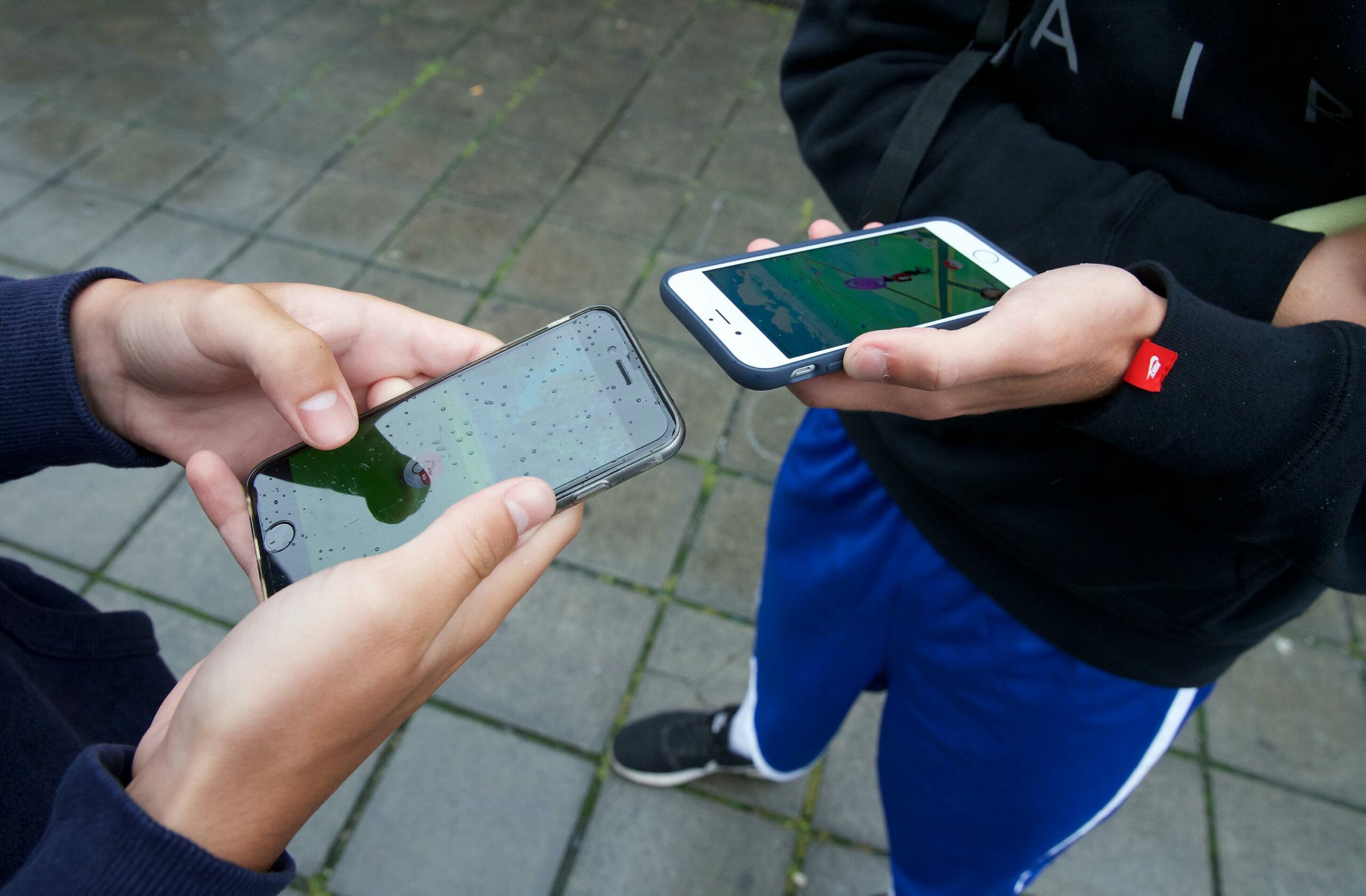
Two people play on their smartphones. Credit Belga/Nicolas Maeterlinck
True safety must be empowering, and it cannot be delivered by laws and information alone: regulators, educational programs, helplines, and NGO's must also be properly resourced to make these protections effective. Additionally, digital spaces must be built and regulated in a way that reflects the lived experience of marginalised communities, in particular those facing systemic harm.
The success of child protection policies should never be measured by how many young people are excluded from online spaces, but by how many young people have access to safe online spaces that match their reality.
We want policies which address the root causes of the harms, ensuring that the adults we are growing into won’t inherit the same exploitative systems. Bans and invasive age verification do not solve the underlying problems; they merely delay them. To achieve safer digital environments, we must confront the systems that produce harm, not remove those most affected by it.
Don’t build a digital world for us, build it with us, so it becomes one we want to inherit.
Confirmed youth co-signatories:
- National Youth Council of Ireland (NYCI)
- National Youth Council of Moldova (CNTM)
- Slovak Youth Council (RmS)
- Flemish Youth Council (VJR)
- Council of the German-speaking Youth of Belgium (RdJ)
- Forum des Jeunes (French-speaking youth council of Belgium) (FJ)
- Hellenic Youth Council (Εθνικό Συμβούλιο Νεολαίας, ESYN)
- Spanish Youth Council (CJE)
- Swiss National Youth Council (SAJV/CSAJ)
- National Youth Council of Slovenia (MSS)
- National Youth Council of Serbia (KOMS)
- Croatian Youth Network (MMH)
- Norwegian Children and Youth Council (LNU)
- Austrian National youth Council (BJV)
- National Youth Council of Latvia (LJP)
- National Youth Congress of Albania (NYC)
- Niels Zagema, Dutch Youth Representative
- ctrl+alt+reclaim France
- IGLYO (The International Lesbian, Gay, Bisexual, Transgender, Queer & Intersex Youth and Student Organisation)
- The youth committee of the European Disability Forum (EDF)
- EDYN (European Democracy Youth Network)
- OBESSU (The Organising Bureau of European School Student Unions)
- AEGEE (European Students' Forum)
- FEMYSO (Forum of European Muslim Youth and Student Organisations)
- JECI-MIEC (Jeunesse Étudiante Catholique Internationale - Mouvement Internationale des Étudiants Catholiques)
- EquiLabs
- YEN (Youth of European Nationalities)
- Gabriele Battimelli, BIK+ youth ambassador
- Teckids
- EUDY (European Union of the Deaf Youth)
Others:
- DEI-Belgium (Défense des Enfants International – Belgique)
- EDRi (European Digital Rights)
