
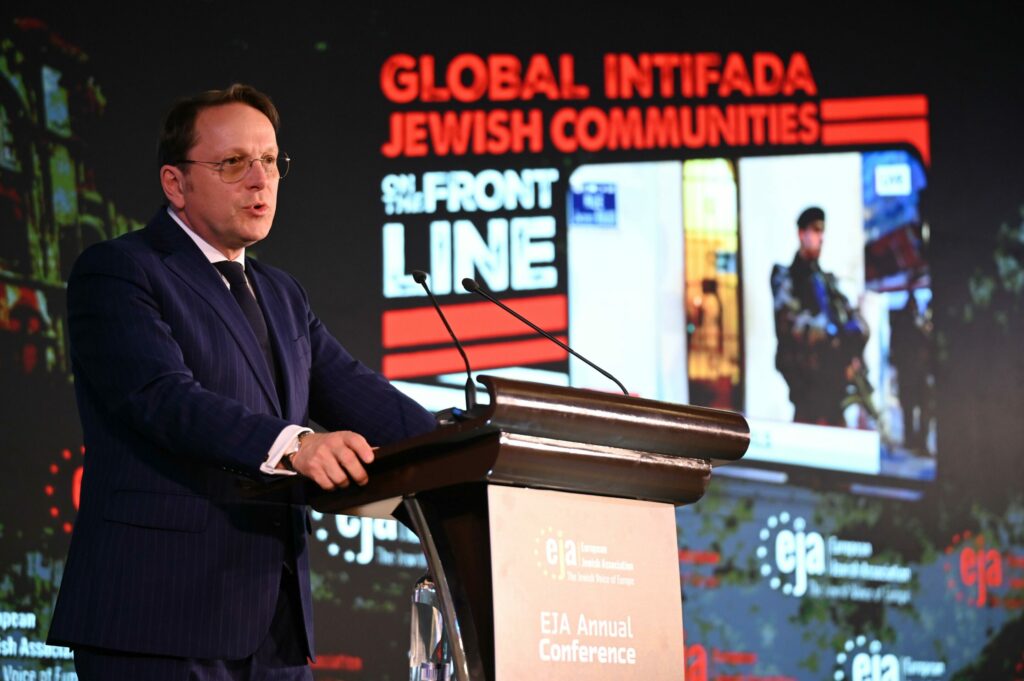
Leaders representing Jewish communities across Europe assembled at a conference in Brussels last week to discuss counter-measures against the alarming surge in antisemitism, rising violence, and growing fear among Jews in public spaces.
The annual conference was organised by the European Jewish Association (EJA) and brought together community leaders, policymakers, and diplomats to confront what many described as a rapidly deteriorating reality across the continent.
“When it becomes normal that Jews are attacked in the streets, communities live behind security barriers, and students are forced to hide their identity, it’s time for a new set of rules,” said EJA chairman Rabbi Menachem Margolin.
"Elections happen. Politicians change. But how Europe treats its Jewish communities shouldn’t,” he said, referring to the recent elections in Hungary. The country is showing zero tolerance to antisemitism but has yet to come to grips with its troubled past during WWII, when its regime collaborated with Nazi-Germany in the Holocaust of the Hungarian Jews.
“Whatever country in Europe we live in, we are faced with the same problem when a government changes,” he added. “What happens to a solid strategy or policy when it changes (after democratic elections)?"
At the centre of the conference agenda was a proposal for the establishment of a ‘Special Protected Minority Status’ for Jews in European countries, aimed at ensuring enforceable legal protections, security guarantees, and long-term safeguards for Jewish life. EJA was given a mandate to negotiate the proposal with national governments and the EU.
A direct online poll during the conference showed that over two-thirds of the participants felt that the Jewish communities had been abandoned by their governments after 7 October 2023.
Belgian and EU leaders agreed with his description of the situation. Georges-Louis Bouchez, leader of Belgium’s Mouvement Réformateur (MR), said: “The security of Jews in Belgium and in Europe is not negotiable. Protecting the Jewish community is not a symbolic gesture. It is about protecting the very core of our democracy.”
"Synagogues attacked, schools targeted, ambulances set on fire, Jewish families afraid to walk the streets," summarised Roberta Metsola, President of the European Parliament, in a video call to the conference.
Every single one of those is an example of an "assault on what everything Europe stands for," she stressed. "They are a warning, and in Europe, we know better than any continent on earth what happens when warnings like these are ignored. Let me be very clear, there is no place for antisemitism in Europe, not in our streets, not online, not dressed up as something else."
At the conference, European Commissioner Olivér Várhelyi underlined that antisemitism, hatred, violence and the glorification of terror "have no place" in Europe. "Not in our public spaces, not in our institutions, not in our schools or universities, not online, nowhere."
"It is not only a threat to our Jewish community; it is a fundamental test of our democratic societies," he said. "Europe must respond to this threat with clarity, consistency, and determination. We will continue to defend fundamental rights. We will continue to protect and support Jewish life, and we will continue to fight antisemitism."
He reassured the conference that the Jewish communities can count on him and the European Commission. As Commissioner for Health, he is expected to deal with an upcoming proposal on enabling male circumcision for religious reasons without infringing on the EU Member States’ health competency.
Circumcision, which is performed by specially-trained practitioners who do not necessarily have to be physicians, is crucial for Jewish life in Europe. Until now, the Commission has said that it has no competence to intervene in these matters, while assuring that it will continue to ensure that Jewish people can go about their lives in line with their religious and cultural traditions.
In October 2021, the EU issued its first strategy on combating antisemitism and fostering Jewish life. The Member States were invited to adopt their own national action plans and appoint national coordinators. Combating antisemitism in the EU is a shared responsibility on the EU and Member State levels, but the onus is on the Member States where antisemitic hate crimes and incidents occur.
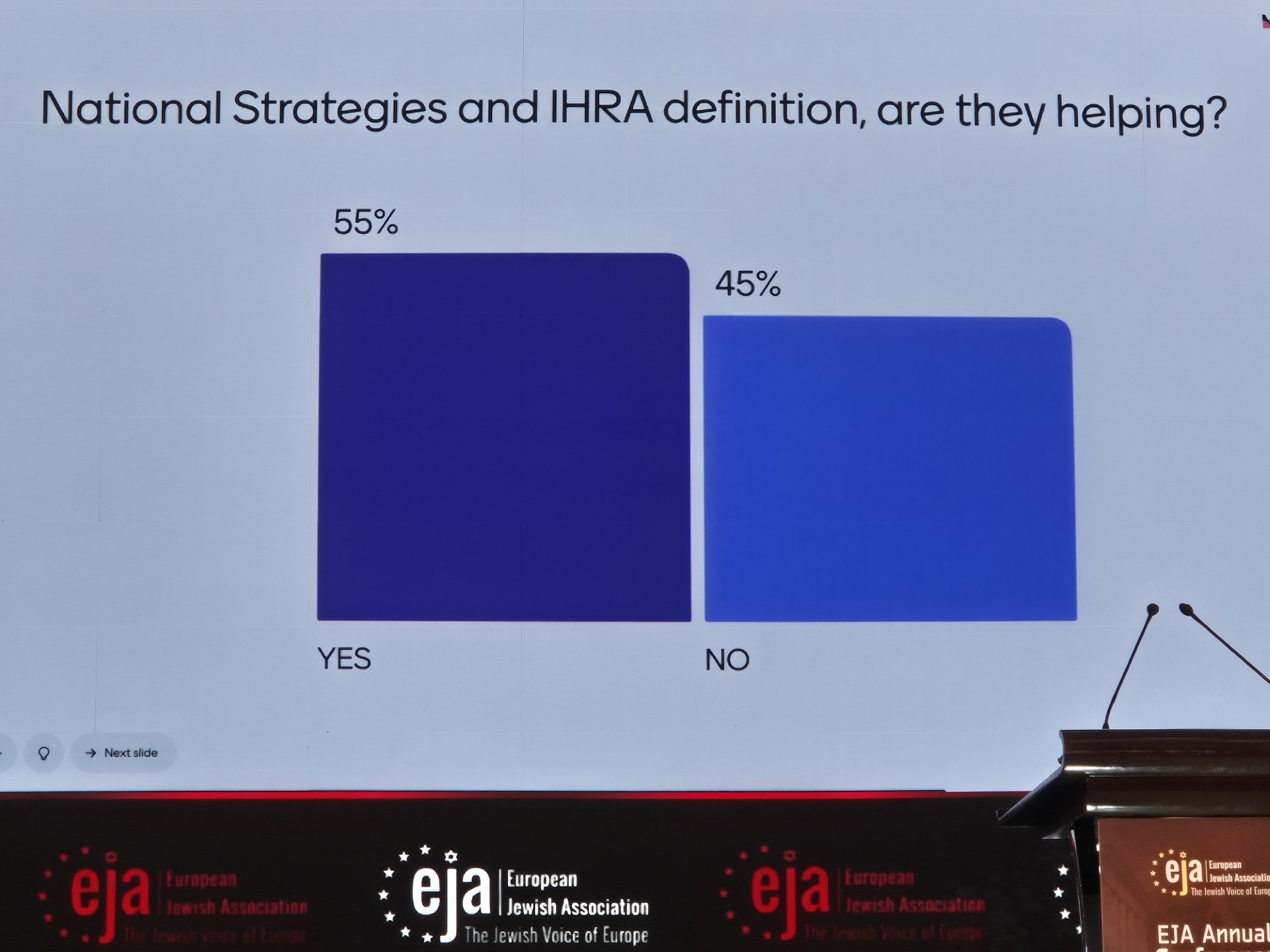
Another poll during the conference showed mixed perceptions of the action plans that are in place by the EU and the Member States. Asked if the plans and the adoption of the international non-binding definition of antisemitism (IHRA) are helping, 55% of the participants answered yes.
Credit: EJA
According to the EJA, existing EU anti-discrimination legislation, equality directives, framework decisions, and measures to delete hate speech on social media are not enough or are not sufficiently enforced. The idea is to establish an actionable framework of what constitutes a permanent ‘Special Protected Minority Status’
This would include legal provisions on safeguarding freedom of religion, including circumcision and kosher slaughter, and establishing practical mechanisms for security and protection. The protection will be ringfenced: Jewish life and practice will no longer be dependent on the goodwill of whichever government is in power at any given period.
If existing measures have failed, why would a new legal framework specially for the Jewish minority work better? Daniel Lega, general secretary of EJA and a former MEP from Sweden, told The Brussels Times that the proposal aims at better securing the current support for and protection of Jewish communities.
"We are proposing constitutional protection so that it won’t depend on which government is in power and cannot be withdrawn in the event of budget cuts," he explained. "We’ll never find the perfect solution, but we have to start somewhere. It should be seen as an extra protection for a vulnerable minority group and will depend on the situation in each country."
“Jews must be able to feel safe and secure in Europe,” he added, using the Swedish word “trygg” for feeling at home, both secure from danger and emotionally secure. He points out that antisemitism was on the rise before 7 October and increased afterwards, before the Israeli government had lost legitimacy for its warfare in Gaza.
Richard Muhlrad, chair of the Jewish Community in Stockholm, replied that a new legal framework will work better as a joint proposal by the Jewish communities. He does not believe that the proposal describing the Jewish people as victims belonging to a persecuted minority will be counter-productive.
“We are a persecuted minority. Many of our Jewish students are extremely anxious when they go to school and university. And unfortunately, it is like that in many European countries. We have a good cooperation with the current government, but there might be a different government after this year's parliamentary elections. Then the new proposal is good.”
Constitutional change does not come easily in Sweden. To amend one of its basic laws, the Parliament (Riksdagen) must make two similar decisions with a general election in between.
